The Master of Bavarian Elegance
In the grand tapestry of nineteenth-century European art, few threads shine with as much refined luster as the works of Joseph Karl Stieler. Born in November 1781 in the historic city of Mainz, Stieler was destined for a life steeped in the meticulous traditions of craftsmanship. His father, August Friedrich Stieler, was a respected engraver and punchcutter, providing the young artist with an early education in the precision and delicate detail that would later become the hallmarks of his Neoclassical mastery. This foundation in printmaking allowed Stieler to develop an extraordinary eye for line and texture, qualities that would eventually elevate him from a skilled craftsman to the most prestigious portraitist of the Bavarian court.
Stieler’s artistic evolution was shaped by the great intellectual and aesthetic currents of his era. His journey took him from the rigorous academic environment of the Vienna Academy of Fine Arts, where he studied under Heinrich Füger, to the vibrant, revolutionary atmosphere of Paris. It was in the Parisian atelier of François Gérard that Stieler truly found his voice. Immersed in the Neoclassical style and influenced by the monumental legacy of Jacques-Louis David, he learned to balance classical idealism with a profound sense of psychological depth. This period of intense study allowed him to master the subtle interplay of light and shadow, a technique he would later use to breathe life into the faces of royalty and luminaries alike.
A Legacy of Beauty and Brilliance
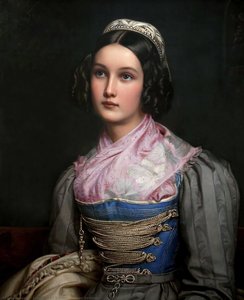
The zenith of Stieler’s career was defined by his unparalleled relationship with the Bavarian monarchy. Serving as the Royal Court Painter from 1820 until 1855, he became the visual chronicler of an era. His most enduring achievement remains the Schönheitengalerie, or the Gallery of Beauties, housed within the Nymphenburg Palace in Munich. This breathtaking collection of portraits, featuring the most notable noblewomen of the age, stands as a testament to his ability to capture not just physical grace, but a sense of timeless, aristocratic dignity. Through these works, Stieler achieved a level of Neoclassical grandeur that remains unparalleled in German portraiture.
Beyond the halls of royalty, Stieler possessed a unique ability to capture the essence of the era's most iconic figures. His portrait of Ludwig van Beethoven, depicting the composer with the manuscript of his Missa solemnis, remains one of the most recognizable and emotionally resonant depictions in musical history. In this work, Stieler moves beyond mere likeness to capture the very intensity and late-period struggle of the maestro. Whether portraying the scandalous allure of Lola Montez or the serene elegance of aristocratic ladies like Maria Amalia, Stieler’s brushwork consistently achieved a delicate balance of technical perfection and soulful expression.
The historical significance of Joseph Karl Stieler extends far beyond the borders of Bavaria. His works are preserved today in some of the world's most esteemed institutions, including:
- The Hermitage Museum in St. Petersburg
- The Neue Pinakothek in Munich
- The Walters Art Museum in Baltimore
- The Finnish National Gallery in Helsinki
As we look back upon his life, we see an artist who did more than simply record faces; he captured the spirit of a century. Through his precise draughtsmanship and subtle tonal gradations, Stieler transformed the ephemeral beauty of his subjects into permanent icons of art history, ensuring that the elegance of the Bavarian court would never fade from the collective memory of the world.