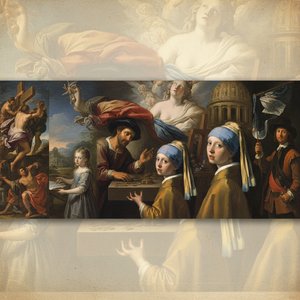
The Shadow and the Light: The Baroque Vision of Nicolas Tournier
In the dramatic landscape of the seventeenth century, few artists captured the profound tension between divine light and earthly shadow as effectively as Nicolas Tournier. Born in Montbéliard, France, around 1590, Tournier emerged during a transformative era when the artistic pulse of Europe was shifting toward the intense emotionalism of the Baroque. His work serves as a poignant bridge between the classical traditions of his French heritage and the revolutionary, high-contrast realism that was sweeping across the continent. To look upon a Tournier canvas is to enter a world where every brushstroke is heavy with the weight of spiritual significance and every shadow holds a secret waiting to be revealed.
The stylistic heartbeat of Tournier’s oeuvre is undeniably linked to the profound influence of Caravaggio. This Italian master’s technique of tenebrism—the use of extreme contrasts between light and dark to achieve a sense of drama and volume—became the cornerstone of Tournier's visual language. Through this lens, the artist did not merely paint scenes; he sculpted them out of darkness. His mastery of light allowed him to illuminate the textures of fabric, the weary lines of a saint’s face, and the visceral reality of religious martyrdom, pulling the viewer into an intimate, almost tactile encounter with the sacred.
A Devotion to the Divine and the Human
Tournier’s subject matter was deeply rooted in the religious fervor of his time. As a painter operating within the French Baroque tradition, he found his greatest inspiration in the profound narratives of Christian iconography. His compositions often centered on themes of sacrifice, penance, and divine intervention, most notably seen in masterpieces such as 'The Carrying of the Cross'. In these works, the artist avoids mere ornamentation, opting instead for a gritty, grounded realism that emphasizes the human suffering inherent in the divine struggle.
What distinguishes Tournier from his contemporaries was his ability to blend this intense religious gravity with a sophisticated sense of composition derived from the Roman School. His development as an artist saw him moving beyond simple imitation of Italian masters to create a uniquely French interpretation of Baroque drama. This evolution is characterized by:
- Emotional Resonance: A focus on the psychological depth of his figures, making the divine feel accessible and human.
- Chiaroscuro Mastery: The use of light not just as a tool for visibility, but as a narrative device to guide the eye toward moments of spiritual climax.
- Textural Realism: An incredible attention to detail in the rendering of skin, cloth, and stone, which lends an air of authenticity to his religious scenes.
Legacy and Historical Significance
The historical significance of Nicolas Tournier lies in his role as a vital contributor to the French Baroque movement. While often overshadowed by the later, more decorative flourishes of the Grand Siècle, Tournier provided a necessary foundation of realism and intensity. He helped cultivate an aesthetic that valued the raw, unvarnished truth of the human condition, paving the way for future generations of French painters to explore the complexities of light and shadow.
Today, his works remain essential studies for anyone seeking to understand the transition from the late Renaissance to the height of the Baroque. His ability to evoke piety through the medium of darkness ensures that his name remains etched in the annals of art history—not merely as a follower of Caravaggio, but as a master who harnessed the shadows to illuminate the very soul of his era.