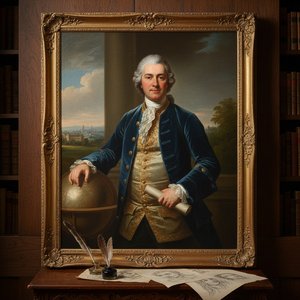
Carl Frederik von Breda: A Swedish Master Bridging Tradition and Innovation
Carl Frederik von Breda, a name synonymous with elegance and insight in 18th-century portraiture, stands as a uniquely compelling figure – a Swedish artist profoundly shaped by his time in London. Born in Stockholm in 1759, his artistic journey wasn’t confined to the familiar landscapes of his homeland; instead, it unfolded through an intricate dance between established Swedish traditions and the revolutionary spirit of British art, ultimately earning him the enduring title “the Van Dyck of Sweden.” His lineage played a crucial role: descended from Pieter von Breda, a Dutch emigrant who settled in Sweden around 1670, and inheriting artistic talent from his grandfather Lucas – a painter himself – and father Lucas the younger, an art collector and arbitrator, Carl was immersed in a world of aesthetics from his earliest years. This rich heritage instilled within him not just technical skill but also a cosmopolitan sensibility, a willingness to embrace new influences and forge his own distinctive style.
The Seeds of Change: Early Training and Royal Recognition
Breda’s artistic development began at the Royal Swedish Academy of Arts in Stockholm, where he studied under Lorens Pasch the Younger, absorbing the classical techniques and historical subjects that were hallmarks of Swedish portraiture. He quickly demonstrated a remarkable aptitude, winning prizes and securing commissions for prominent figures within the Swedish court – including Duchess Hedvig Elisabeth Charlotte, Crown Prince Gustavus Adolphus, and most notably, King Gustavus III himself. These early works reveal a solid foundation in established styles, characterized by careful detail and a restrained elegance. However, beneath this surface lay an ambition that yearned to transcend national boundaries. The portraits of the royal family showcased a growing confidence and technical skill, but also hinted at a desire for something more – a willingness to experiment with light, composition, and expression.
London Calling: The Profound Influence of Joshua Reynolds
A pivotal moment in Breda’s artistic trajectory arrived in 1786 when he made the bold decision to relocate to London with his family. This move proved transformative, catapulting him into a vibrant artistic environment teeming with innovation and intellectual ferment. He sought out tutelage under Sir Joshua Reynolds, arguably the most influential portraitist of his time. While Reynolds’s instruction wasn't particularly intensive, its impact was profound. Breda absorbed Reynolds’s emphasis on capturing character, utilizing dramatic lighting to sculpt form, and employing a looser, more expressive brushstroke – a departure from the rigid formality of earlier styles. This exposure fundamentally altered Breda’s approach, injecting a dynamism and psychological depth into his portraits that distinguished him from his Swedish contemporaries.
The Lunar Society and the Dawn of Romanticism
London became a crucible for artistic experimentation, and Breda found himself immersed in a circle of intellectuals known as the Lunar Society – a group of scientists, engineers, and philosophers who gathered regularly to discuss ideas and pursue knowledge. It was during this period that he painted portraits of James Watt, Matthew Boulton, and William Withering – figures at the forefront of the Industrial Revolution and scientific inquiry. These weren’t merely commissions; they were engagements with some of the most forward-thinking minds of the era, reflecting a growing interest in portraying not just outward appearances but also intellectual prowess and social influence. The portraits of Watt and Boulton, in particular, demonstrate a shift towards a more dramatic and psychologically complex style – foreshadowing the emerging Romantic movement. His work during this time began to incorporate elements of Romanticism: heightened emotion, an emphasis on individual experience, and a fascination with the sublime.
A Return to Sweden and Enduring Legacy
In 1796, Breda returned to Stockholm, accepting a prestigious professorship at the Academy of Arts. This marked a new phase in his career, one characterized by artistic maturity and a distinctive style honed during his years in England. He was immediately inundated with portrait commissions, quickly becoming a leading figure in the Swedish art scene. His brushwork became bolder and more spirited, reflecting the energy and dynamism he had absorbed in London. Notable portraits from this period include those of his father Lucas, two of his nephews, the scholar Nils von Rosenstein, and most celebrated of all, Teresa Vandoni, a renowned Italian opera singer performing at the Royal Swedish Opera. The portrait of Vandoni is particularly striking, capturing her dramatic presence and vocal artistry with remarkable sensitivity – a testament to Breda’s ability to convey both physical beauty and inner emotion.
A Lasting Impression: “The Van Dyck of Sweden”
Carl Frederik von Breda's impact on Swedish art extended far beyond his own prolific output. His exposure to British artistic trends—particularly the influence of Reynolds—helped modernize portraiture in Sweden, inspiring subsequent generations of artists to embrace new techniques and stylistic approaches. He wasn’t simply a painter of faces; he was a chronicler of his time, creating a visual record of some of the leading scientific, intellectual, and cultural figures of the late 18th and early 19th centuries. His portraits of members of the Lunar Society, for example, offer invaluable insights into this influential group of innovators. The artistic legacy continued within his family; his son, Johan Fredrik von Breda, followed in his father’s footsteps, receiving tutelage from him and continuing the family tradition. While some critics noted a perceived decline in consistency in his later works—a tendency towards monotony—Breda remained an important figure in Swedish art history until his death in Stockholm in 1818. He is remembered today as “the Van Dyck of Sweden,” a testament to his skill, elegance, and enduring contribution to the world of portraiture – a master who seamlessly blended classical training with the spirit of innovation.