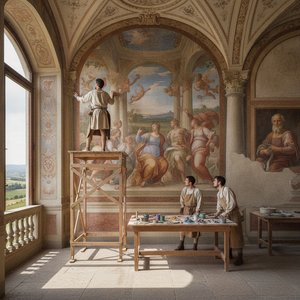
The Enigmatic Master of St Francis
In the quiet, hallowed corridors of art history, certain names flicker like candlelight in a cathedral—present, yet shrouded in a profound and captivating mystery. The Master of Saint Francis is precisely such a figure. An anonymous hand from the late thirteenth century, this painter emerged during a transformative era when the rigid, golden hierarchies of the Byzantine tradition began to soften under the influence of a new, more humanistic light. While his true identity remains lost to the mists of time, his brushstrokes speak with a clarity that allows us to glimpse the soul of the Italo-Byzantine style, capturing a moment when art was transitioning from the celestial to the terrestrial.
Scholars believe this enigmatic creator likely operated within the vibrant artistic circles of Italy, perhaps finding his roots in the coastal elegance of Pisa or receiving his formative training amidst the spiritual landscapes of Umbria. Working between approximately 1250 and 1280, the Master navigated a world where art served as a bridge between the mortal and the divine. His work is not merely a collection of religious icons but a sophisticated dialogue between the established Eastern influences and the burgeoning vernacular styles of Tuscany and Florence. Through this delicate balance, he helped lay the groundwork for the emotional depth that would later define the Renaissance.
A Visionary of Devotion and Detail
The legacy of the Master is inextricably linked to his ability to render the sacred with an almost tactile presence. His oeuvre, though fragmented by history, reveals a painter deeply invested in the narrative power of the fresco and the panel. He was a master of atmosphere, capable of imbuing scenes of saintly life with a sense of profound stillness and reverence. One can almost feel the weight of the monastic silence in his depictions, where every fold of a habit and every glint of light on a halo is rendered with meticulous care.
His artistic achievements are best understood through the lens of his thematic focus, particularly his devotion to the life of Saint Francis of Assisi. His contributions to the visual language of Franciscan spirituality include:
- Narrative Innovation: The ability to weave complex theological stories into accessible, visually compelling sequences that guided the faithful through moments of trial and triumph.
- Stylistic Synthesis: A masterful blending of the formal, iconic elements of Byzantine art with a burgeoning interest in naturalism and spatial depth.
- Emotional Resonance: The use of subtle facial expressions and gestures to evoke empathy, transforming religious figures from distant deities into relatable, suffering, and ecstatic human beings.
The Enduring Shadow of the Master
To study the work of the Master of Saint Francis is to witness the very dawn of a revolution in seeing. He stood at the precipice of change, capturing the tension of an age caught between the medieval and the modern. While his name may be absent from the signatures of his masterpieces, his influence is etched into the very fabric of Western art. He provided the essential vocabulary of emotion and narrative that later giants, such as Giotto, would expand upon to create the monumental heights of the Proto-Renaissance.
Today, his paintings remain more than mere historical artifacts; they are windows into a period of intense spiritual and artistic ferment. In every line and every pigment, we find the heartbeat of an era striving to understand its place in the cosmos. The Master of Saint Francis remains a silent but powerful architect of our visual heritage, reminding us that even in anonymity, true artistry possesses an immortal voice.