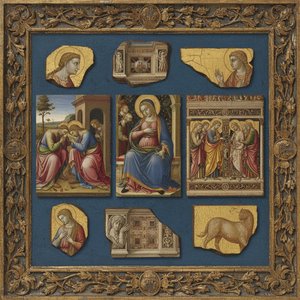
The Luminous Synthesis of Sassetta
Stefano di Giovanni, known to history by the evocative moniker
Sassetta, remains one of the most enchanting figures of the Sienese Renaissance. His art serves as a bridge between two worlds: the ornate, jewel-like splendor of the Gothic tradition and the burgeoning, grounded realism of the Florentine masters. Born around 1392, his life was deeply rooted in the cultural soil of Siena, a city that cherished its decorative heritage even as the winds of change from Florence began to blow. To look upon a Sassetta panel is to witness a delicate dance between the celestial and the terrestrial, where every gilded edge and vibrant pigment tells a story of spiritual devotion and human observation.
A Legacy Forged in Tradition and Innovation
The formative years of this Tuscan master are draped in the soft shadows of history, yet his artistic lineage is clearly etched in his brushwork. It is widely believed that he refined his craft under the guidance of
Maestro Piero Lorenzetti, a painter whose work already embodied the dualities of Sienese art. From this foundation, Sassetta developed a unique visual language. While he remained fiercely loyal to the Sienese School’s penchant for intricate tracery and rich, emotive color, he was not immune to the revolutionary spirit of his era. He looked toward the innovations of
Masaccio, embracing the emerging principles of linear perspective and a more profound anatomical accuracy. This synthesis allowed him to create compositions that felt both timelessly sacred and strikingly present, imbuing his figures with a psychological depth that was rare for his time.
The Spiritual Resonance of Technique
In the quietude of his most celebrated works, such as the
Saint Thomas Aquinas in Prayer, one finds the true heart of his genius. Utilizing the meticulous medium of tempera on panel, Sassetta achieved a luminous quality that seems to emanate from within the wood itself. His technique allowed for:
- Intricate Detail: The fine, precise linework that defines the heavy folds of monastic robes and the delicate features of contemplative faces.
- Vibrant Color Palettes: A use of pigment that captures the ethereal light of a divine presence.
- Emotional Depth: A mastery of gesture and stillness that invites the viewer into a state of silent, prayerful reflection.
Through this masterful application of color and form, Sassetta did more than merely decorate altarpieces; he created windows into the divine. His ability to marry the decorative grace of the past with the intellectual rigor of the future ensures his place as a cornerstone of the Italian Renaissance, leaving behind a corpus of work that continues to breathe life into the halls of art history.