The Visionary Synthesis of Zhang Daqian
Zhang Daqian, born in 1899 in the Nei Jiang Province of China, stands as one of the most prodigious and transformative figures of the twentieth century. His life was a tapestry woven from serendipity and profound cultural immersion, beginning with a precocious talent that saw him commissioned for fortune-telling at just twelve years old. This early engagement with the spiritual and the symbolic set the stage for an artistic journey that would eventually bridge the ancient traditions of China with the avant-garde movements of the West. His path was further shaped by unexpected hardships; a period of imprisonment during a bandit raid became a crucible for his intellect, fostering an intense devotion to poetry and sharpening the observational precision that would later define his brushwork.
The essence of Zhang’s greatness lies in his ability to honor the past while fearlessly embracing the future. He did not merely replicate classical styles but breathed new life into them through a radical reimagining of form. His early explorations were deeply rooted in the mastery of calligraphy and traditional ink wash, yet he possessed an insatiable hunger for innovation. This duality allowed him to become a pioneer of Geometric Abstraction within a Chinese context, creating a visual language that felt both timelessly ancient and strikingly modern.
A Journey Through Ancient Iconography and Modernity
One of the most pivotal chapters in Zhang Daqian’s development was his profound engagement with the Dunhuang Buddhist art. Under the patronage of Ma Bufang, the Governor of Qinghai Province, Zhang traveled to study the magnificent cave murals of Dunhuang. This immersion in ancient iconography provided him with a spiritual and technical foundation, as he meticulously analyzed the vibrant colors and flowing lines of Buddhist frescoes. This period solidified his commitment to preserving cultural heritage, even as he sought to dismantle the boundaries of representational art.
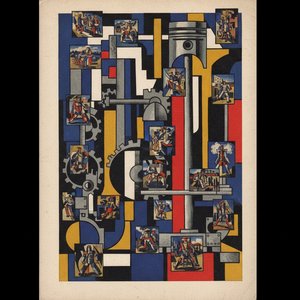
As his career progressed into the 1930s and 40s in Shanghai, Zhang began to experiment with a style that would become his hallmark. Influenced by the structural rigor of Bauhaus principles and the bold energy of Russian Constructivism, he moved toward a simplified, geometric vocabulary. By utilizing circles, squares, and triangles, he sought to convey profound emotional resonance and universal truths through structure rather than mere illusion. This evolution marked him as a cornerstone of the Chinese Geometric Abstraction movement, proving that the traditional medium of ink could be used to express the complexities of a modern, fragmented world.
Mastery of Technique and Lasting Legacy
The technical brilliance of Zhang Daqian is perhaps most evident in his ability to manipulate the fluidity of ink and color to evoke atmosphere and emotion. His works often oscillate between the delicate precision of classical landscape art and the expressive freedom of modern impressionism. In masterpieces such as "Bamboo & Plum Blossom," he utilizes intricate ink wash details to symbolize resilience and purity, while in "Fun at a Lotus Pond," his loose, masterful brushwork captures a sense of philosophical depth and serene natural beauty. His ability to command both the fine line of the calligrapher and the broad, atmospheric stroke of the landscape painter remains unparalleled.
Beyond his individual canvases, Zhang Daqian’s historical significance lies in his role as a cultural bridge. He successfully integrated the aesthetic values of the East with the structural innovations of the West, creating a legacy that continues to inspire artists globally. His life's work serves as a testament to the power of artistic evolution—a journey from the ancient caves of Dunhuang to the cutting edge of modern abstraction. Through his mastery, he ensured that the soul of traditional Chinese art would not only survive the twentieth century but thrive within it.