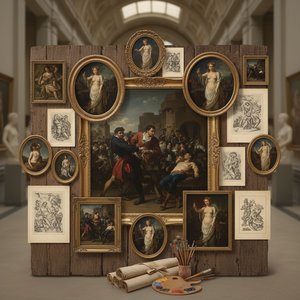
The Delicate Precision of Louis-Marie Dulieu De Chenevoux
In the soft, luminous world of eighteenth-century French miniature portraiture, few names evoke the quiet intimacy of the era quite like Louis-Marie Dulieu De Chenevoux. Born in Lyon in 1752, a city then pulsing with artistic vitality and intellectual fervor, Chenevoux carved out a niche that prioritized the subtle over the spectacular. While the grand galleries of Paris were often dominated by sweeping historical canvases and dramatic royal narratives, Chenevoux focused his gaze on the small-scale, capturing the fleeting nuances of human emotion within the confines of a miniature frame. His work serves as a window into a lost age of refinement, where the smallest stroke of a brush could convey the profound dignity of an aristocratic soul.
The foundation of Chenevoux’s mastery can be traced back to his formative apprenticeship under the legendary Jean-Baptiste Oudry. Though Oudry was celebrated primarily as a master of animal painting, his influence on Chenevoux went far beyond subject matter. From Oudry, the younger artist inherited an uncompromising devotion to naturalism and a sophisticated understanding of texture and light. This training allowed Chenevoux to move beyond mere decorative imitation; he learned to observe the way light rests upon silk, the softness of skin, and the intricate details of lace, bringing a tactile reality to his miniature portraits that bridged the gap between the ornate Rococo style and a more grounded, realistic sensibility.
A Legacy of Elegance and Patronage
As Chenevoux’s reputation grew within the Lyon school, his talent attracted the gaze of the era's most influential figures. The vibrant atmosphere of Lyon, bolstered by royal patronage and a sophisticated merchant class, provided the perfect stage for his meticulous artistry. He became a preferred portraitist for prominent families, most notably the Bourbons, who sought his ability to render their likenesses with both grace and an unmistakable sense of character. His portraits were never mere anatomical records; they were carefully composed studies in temperament, often depicting subjects in quiet, domestic moments that suggested a deep, interior life.
<- Technical Mastery: His ability to manipulate light and shadow on a minuscule scale created a sense of depth rarely seen in miniature works.
- Naturalistic Influence: By integrating Oudry’s lessons in texture, he brought a lifelike quality to the aristocratic subjects of his time.
- Historical Significance: His work stands as a vital record of the social graces and aesthetic values of late 18th-century France.
Though the historical record of his later years remains somewhat obscured by the turbulent shifts of the French Revolution, the impact of Chenevoux’s hand remains visible in the enduring charm of his surviving works. He achieved a rare balance between the decorative requirements of his era and a profound psychological depth. Today, collectors and historians look to his miniatures not just as beautiful objects, but as poignant artifacts of an age that valued the exquisite, the intimate, and the eternally refined.