x

Huile sur toile peinte à la main, avec cadre et dimensions personnalisés, réalisée sur commande par nos artistes. ( Commander l'impression Télécharger l'image haute résolution)





























Choisissez parmi nos formats prédéfinis qui respectent les proportions originales de l’œuvre.

Vous pouvez saisir vos propres dimensions pour l'adapter à un cadre ou à un espace spécifique. Si la taille sélectionnée ne correspond pas aux proportions de l'image d'origine, nous recadrerons l'œuvre ou prolongerons la peinture avec des éléments peints à la main supplémentaires. Une maquette numérique vous sera envoyée pour approbation avant le début de la production.
Veuillez noter que l'aperçu à l'écran ne reflète pas le recadrage ou l'extension réels. Seule la maquette montrera fidèlement la composition finale.
Bien que des tailles personnalisées soient disponibles, nous vous recommandons de sélectionner une dimension dans la liste prédéfinie afin de préserver les proportions d'origine.
Livraison dans le monde entier () en 3 à 4 semaines au lieu des 5 semaines habituelles. (15 août). Aucun compromis sur la qualité.


Girl with a Fan
Format de la reproduction
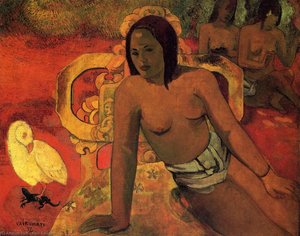
Paul Gauguin’s "Girl with a Fan," painted in 1902, is a captivating portrait that encapsulates the artist’s exploration of Post-Impressionism and his fascination with Polynesian culture. Created during his second sojourn in French Polynesia, this artwork offers a window into Gauguin's artistic philosophy and his desire to capture the essence of a world far removed from European civilization.
Gauguin’s journey as an artist was deeply intertwined with his quest for authenticity and escape. Dissatisfied with the conventions of Western art, he sought inspiration in the perceived simplicity and spirituality of Polynesian life. His time on Tahiti and the Marquesas Islands profoundly influenced his artistic style, leading him to embrace bold colors, flattened perspectives, and a focus on symbolic representation. "Girl with a Fan" is part of the Folkwang Museum's collection in Essen, Germany, and exemplifies Gauguin’s Synthetist approach – blending realism with abstraction to convey deeper meaning.
The subject of the painting is Tohotaua, the wife of Gauguin’s cook. She is depicted seated on a richly carved chair, adorned in a traditional white lavalava (cloth). In her hand, she holds a white feather fan featuring the French national colors – blue, white, and red. This subtle detail serves as a poignant commentary on colonialism, referencing France’s annexation of Tahiti and the Marquesas Islands in 1880. Gauguin transformed a photograph into this painting, focusing on capturing the essence of his subject rather than strict realism.
“Girl with a Fan” evokes a sense of quiet contemplation and understated elegance. Gauguin’s masterful use of color and form creates an atmosphere that is both serene and enigmatic. The painting's enduring appeal lies in its ability to transcend cultural boundaries, inviting viewers to reflect on themes of identity, colonialism, and the search for beauty in unexpected places.
The artwork has had a lasting impact on modern art movements, inspiring Cubism, Futurism, and other avant-garde styles. Its acquisition by Karl Ernst Osthaus for the Folkwang Museum in 1904 solidified its significance within the art world. Today, "Girl with a Fan" remains a testament to Gauguin's artistic genius and his profound exploration of human experience.
Born on June 7, 1848, in Paris, France, Eugène Henri Paul Gauguin was a French painter, sculptor, printmaker, ceramist, and writer whose work is primarily associated with the Post-Impressionist movement. He was also an influential practitioner of wood engraving and woodcuts as art forms.
His early life was marked by the political turmoil of 1848 and a period spent in Peru with his family. This experience left a lasting impression on him. Gauguin’s maternal grandmother, Flora Tristan, was an influential socialist writer and activist, shaping his worldview. Initially pursued a career as a stockbroker but began painting in his spare time, fueled by visits to galleries and exhibitions.
Gauguin quickly diverged from the strictures of Impressionism, seeking a more expressive and symbolic style. His exploration of Polynesian culture profoundly influenced his artistic vision. He developed Synthetist style – blending realism with abstraction to convey deeper meaning.
Gauguin’s influence extended beyond his own paintings, inspiring subsequent generations of artists and shaping the trajectory of modern art. His bold use of color and simplified forms challenged conventional artistic norms, paving the way for movements like Cubism and Futurism.


1848 - 1903 , France

Explore the transformative era of Post-Impressionism. Discover how masters like Van Gogh moved beyond light to embrace emotion, structure, and vibrant color, redefining modern art history through expressive brushwork and symbolic depth.


Restez informé(e) des dernières actualités artistiques, des offres exclusives et des idées de décoration.
Parlez-nous de votre projet et nos experts en art vous proposeront 3 suggestions d'œuvres personnalisées.
Laissez-nous sélectionner 3 œuvres rien que pour vous – Gratuit !


 Aperçu en situation
 Envoyer
 Partager
 Détails de l'œuvre

 Télécharger
 Articles similaires
 Radiographie
 Diaporama


 Lire la suite







 L'option verre n'est disponible que pour les dimensions inférieures à 110 cm.