The Architect of the Absurd: The Visionary World of Maurizio Cannavacciuolo
Born in the vibrant, culturally layered landscape of Naples in 1954, Maurizio Cannavacciuolo emerged as a singular voice in contemporary art by embracing the unexpected. His journey was not one of academic conformity but of deliberate departure; in his youth, he famously abandoned formal architectural studies, a decision that would ultimately become the cornerstone of his aesthetic identity. This rejection of rigid structure allowed him to develop a self-taught mastery that blends the precision of an architect with the wandering soul of a philosopher. By trading blueprints for brushes, Cannavacciuolo began to construct worlds not out of stone and mortar, but out of irony, memory, and a profound fascination with the layered complexities of human existence.
His early career in the 1970s was marked by significant encounters with some of the most influential figures in the international art scene. Collaborations with legendary gallery owners such as Lucio Amelio and Gian Enzo Sperone provided him with a platform that quickly propelled his work beyond the borders of Italy. As he navigated the global art landscape, his travels through Southeast Asia and the Americas infused his practice with a rich, multicultural tapestry. These journeys introduced Middle Eastern influences and Mediterranean traditions into his visual vocabulary, creating a synthesis of styles that feels both ancient and startlingly modern.
A Tapestry of Horror Vacui and Narrative Depth
At the heart of Cannavacciuolo’s practice lies a captivating tension between horror vacui—the fear of empty space—and a theatrical sense of the absurd. His canvases and wall drawings are often densely populated, teeming with intricate details that demand slow, meditative observation. He utilizes a meticulous method of drawing, which he regards as the most honest form of expression, often using projected images from diverse sources such as natural history, anthropology, and popular culture as catalysts for his compositions. This process allows him to weave disparate threads of human knowledge into a single, cohesive narrative.
His work frequently explores themes of:
- Fictional Narratives: Creating elaborate, often surreal stories that challenge the viewer's perception of reality.
- Architectural Memory: Using his background to manipulate space and structure within a conceptual framework.
- Cultural Overlap: Examining how different civilizations and histories intersect and diverge through visual symbols.
- The Theater of the Absurd: Employing humor and irony to reflect on the deeper, often unsettling truths of the human condition.
Legacy and Global Resonance
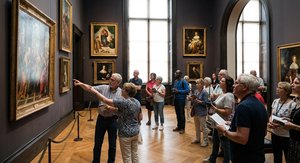
Cannavacciuolo’s significance extends far beyond the traditional boundaries of painting. His ability to create site-specific installations has left an indelible mark on prestigious institutions worldwide. A notable highlight of his career includes his residency at the Isabella Stewart Gardner Museum in Boston, where he transformed the museum's very fabric through elaborate wall drawings and conceptual projects like TV Dinner. These works, often created in view of the public, turned the act of creation itself into a performance of historical and personal inquiry.
Today, living and working in Rome, Cannavacciuolo continues to push the boundaries of postmodern art. His ability to navigate between the calligraphic beauty of his lines and the profound philosophical weight of his concepts ensures that his work remains deeply insightful. He does not merely present images; he invites the viewer into a meditative state, guiding them through a labyrinth of history, spirituality, and the beautiful, chaotic richness of life itself.