x

 Akril na platnuUmjetnina za zidoveRenaissance Classicism
 148.0 x 138.0 cm
 Pinacoteca di Brera
Ručno oslikano uljanim bojama na platnu u dimenzijama i okviru po vašem izboru, izrađeno po narudžbi od strane naših umjetnika. ( Pređi na tisak Prebacite na sliku)





























Odaberite jednu od naših unaprijed definiranih veličina koje odgovaraju izvornim proporcijama umjetničkog djela.

Možete unijeti vlastite dimenzije kako bi odgovarale određenom okviru ili prostoru. Ako odabrana veličina ne odgovara proporcijama izvorne slike, izrezat ćemo umjetničko djelo ili proširiti sliku dodatnim ručno oslikanim elementima. Digitalni nacrt bit će vam poslan na odobrenje prije početka proizvodnje.
Imajte na umu da pregled na ekranu ne prikazuje stvarno izrezivanje ili proširivanje. Samo će nacrt točno prikazati konačni sastav.
Iako su dostupne prilagođene veličine, preporučujemo odabir dimenzije s preddefiniranog popisa kako bismo očuvali izvorne proporcije.
Isporuka širom svijeta () u roku od 3-4 tjedna umjesto standardnih 5 tjedana. (10 Kolovoz). Bez kompromisa u kvaliteti.


Преображение
Veličina reprodukcije
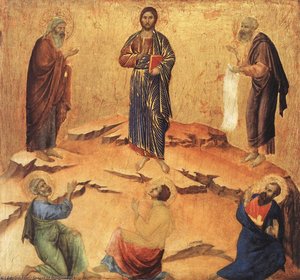
The painting “Transfiguration” by Andrea Previtali stands as a testament to the artistic brilliance of the Italian Renaissance, capturing a pivotal biblical narrative with meticulous detail and profound spiritual resonance. Executed around 1513, this oil-on-panel artwork resides within the Pinacoteca di Brera in Milan, Italy—a museum renowned for its impressive collection of Venetian and Lombard paintings from the fifteenth and sixteenth centuries.
Previtali’s artistic lineage traces back to Giovanni Bellini, whose influence is palpable throughout his oeuvre. Serving as a pupil under Bellini's tutelage instilled in Previtali a mastery of color palettes and compositional strategies that would define his distinctive style. This dedication to classical principles underscores the painting’s enduring appeal.
The scene depicted portrays Jesus Christ ascending into heaven accompanied by Saint Peter, Saint John, Moses and Elijah—figures revered for their roles in Jewish and Christian tradition. The central figure of Jesus dominates the composition, bathed in radiant light emanating from above his head – a deliberate artistic choice symbolizing divine illumination and spiritual transcendence.
Previtali’s technique demonstrates remarkable skill in capturing atmospheric perspective, skillfully blending hues to create depth and realism within the landscape backdrop. Rolling hills and verdant trees frame the celestial ascension, fostering an environment of serenity and contemplation. The artist's meticulous brushstrokes convey a palpable sense of movement and luminosity—characteristics emblematic of Renaissance painting.
Beyond its aesthetic beauty, “Transfiguration” carries significant symbolic weight. Moses and Elijah represent prophetic figures who witnessed God’s glory on Mount Sinai and Carmel respectively, signifying divine revelation and spiritual authority. The inclusion of these biblical luminaries reinforces the painting's theological message—the triumph of faith over adversity and the promise of eternal life.
The painting’s enduring legacy stems from its ability to evoke emotion and inspire awe. Its luminous colors and masterful execution continue to captivate viewers centuries after its creation, cementing Previtali’s place as a pivotal figure in Renaissance art history. A reproduction of “Transfiguration” would undoubtedly enrich any interior space with its timeless elegance and spiritual depth.

In the vibrant tapestry of the Italian Renaissance, few threads are as delicately woven as those belonging to Andrea Previtali. Born around 1480 in the historic city of Bergamo, Previtali emerged during an era of profound artistic transformation, a time when the shadows of the Middle Ages were being dissolved by the luminous clarity of humanism. His early years were shaped by the atmospheric brilliance of the Venetian school, as he sought mastery under the legendary Giovanni Bellini. This apprenticeship was more than mere technical training; it was an immersion into a world where light and color served as the primary languages of divinity and emotion. Through Bellini’s influence, Previtali learned to manipulate pigment to capture the soft transitions of skin and the ethereal glow of sacred landscapes, establishing a stylistic foundation that would define his entire career.
As his talent matured, Previtali became a vital figure in the ecclesiastical landscape of Bergamo. His work served as a bridge between the grand traditions of Venice and the local devotion of his home region. One of his most profound achievements can be seen in his 1515 masterpiece, John the Baptist preaching with other saints, created for the Santo Spirito church. In this monumental altarpiece, one can observe the seamless integration of Bellini’s compositional grace with Previtali's own burgeoning ability to render complex, multi-figure narratives. His devotion to his craft extended to the Bergamo Cathedral, where his depictions of Saint Benedict and other saints provided a visual anchor for the piety of the era, blending solemnity with a breathtakingly nuanced use of color.
Beyond the sacred walls of Bergamo’s churches, Previtali’s artistry reached into the broader Italian landscape, demonstrating a versatility that allowed him to tackle both grand religious narratives and intimate, character-driven studies. His work on The Deposition from the Cross for Sant'Andrea church showcases a profound capacity for emotional resonance, where every brushstroke contributes to the palpable sorrow of the scene. This ability to convey deep human feeling through meticulous detail is a hallmark of his oeuvre, aligning him with the most significant trends of the High Renaissance.
The historical recognition of Previtali’s genius underwent a remarkable revival in the modern era. In 1937, the art world was stirred when Kenneth Clark, the esteemed director of the National Gallery in London, acquired two small panels featuring rustic landscapes. This discovery sparked intense scholarly dialogue regarding his attribution, eventually solidified by the meticulous research of curators like Philip Pouncey. These smaller works reveal a different facet of his talent—a serene, almost poetic observation of nature that complements his more structured religious compositions.
Today, the legacy of Andrea Previtali remains etched in the great altars of Italy. His Annunciation, positioned above the high altar of Santa Maria del Meschio in Vittorio Veneto, stands as a testament to his enduring impact. It is a work that encapsulates his entire artistic journey: a perfect harmony of:
Through his contributions to the Renaissance, Previtali ensured that the artistic soul of Bergamo would be remembered as a vital component of the broader Italian cultural heritage.

1480 - 1528 , Italy

Explore the rich history of religious art from Giotto to the Renaissance masters with Most-Famous-Paintings. Discover symbolism, techniques & enduring legacies. Museum-quality reproductions available.

Explore the rich history of biblical art from Giotto to the Renaissance masters. Discover symbolism, techniques & enduring legacies with Most-Famous-Paintings – your source for museum-quality reproductions and expert art insights.

Explore the rich history of religious iconography in art! Discover symbolism, movements & masterpieces from Byzantine to Renaissance periods. Expert insights for collectors and enthusiasts at Most-Famous-Paintings.

Explore the Italian Renaissance! Discover humanist ideals, iconic masterpieces by Leonardo, Michelangelo & Raphael, and lasting artistic innovations. A comprehensive guide for art enthusiasts.

Explore the profound history of biblical art! Discover Renaissance masterpieces by Giotto & more. Uncover symbolism, artistic techniques, and lasting influence. Expert insights at Most-Famous-Paintings.


Budite u tijeku s najnovijim umjetničkim vijestima, ekskluzivnim ponudama i idejama za dekoraciju.
Recite nam nešto o svom projektu, a naši će stručnjaci za umjetnost pripremiti 3 personalizirana prijedloga umjetnina.
Dopustite nam da odaberemo 3 opcije samo za Vas – Besplatno!


 Pregledaj u stvarnoj veličini
 Pošalji
 Podijeli
 Detalji o umjetničkom djelu

 Preuzmi
 Slični predmeti
 Rentgenska snimka
 Automatska prezentacija
 Prikaži više







 Opcija stakla dostupna je samo za dimenzije manje od 110 cm