x

Kézzel festett olajvastú vászon, az Ön által választott méretben és keretben, művészeink készítik meglévőre. ( Váltás nyomtatványra Képváltás)
Válasszon előre meghatározott méreteink közül, amelyek megfelelnek a műalkotás eredeti arányainak.

Ön megadhat saját méreteket egy adott kerethez vagy térhez igazításhoz. Ha a kiválasztott méret nem egyezik az eredeti kép arányával, akkor a műalkotást levágjuk, vagy további kézzel festett elemekkel meghosszabbítjuk a festményt. A gyártás megkezdése előtt küldünk Önnek egy digitális előnézetet jóváhagyásra.
Kérjük, vegye figyelembe, hogy a képernyőn megjelenő előnézet nem tükrözi a tényleges vágást vagy kiterjesztést. Csak az előnézet fog pontosan mutatni a végső kompozíciót.
Bár egyedi méretek állnak rendelkezésre, javasoljuk, hogy válasszon egy méretet az előre meghatározott listából az eredeti arányok megőrzése érdekében.
Világszerte elérhető szállítás () 3-4 hét alatt a szokásos 5 hét helyett. (5 augusztus). A minőség nem kérdőjelezhető.


A Szentháromság feltárása (The Entombment of the Virgin)
A reprodukció mérete
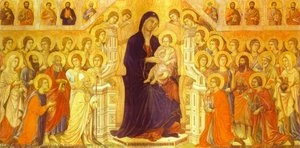
A 14th-century masterpiece, Duccio di Buoninsegna’s “The Entombment of the Virgin” – a pivotal panel from his monumental *Maestà* altarpiece – stands as more than just a religious depiction; it's a profound meditation on loss, faith, and the enduring human spirit. Created between 1308 and 1311 for Siena Cathedral, this artwork represents a dramatic shift in Italian painting, moving away from the rigid formality of Byzantine tradition towards a richer, more emotionally resonant style that would profoundly influence generations of artists. The panel’s power lies not just in its technical brilliance but also in its ability to evoke a deep sense of empathy and reverence, drawing viewers into the heart of this poignant scene.
At its core, “The Entombment” captures the immediate aftermath of Christ's crucifixion – the preparation for his burial. Duccio masterfully portrays the sorrowful gathering of disciples, angels, and mourners surrounding the Virgin Mary as she lies before the tomb-like structure holding her son’s body. The composition isn’t a static tableau; it’s a dynamic expression of grief, with figures reaching out in gestures of lamentation, covering their faces, and clasping each other in shared sorrow. The scene is layered with both acceptance of death and profound respect for the Virgin, highlighting her role as Mother of God and central figure in salvation history. Notice how Duccio avoids a purely dramatic portrayal; instead, he imbues the scene with a quiet dignity and a sense of communal mourning.
Technically, “The Entombment” is a testament to Duccio’s innovative approach to painting. He skillfully blends Byzantine influences – particularly the use of gold backgrounds symbolizing divine presence – with emerging Gothic sensibilities. The artwork is executed in tempera on wood panel, a technique that allowed for meticulous detail and luminous color. Duccio's mastery lies in his ability to render human forms with remarkable realism, moving beyond the stylized figures of earlier Byzantine art. Observe the elongated proportions characteristic of the period, but also the newfound grace and fluidity in the drapery folds and facial expressions. The spatial arrangement is subtly complex, creating a sense of depth through overlapping forms and varying figure sizes – a departure from the flattened perspective typical of earlier works.
Every element within “The Entombment” carries significant symbolic weight. The gold background represents the heavenly realm, while the figures themselves are laden with meaning. The angels’ gestures—wringing hands and covering faces—express profound sorrow, mirroring the grief of the human mourners. The positioning of Christ and Mary emphasizes their central roles in salvation history – he as the sacrificed savior, she as his devoted mother. Even the colors used hold symbolic significance: blue for heaven, red for sacrifice, and white for purity. The careful arrangement of figures isn’t arbitrary; it guides the viewer's eye through the scene, reinforcing its emotional impact and narrative complexity.
Consider the details – the instruments of mourning (trumpets, harps), the folded cloth covering Christ’s body, representing his burial shroud. The expressions on the faces of the figures are remarkably nuanced, conveying a range of emotions from raw grief to quiet acceptance. The scene is not simply about death; it's about the shared human experience of loss and the enduring power of faith.
“The Entombment of the Virgin” played a crucial role in shaping the artistic landscape of Siena and Italy. It was part of the ambitious *Maestà* project, commissioned to adorn the high altar of Siena Cathedral – a bold statement of civic pride and religious devotion. Duccio’s work broke with established conventions, moving away from the austere Byzantine style favored by Florence towards a richer, more emotive aesthetic that would define the Sienese School. This panel, along with others from the *Maestà*, demonstrated a new approach to painting – one that prioritized emotional expression and naturalistic representation over rigid formality.
Duccio’s influence extended far beyond Siena. Artists like Simone Martini and Ambrogio Lorenzetti were deeply inspired by his work, adopting his techniques and embracing his innovative style. “The Entombment” stands as a testament to Duccio's genius – a masterpiece that not only captures a poignant biblical scene but also embodies the spirit of a new era in Italian art.
Experience the beauty and power of Duccio di Buoninsegna’s “The Entombment of the Virgin” through high-quality reproductions. These meticulously crafted prints allow you to bring this iconic artwork into your home, creating a space of contemplation and appreciation for one of Italy's greatest artistic treasures. Explore other panels from the *Maestà* at the Museo dell'Opera del Duomo in Siena, or delve deeper into Duccio’s life and legacy through further research.
Contact us today to order your own reproduction of “The Entombment of the Virgin” – a timeless masterpiece that will grace your home for generations to come.

Duccio di Buoninsegna, born in Siena around 1255, stands as a pivotal figure bridging the stylistic chasm between the Byzantine world and the burgeoning artistic sensibilities of Italy. While biographical details remain frustratingly scarce—the man himself often obscured by the brilliance of his art—his impact on the Sienese School and the trajectory of Italian painting is undeniable. He emerged during a period where religious iconography was deeply entrenched, yet a yearning for greater naturalism and emotional resonance was beginning to stir within artistic circles. Duccio wasn’t merely a painter; he was an innovator who dared to infuse sacred narratives with human feeling, subtly shifting the focus from rigid formality towards a more intimate connection between the divine and the earthly realm. His early training remains somewhat mysterious, though speculation suggests possible influences ranging from Florentine masters to direct exposure to Byzantine artistry—perhaps even travels to Constantinople itself. Whatever his formative experiences, they coalesced into a unique style that would define an era.
Duccio’s artistic development wasn't a sudden rupture with the past but rather a graceful evolution. His initial works were deeply rooted in Byzantine conventions: the lavish use of gold leaf to evoke celestial light, stylized figures possessing an ethereal quality, and a meticulous attention to religious symbolism. These elements, characteristic of Byzantine art, formed the foundation upon which he built his distinctive style. However, even within these established parameters, Duccio began to subtly introduce elements that foreshadowed his later innovations. He experimented with spatial arrangements, hinting at depth where flatness had previously reigned supreme. His color palettes, while still vibrant and rich—reflecting the opulence of Byzantine iconography—gained a newfound subtlety and harmony, moving beyond simple brilliance towards nuanced shades and delicate transitions. More importantly, he started imbuing his figures with a nascent sense of humanity—a gentle curve of the mouth suggesting a smile, a slight tilt of the head conveying contemplation. This wasn’t a rejection of Byzantine ideals but a refinement, an infusion of life into what had often been static representations. He skillfully blended tradition and innovation, creating a style that was both reverent and remarkably fresh.
Two works stand as testaments to Duccio’s genius: the *Rucellai Madonna* (1285) and, most famously, the *Maestà* (1308-1311). The *Rucellai Madonna*, commissioned for a chapel in Florence, marked a significant departure from conventional Byzantine iconography. While still adhering to traditional forms—the Virgin Mary presented with serene dignity, the Child Jesus nestled in her lap—its composition displayed a greater sense of spatial organization and a more naturalistic depiction of the figures. The faces were no longer purely stylized; they possessed a subtle realism that hinted at individual personalities. This work demonstrated Duccio’s growing command of perspective and his ability to create a believable, three-dimensional space. But it was the *Maestà*—a monumental altarpiece created for Siena Cathedral—that truly cemented Duccio’s legacy. This sprawling masterpiece comprises numerous panels depicting scenes from the life of the Virgin Mary and Christ, each one a miniature work of art in itself. The Maestà is not merely a collection of paintings; it's a visual narrative, unfolding with breathtaking detail and emotional depth. Duccio’s mastery of light and shadow—creating an ethereal glow around the figures—his ability to convey complex emotions through subtle gestures, and his innovative use of perspective all converge in this single, awe-inspiring work. The *Maestà* is considered one of the most important works of Italian Gothic art.
Duccio’s artistic journey was shaped by a complex interplay of influences. His early training undoubtedly involved exposure to Byzantine artistry, particularly the rich iconography and meticulous detail characteristic of Sienese painting at the time. However, he also absorbed elements from Florentine masters, such as Cimabue, who had begun to introduce greater naturalism into his work. Some scholars speculate that Duccio may have even traveled to Constantinople itself, immersing himself in the artistic traditions of the Eastern Roman Empire. Regardless of the precise details of his training, Duccio synthesized these diverse influences into a unique style—one that was both deeply rooted in tradition and remarkably innovative. He didn’t simply copy Byzantine models; he adapted them to his own artistic vision, creating works that were distinctly Italian.
Duccio di Buoninsegna’s influence extended far beyond his lifetime. He revolutionized Italian painting, paving the way for the development of the Sienese School—a distinct artistic tradition characterized by its elegance, refinement, and emotional intensity. His emphasis on naturalism, spatial depth, and human emotion directly impacted subsequent generations of artists, influencing not only those within Siena but also painters in Florence and beyond. While Giotto is often credited with initiating the Renaissance style, Duccio’s contributions were equally crucial, laying the groundwork for the artistic innovations that would define the 14th century and beyond. His legacy continues to inspire artists today, demonstrating the enduring power of art to capture the beauty and complexity of the human experience. His works are celebrated in museums across Europe, offering a window into a pivotal moment in the history of Western art.
1255 - 1319 , Olaszország

Rendeljen egyedi, kézzel festett történelmi stílusú portrét! Professzionális művészek, barokk mesterművek ihletésével. Prémium minőség, személyre szabott tanácsadás a Most-Famous-Paintings.com-on!

Explore the spiritual intensity & architectural innovation of Gothic art! Discover the symbolism behind cathedrals, stained glass & master artists like Giotto and Monet. A deep dive into medieval history & artistic expression.

Explore the rich history of Medieval Art (c. 500 – c. 1500) with Most-Famous-Paintings. Discover Byzantine mosaics, Gothic cathedrals & Renaissance masterpieces. Expert insights & museum-quality reproductions.

Explore the exquisite beauty & spiritual depth of International Gothic art. Discover key artists like Simone Martini & Pol de Limbourg, its origins, symbolism, and lasting influence on European painting. Expert insights at Most-Famous-Paintings.

Explore the revolutionary Ashcan School! Discover how artists like Henri & Sloan challenged tradition with gritty realism, capturing urban life in early 20th-century America. Learn about their impact on American art history.


Maradjon naprakész a legfrissebb művészeti hírekkel, exkluzív ajánlatokkal és dekorációs ötletekkel.
Írja le nekünk projektjét, és művészeti szakértőink 3 személyre szabott műalkotási javaslatot készítenek Önnek.
Hagyjuk, hogy mi válogassunk ki Önnek 3 legjobb opciót – Ingyenesen!


 Megosztás
 Megosztás
 Részletek

 Letöltés
 Hasonló alkotások
 Diavetítés

 Tovább olvasom




































 Az üvegkeretes opció csak 110 cm alatti méretben érhető el