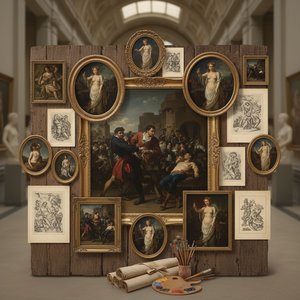
The Audacious Spirit of José Claudio Antolinez
In the golden, dramatic era of the Spanish Baroque, few figures possessed a personality as polarizing and vibrant as José Claudio Antolinez. Born in Madrid in 1635, Antolinez was far more than a mere practitioner of the brush; he was a man of sharp wit and a famously haughty temperament that often placed him at odds with his contemporaries. His artistic journey began within the prestigious orbit of Francisco Ribalta’s studio, where he absorbed the foundational principles of classical composition and the expressive, swirling energy of Mannerism. This early training provided him with a technical rigor that would later allow him to navigate the complex demands of both sacred and secular commissions with unparalleled skill.
Antolinez was not a silent observer of the artistic community but an active, often provocative participant. He was known for his sardonic humor and a penchant for intellectual sparring, frequently engaging in playful yet biting critiques of his peers. His legendary jab at the artist Itizi, whom he derisively labeled a “painter of wall ornaments,” serves as a testament to his critical eye and his refusal to adhere to the established hierarchies of the Madrid art scene. This rebellious streak, while occasionally earning him detractors, infused his work with a unique psychological depth and a sense of dramatic tension that set him apart from the more conventional painters of his generation.
Mastery of Light and Devotion
The oeuvre of Antolinez is a profound exploration of the Baroque duality between the earthly and the divine. His religious compositions are characterized by a masterful command of chiaroscuro, using deep shadows and piercing highlights to evoke a sense of spiritual transcendence. In works such as Assumption of Mary Magdalene, one can witness his ability to weave intricate details into a larger narrative of devotion, where light does not merely illuminate the scene but acts as a vessel for divine presence. Similarly, his Immaculate Conception captures a serene, heavenly atmosphere, inviting the viewer into a space of profound peace through soft textures and ethereal compositions.
Beyond the purely celestial, Antolinez possessed a remarkable talent for capturing the human condition through portraiture. He had an uncanny ability to translate character and psychological nuance onto the canvas, often imbuing his subjects with a sense of lived experience and quiet intelligence. This is perhaps most exquisitely realized in The Picture Merchant, housed in the Museo Nacional del Prado. In this masterpiece, the subject’s air of melancholy and sharp intellect are rendered with such realism that the boundary between the painted figure and the living soul seems to dissolve, showcasing Antolinez's ability to master the subtle gestures and expressions that define human emotion.
Legacy of a Baroque Visionary
Though his life was relatively short, ending in 1675, the impact of José Claudio Antolinez remains etched in the history of Spanish art. He bridged the gap between the structured traditions of his training and the emotive, dramatic innovations of the high Baroque. His ability to pivot from the intense, dramatic lighting of St. Rose of Lima before the Madonna to the nuanced psychological realism of his secular portraits demonstrates a versatile genius that commanded respect despite his controversial reputation.
Today, Antolinez is remembered not only as a skilled technician but as an artist who brought a distinct, often satirical, perspective to the canvas. His works continue to serve as vital windows into the 17th-century Spanish soul, reflecting a period of intense religious fervor and burgeoning social complexity. Through his mastery of light, shadow, and human character, Antolinez ensured that his vision would endure long after his provocations had faded into the annals of art history.