Early Life and Artistic Beginnings
Sir William George Gillies, a name synonymous with the evocative beauty of Scottish landscapes and poignant still lifes, was born in Haddington, East Lothian, in 1898. His early life unfolded amidst the rolling hills and historic charm of his native region – a landscape that would profoundly shape his artistic vision. Initially enrolled at the Edinburgh College of Art, Gillies’ academic pursuits were abruptly interrupted by the exigencies of World War I, where he served with distinction as an engineer in the Royal Engineers. This experience, marked by both hardship and camaraderie, undoubtedly instilled within him a resilience and perspective that would later permeate his work. Following the war's conclusion, he returned to complete his education at the Edinburgh College of Art, ultimately securing a position as a dedicated teacher there for over four decades – a role that not only sustained his livelihood but also allowed him to nurture the talents of countless aspiring artists.
A Journey Through Modernism: Influences and Early Style
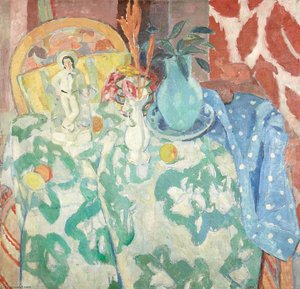
Gillies’ artistic journey began with an enthusiastic exploration of Cubism after studying under the influential André Lhote in Paris during 1923, and a subsequent visit to Italy in 1924. This period exposed him to the radical innovations of European modern art, particularly the geometric explorations of Picasso and Braque. Early works such as “Two Pots, Saucer and Fruit” (1933) demonstrate this initial influence, showcasing a Cézanne-inspired arrangement – a careful consideration of form and space reminiscent of the master’s later work – combined with the understated color palettes characteristic of Braque and Picasso. However, a pivotal moment arrived in 1934 when he encountered the vibrant and imaginative works of Paul Klee. This encounter proved transformative, inspiring Gillies to embrace a more playful use of colour and to imbue his compositions with a sense of childlike wonder – a departure from the strict geometric constraints of Cubism that would ultimately define his distinctive style.
The 1922 Group: A Hub for Scottish Innovation
In 1922, Gillies played a crucial role in establishing the “1922 Group,” alongside fellow artists including William Crozier, William Geissler, and William MacTaggart. This group, formed at the New Gallery in Edinburgh, served as a vital platform for emerging Scottish artists to showcase their work to a wider audience. The 1922 Group fostered a remarkable sense of community and collaboration within the burgeoning Scottish art scene – a period of significant experimentation and artistic growth. The exhibition society provided a space for these artists to share ideas, critique each other’s work, and collectively push the boundaries of contemporary art in Scotland.
Themes and Subjects: A Reflection of Scotland
Gillies' oeuvre is deeply rooted in the landscapes and still lifes of his native Scotland. He became renowned for his sensitive depictions of the Lothian, Fife, and Border regions – capturing not just their physical beauty but also a profound sense of atmosphere and mood. His landscapes are characterized by a masterful use of light and colour, evoking the changing seasons and the dramatic shifts in weather that define these regions. Equally significant were his still life compositions, often featuring ceramics created by his younger sister, Emma Smith Gillies – whose untimely death in 1936 profoundly impacted the artist and imbued many of his works with a poignant sense of melancholy. Beyond these core themes, he occasionally explored portraiture, but it was primarily through his landscapes and still lifes that he established his enduring legacy.
Recognition and Legacy
Throughout his distinguished career, Sir William George Gillies received numerous accolades recognizing his artistic merit and contributions to the Scottish art world. He was elected as an Associate of the Royal Scottish Academy in 1940 and a full Academician in 1947 – prestigious honors that affirmed his standing within the artistic community. In 1957, he was awarded the Commander of the Order of the British Empire (CBE), followed by knighthood in 1970. His influence extended beyond his own paintings; as Principal of the Edinburgh College of Art from 1959 to 1966, he shaped the artistic development of generations of students. Today, Gillies’ work is celebrated in museums and galleries across Scotland and internationally, a testament to his enduring vision and profound impact on the landscape of 20th-century art. His legacy continues to inspire artists and captivate viewers with its beauty, sensitivity, and deeply rooted connection to the Scottish spirit.