Verkoop uw kunst
Verlanglijstje Winkelwagen Cart
VoorvertoningVoorvertoning Bekijk in ARBekijk in AR Bestel print Bestel printKoop afbeelding Koop afbeelding VerstuurVerstuur
Details bekijkenDetails bekijken Toevoegen aan favorieten Toevoegen aan favorieten DownloadDownload Vergelijkbare itemsVergelijkbare items RöntgenonderzoekRöntgenonderzoek DiavoorstellingDiavoorstelling

Mrs. Graham

An exquisite Rococo masterpiece featuring the luminous elegance of Mrs. Graham by Thomas Gainsborough, capturing 18th-century British refinement through delicate textures and light for your private collection.

Thomas Gainsborough (1727-1788): Een Britse meester van portretten & landschappen, bekend om zijn elegante stijl en liefde voor het Engelse platteland. Ontdek zijn kunst bij Most-Famous-Paintings!

Handgemaakte olieverfreproductie

Met de hand geschilderd in olieverf op canvas in uw gewenste maat en lijst, op bestelling gemaakt door onze kunstenaars. (Bestel print Bestel printKoop afbeelding Koop afbeelding)

P118B $10
P118H $10
P118W $10
P438Z $10
P508JH $12
P508YH $12
P805H $10
P805Z $10
P919BZ $10
P919G $10
P919XJ $10
P959ZH $10
P968JZ $12
W106C $8
W218G $10
W218JH $8
W218Y $10
W307PJ $10
W316G $10
W316PJ $8
W316Y $10
W398PJ $8
W4111J $10
W500HY $15
W500JH $15
W692G $12
W849H $8
W940BG $15
W953PJ $8

Standard
custom
CM
INCH

Kies uit onze vooraf ingestelde maten die overeenkomen met de originele verhoudingen van het kunstwerk.

breedte
hoogte

U kunt uw eigen afmetingen invoeren om in een specifieke lijst of ruimte te passen. Als de door u gekozen maat niet overeenkomt met de verhoudingen van het originele beeld, zullen we het kunstwerk bijsnijden of het schilderij uitbreiden met extra handgeschilderde elementen. Een digitale mockup wordt ter goedkeuring naar u verzonden voordat de productie begint.
Houd er rekening mee dat de preview op het scherm niet de werkelijke uitsnede of uitbreiding weergeeft. Alleen de mockup toont de uiteindelijke compositie nauwkeurig.
Hoewel aangepaste afmetingen mogelijk zijn, raden we aan een maat uit de vooraf gedefinieerde lijst te selecteren om de originele verhoudingen te behouden.

Voorbeelden van aanpassingen: Vervang het gezicht met een eigen foto; Voeg een huisdier toe (bijv. vervang de kat door een hond); Verwerk een verborgen boodschap in de achtergrond; Wijzig het landschap of andere elementen in de achtergrond.
Na de bestelling zal het team van Most-Famous-Paintings.com per e-mail contact opnemen met de klant voor instructies en een mockup-voorbeeld sturen.

Wereldwijde levering () binnen 3 tot 4 weken in plaats van de standaard 5 weken. (15 augustus). Zonder concessies aan de kwaliteit.

why_choose_icon
Gratis wereldwijde expressverzending
why_choose_icon
Hoogwaardig linnen canvas
why_choose_icon
Volledige verzendverzekering
why_choose_icon
Garantie op terugbetaling van invoerrechten
why_choose_icon
Garantie op exacte kleurweergave
why_choose_icon
Retourbeleid van 60 dagen (alleen bij defecten)
why_choose_icon
100% Geld-terug-garantie
why_choose_icon
Korting bij meerdere afnames

Totaalprijs

$ 272

reproduction

Mrs. Graham

Druktechniek

Afmetingen reproductie

-

Eindtotaal

$ 272

Snelle feiten

  • Movement: Rococo
  • Notable elements or techniques: Fan, Delicate rendering
  • Location: National Gallery of Art, Washington
  • Artistic style: Elegant and refined
  • Title: Mrs. Graham
  • Artist: Thomas Gainsborough
  • Influences: French art

Kunstquiz

Er is slechts één goed antwoord op elke vraag.

Vraag 1:
What artistic movement is Thomas Gainsborough’s ‘Mrs. Graham’ primarily associated with?
Vraag 2:
In what year was ‘Mrs. Graham’ painted?
Vraag 3:
Where is ‘Mrs. Graham’ currently housed?
Vraag 4:
What prominent artist influenced Gainsborough's style and technique in ‘Mrs. Graham’?
Vraag 5:
Describe a key characteristic of Gainsborough’s approach to portraiture as exemplified by ‘Mrs. Graham’.

Beschrijving kunstwerk

A Vision of Georgian Elegance

In the soft, luminous glow of the mid-18th century, few images capture the essence of aristocratic grace as profoundly as Thomas Gainsborough’s Mrs. Graham. Painted around 1775, this masterpiece is far more than a mere likeness of a noblewoman; it is a window into the opulent soul of Georgian Britain. The portrait depicts the Honourable Mary Cathcart, a woman whose very presence in the canvas seems to command the air around her. As she sits poised, perhaps lost in a moment of quiet reflection or preparing for a grand social engagement, the viewer is transported to an era defined by refinement, ceremony, and an unapologetic embrace of beauty. For the discerning collector or interior designer, this work offers a timeless anchor, bringing a sense of historical weight and sophisticated charm to any curated space.

Gainsborough, a master of the British school, weaves together the delicate sensibilities of the Rococo style with a burgeoning interest in naturalism. The composition is a triumph of balance, where the sitter’s delicate features are framed by an environment that feels both intimate and grand. There is a rhythmic flow to the painting, a movement that guides the eye from the soft textures of her skin to the intricate, swirling details of her attire. This seamless integration of subject and setting creates an atmosphere of effortless luxury, making the piece an ideal inspiration for those looking to evoke a sense of classical prestige within a modern or traditional interior.

The Mastery of Light and Texture

To gaze upon Mrs. Graham is to witness Gainsborough’s unparalleled command over the medium of oil on canvas. The artist utilized a sophisticated glazing technique, applying translucent layers of pigment to achieve a breathtaking luminosity. This method allows light to penetrate the surface, creating a depth that makes the subject's complexion appear almost ethereal, as if lit from within. Such technical brilliance is most evident in the rendering of the fabrics; the heavy, luxurious folds of her gown are captured with such tactile precision that one can almost sense the weight and sheen of the silk.

Beyond the skin tones, Gainsborough’s brushwork celebrates the interplay of light and shadow. The subtle tonal gradations across the drapery and the delicate handling of accessories—such as the soft lace or a handheld fan—demonstrate a meticulous attention to detail that defines high-quality portraiture. This mastery of texture does not merely serve a decorative purpose; it imbues the work with a physical presence that commands attention. For those seeking a high-quality reproduction, these nuances are essential, as they provide the visual richness necessary to transform a room into a gallery of fine art.

A Legacy of Emotion and Grandeur

The historical narrative surrounding Mrs. Graham adds a layer of poignant depth to its visual splendor. The portrait was born from a period of significant social transition, yet it looks backward with reverence to the opulent court portraits of Sir Anthony van Dyck. There is a certain romanticism embedded in the work—a sense of a vanished world where elegance was a way of life. The painting carries an emotional resonance that transcends its era; it speaks to the universal human desire for dignity, beauty, and the preservation of grace.

For the art lover, owning a piece inspired by this work is an invitation to engage with history. It serves as a conversation piece that bridges the gap between the 18th-century salon and the contemporary home. Whether placed in a sunlit study or a formal dining hall, the presence of such a refined subject brings a calming, stately energy to the environment. It is not simply an ornament, but a profound statement of taste, celebrating the enduring power of the human spirit captured through the lens of artistic genius.


Biografie van de kunstenaar

A Suffolk Beginning: The Early Life and Artistic Awakening

The story of Thomas Gainsborough, one of Britain’s most celebrated artists, unfolds not within the confines of a grand academy or bustling metropolis, but in the tranquil market town of Sudbury, Suffolk. Born in 1727, the youngest son of John Gainsborough, a weaver and wool merchant, young Thomas displayed an innate artistic sensibility from a remarkably early age. While his siblings pursued more conventional paths, Thomas’s world rapidly became consumed by drawing and painting – miniature self-portraits and delicate landscapes blossoming from his hand even before he reached ten years old. This precocious talent wasn't merely a childhood pastime; it was the burgeoning of a vision that would reshape British art. His father, recognizing this unique gift, encouraged its development, setting young Thomas on a path diverging sharply from the family trade. The Suffolk countryside itself became his first studio, imbuing his later works with a deep and abiding love for the natural world – a characteristic that would distinguish him throughout his career. This early immersion in landscape wasn’t simply about replicating what he saw; it was about *feeling* the essence of the English countryside, an emotional resonance that would permeate his canvases for decades to come.

London and the Shaping of a Style: Influences and Early Commissions

In 1740, at the age of thirteen, Gainsborough journeyed to London, embarking on formal artistic training under Hubert Gravelot, a French engraver renowned for his elegant rococo style. This exposure proved pivotal, introducing him to refined techniques and fashionable aesthetics. However, it was his association with William Hogarth and the St Martin’s Lane Academy that truly began to mold his artistic identity. Initially influenced by Hogarth's narrative approach – his focus on social commentary and moral lessons through meticulously detailed scenes – Gainsborough soon charted his own course, developing a distinctive style characterized by its lightness of touch, fluid brushwork, and subtle color palettes. He absorbed lessons from various masters, yet resisted strict adherence to any single school, forging a path that blended observation with imagination. Gainsborough’s early works often featured scenes of rural life, reflecting the landscapes he knew so intimately. His style was influenced by Dutch Masters like Jacob van Ruisdael, whose atmospheric landscapes and use of light he deeply admired. Returning to Sudbury after marrying Margaret Burr in 1746, Gainsborough established himself as a portraitist for the local gentry. This period honed his skills in capturing likenesses and character, but it was during his subsequent move to Ipswich, and later Bath, that he began attracting a more sophisticated clientele – individuals who appreciated not just accurate representation, but also artistic flair and emotional depth.

Bath and Beyond: Portraiture, Landscape, and Royal Patronage

The years spent in Bath (1759-1774) marked a significant turning point in Gainsborough’s career. The city was a hub of fashionable society, providing him with ample opportunities to paint portraits of the wealthy and influential. He quickly gained renown for his ability to capture not only physical resemblance but also the personality and social standing of his sitters. His portraits weren't merely depictions; they were statements about identity and status. He developed a remarkable skill in capturing fleeting expressions and subtle nuances, imbuing his subjects with a sense of life and immediacy. Gainsborough’s style evolved during this period, becoming looser and more expressive, reflecting the changing artistic trends of the time. He also continued to paint landscapes, often incorporating them into his portraits – a technique that highlighted both the beauty of nature and the importance of human connection. The culmination of his success came with his move to London in 1774, where he established a studio on Pall Mall and became a founding member of the Royal Academy. He also secured royal patronage, becoming a favorite painter of King George III and Queen Charlotte, further solidifying his position as one of Britain’s leading artists. His portraits of the royal family are considered masterpieces of their time, showcasing his technical skill and artistic sensitivity.

A Legacy of Innovation: Enduring Appeal and Influence

Thomas Gainsborough died in 1788, leaving behind a body of work that continues to captivate audiences today. His influence on subsequent generations of British artists is undeniable. He liberated portraiture from rigid formality, infusing it with spontaneity and emotional resonance. His loose brushwork and atmospheric effects paved the way for the Impressionists, while his lyrical landscapes inspired artists like John Constable, who deeply admired Gainsborough’s ability to capture the spirit of the English countryside. Gainsborough's legacy extends beyond technique; it lies in his profound understanding of human character and his unwavering commitment to artistic expression. He wasn’t simply a painter of portraits or landscapes; he was a storyteller, a poet of light and color, and a visionary who transformed British art. Mrs. Thomas Gainsborough, painted in 1785, exemplifies this period – an elegant portrait showcasing rococo style and muted tones. His paintings are a testament to the power of observation, imagination, and the enduring allure of the English landscape.

Exploring Gainsborough's World Today

Fortunately, the opportunity to experience Gainsborough’s genius firsthand remains readily available. Gainsborough’s House, in his birthplace of Sudbury, stands as a testament to his life and work, offering visitors an intimate glimpse into his early influences and artistic development. Christchurch Mansion in Ipswich houses a significant collection of Gainsborough paintings alongside works by Constable and other masters. Numerous museums across the United Kingdom and internationally display his masterpieces, including the National Gallery in London and the Metropolitan Museum of Art in New York. His work continues to be studied, analyzed, and celebrated, ensuring that his artistic vision will endure for generations to come.
Thomas Gainsborough

Thomas Gainsborough

1727 - 1788 , Verenigd Koninkrijk

Belangrijkste feiten

  • Artistic Movement Or Style: Rocococo, portretten
  • Artists Or Movements Influenced By This Artist:
    • Constable
    • Impressionisten
  • Artists Who Influenced This Artist:
    • Gravelot
    • Hogarth
  • Date Of Birth: 1727
  • Date Of Death: 1788
  • Full Name: Thomas Gainsborough
  • Nationality: Britse kunstenaar
  • Notable Artworks:
    • Mrs. Gainsborough
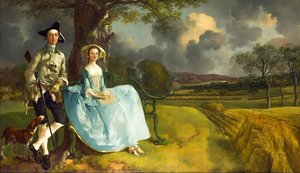
    • Mr & Mrs Andrews
  • Place Of Birth (City And Country): Sudbury, VK
Ontdek kunstwerken georganiseerd op thema, stijl en kenmerk.