


Introduction
There is a profound, almost breathless moment that occurs when we encounter art that refuses to be contained by the familiar shapes of our world. While many of us find solace in the gentle, light-drenched landscapes of the Impressionists, there exists a different kind of magic found in the raw, unbridled energy of the mid-20th century—a magic that seeks not to capture what the eye sees, but what the soul feels.
The rise of Abstract Expressionism was more than just a change in technique; it was a seismic shift in the human narrative. Emerging from the profound cultural and emotional upheaval following the Second World War, this movement transformed the canvas into an intimate arena for the subconscious. It was a time when the artist's very gesture—the drip, the splash, the heavy, textured sweep of paint—became the subject itself, turning the act of painting into a visceral, lived experience.
These works remain vital and deeply moving today because they bypass the intellect and speak directly to our primal emotions. Whether through the vast, meditative color fields that invite quiet contemplation or the frenetic, rhythmic layers of action painting that pulse with life, these masterpieces offer us a mirror to our own internal complexities. They remind us that even in chaos, there is a profound, underlying beauty.
As we journey through this selection, we will explore ten definitive works that shaped this era. Each piece is a testament to the power of abstraction to convey the deepest truths of our existence, inviting you to look beyond the surface and find yourself within the paint.
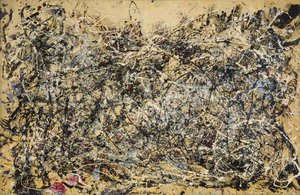
Number 1, 1949 - Paul Jackson Pollock
To stand before Number 1, 1949 by Paul Jackson Pollock is to witness a soul laid bare upon the canvas. It is not merely paint; it is a rhythmic, visceral dance of energy that captures the very essence of human turbulence and unbridled freedom. This work stands as a cornerstone of the Abstract Expressionism movement because it shattered the boundaries of tradition, transforming the canvas from a window into an arena of action.
Through his iconic drip technique, Pollock moved us away from representation toward the pure, raw power of the subconscious, creating a non-representational landscape that feels both chaotic and cosmic. We believe such profound emotional depth should not be confined to museum walls. Our hand-painted oil reproductions meticulously capture every energetic stroke and textured layer, allowing you to invite this monumental spirit of innovation into the sanctuary of your own home.
Composition VIII - Wassily Wassilyevich Kandinsky
 Composition VIII - Wassily Wassilyevich Kandinsky
To gaze upon Composition VIII by Wassily Kandinsky is to witness a silent symphony where color and geometry dance in perfect, rhythmic tension. This 1923 masterpiece stands as a cornerstone of the movement, marking the profound moment when art shed its need for recognizable objects to speak directly to the soul through pure, non-objective form. Within this complex arrangement of floating circles and intersecting lines, one feels the pulse of Kandinsky’s "inner necessity"—a spiritual resonance that transcends the canvas.
As a pivotal milestone in the evolution toward Abstract Expressionism, it redefined the boundaries of visual language through its musicality and movement. Today, the energetic interplay of his bold primaries and sharp geometries continues to inspire modern aesthetics, finding a sophisticated echo in contemporary minimalist interiors and avant-garde graphic design. It is not merely a painting; it is an emotional landscape that invites us to find harmony within apparent chaos.
Woman I - Willem de Kooning
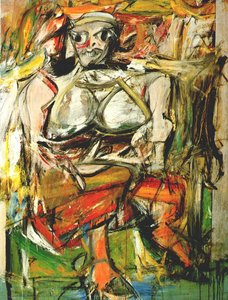 Woman I - Willem de Kooning
To encounter Woman I by Willem de Kooning is to witness a beautiful, fractured storm captured on canvas. Painted in 1952, this work does not merely sit upon a wall; it breathes with the raw, post-war anxieties of a changing world. De Kooning’s brushwork is visceral—a frenetic dance of thick, textured impasto where vibrant reds clash against unsettling greens and stark blacks. There is no serene beauty here, only an honest, almost primal intensity that pulls you into its swirling, unstable depths.
As you surround yourself with such genius, your home transcends mere decoration; it undergoes a profound transformation . This masterpiece invites you to move beyond the ordinary and turn your walls into a gallery of the soul , where every heavy, gestural stroke serves as a window into the beautiful complexity of human emotion.
Anthropometry of the blue period - Yves Klein
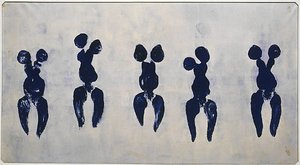 Anthropometry of the blue period - Yves Klein
What if I told you that Anthropometry of the blue period by Yves Klein was born from a moment of rebellion—a stroke of defiance against the ordinary? To encounter this work is to feel the pulse of an ancient ritual; it is the haunting, visceral memory of bodies pressed into canvas, leaving behind only the deep, celestial resonance of International Klein Blue. This masterpiece earned its place among the defining works of Abstract Expressionism by stripping away the brush to find the soul, redefining artistic emotion through pure, rhythmic gesture.
At Most-Famous-Paintings.com, we believe such profound energy belongs in your most intimate sanctuaries. Imagine this velvety, midnight blue anchoring your study, turning a quiet wall into a window to the infinite. This is not art; it’s a manifesto . Its place in the Top 10 is not just earned; it’s demanded by history. Now, imagine this rebellion hanging above your desk, turning every glance into a reminder: your space is not just a room. It’s a statement.
The Liver is the Cock's Comb - Arshile Gorky
 The Liver is the Cock's Comb - Arshile Gorky
There’s a gaze in "The Liver is the Cock's Comb by Arshile Gorky" that follows you—not with judgment, but with understanding . This isn’t a portrait; it’s a mirror . Its spot in the Top 10 is a testament to its power to make the invisible visible. Now, imagine that gaze in your space. Not watching you, but reminding you : you are seen. You are part of the story.
In this 1944 masterpiece, Gorky dissolves tradition into a vibrant, chaotic dance of biomorphic forms and fractured planes. The canvas erupts with a visceral palette—fiery reds and sun-drenched yellows clashing against deep, bruised purples and ethereal whites. It is a landscape of the subconscious, where the weight of personal trauma and the anxieties of a world at war manifest as fluid, gestural lines and thick, textured impasto. To witness this work is to feel the pulse of Abstract Expressionism itself: an evocative, swirling energy that transcends mere shape to capture the raw, unvarnished essence of human emotion.
On White II - Wassily Wassilyevich Kandinsky
 On White II - Wassily Wassilyevich Kandinsky
Tracing the surface of On White II , one is immediately struck by the rhythmic tension where Kandinsky’s deliberate brushwork meets the luminous, off-white expanse. There is a profound materiality in how the bold, geometric shapes—those sharp triangles and floating circles—seem to vibrate against the canvas, as if the oil paint itself were composed of pure musical notes. This 1923 masterpiece stands as a vital pillar in the journey toward abstract expressionism, replacing the visible world with a spiritual language of color and form. At Most-Famous-Paintings, we feel that such a profound visual symphony deserves more than a flat digital image. Our mission is to preserve this tactile, three-dimensional soul through our hand-painted oil reproductions. We meticulously recreate the layered depth and the subtle, physical presence of every stroke, allowing you to invite the true, textured essence of Kandinsky's geometric brilliance into your own sanctuary.
Abstract Painting 780-1 - Gerhard Richter
 Abstract Painting 780-1 - Gerhard Richter
In Abstract Painting 780-1 by Gerhard Richter, light does not merely fall upon the canvas; it seems to erupt from within its very layers. The work orchestrates a breathtaking dance of internal illumination, utilizing a modern form of chiaroscuro where deep, somber tones create a sense of quiet shadow that contrasts against a sudden burst of sun-drenched warmth. This masterful command of tonal tension—the way light and dark collide through thick, energetic impasto brushstrokes—is precisely what secured this piece's place among the defining masterpieces of the Abstract Expressionism movement.
To invite a hand-painted reproduction of such a work into your home is to bring a living energy into your sanctuary. The tactile depth of the oil paint captures every flicker of color, adding an unmistakable layer of sophisticated luxury and rhythmic movement to a contemporary wall. It transforms a simple space into a curated gallery, offering a profound emotional resonance that lingers long after the first glance.
First Abstract Watercolor, Collection of Mad - Wassily Wassilyevich Kandinsky
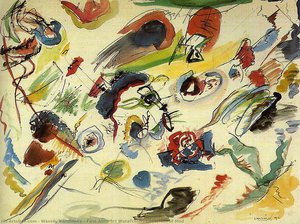 First Abstract Watercolor, Collection of Mad - Wassily Wassilyevich Kandinsky
When you gaze upon First Abstract Watercolor, Collection of Mad , you realize the lines in Wassily Kandinsky’s masterpiece aren’t merely drawn; they are choreographed . This is not a simple composition; it is a dance frozen in time , where vibrant washes of crimson, azure, and sun-drenched yellow collide in a beautiful, controlled chaos. Created in 1910, this work marks the breathtaking moment when art shed its need for recognizable forms to embrace pure, spiritual emotion.
Kandinsky’s brushstrokes move with a spontaneous energy, weaving organic shapes and sharp geometric accents into a visual symphony that resonates deep within the soul. It is a rare ability—to make such intense, swirling movement feel like absolute harmony. Imagine the impact of such a pulse in your own sanctuary; what if your walls could breathe rhythm ? This piece does not simply decorate a room; it invites a profound, rhythmic life into your home.
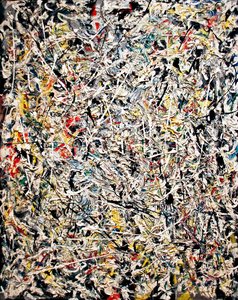
Convergence - Paul Jackson Pollock
 Convergence - Paul Jackson Pollock
To stand before Jackson Pollock’s Convergence is to witness a beautiful, controlled chaos that transcends the canvas. It is not merely a painting; it is a visceral pulse of energy captured in time. In this masterpiece, Pollock abandons the traditional brush to engage in a rhythmic dance with gravity, using drips and splatters to weave an intricate web of black, yellow, fiery orange, and deep blue. There is no single place for your eyes to rest; instead, you are invited to wander through a boundless field of motion where every layer tells a story of spontaneous creation.
This "all-over" composition rejects the boundaries of form, offering instead a profound sense of liberation. To bring such a work into one's home is to move beyond mere decoration—it is to transform a room into a gallery of the soul, surrounding yourself with the raw, unbridled spirit of an era that redefined what it means to be truly alive through art.
Improvisation 28 (second version) - Wassily Wassilyevich Kandinsky
 Improvisation 28 (second version) - Wassily Wassilyevich Kandinsky
To encounter Improvisation 28 (second version) by Wassily Kandinsky is to step directly into a visual symphony where color and rhythm transcend the physical world. This masterpiece stands as a cornerstone of our exploration into the defining works of the Abstract Expressionism movement, capturing that rare, breathless moment when art breaks free from representation to speak directly to the soul. Through a spontaneous dance of vibrant hues and intersecting lines, Kandinsky translates the ineffable language of music into a tactile experience of pure emotion.
The painting’s energy is infectious; its layered textures and dynamic forms offer a profound sense of movement that feels remarkably contemporary. In today's interiors, such a piece serves as a breathtaking focal point, injecting a room with a spirited, avant-garde elegance. It does not merely decorate a wall; it breathes life and a sense of spiritual depth into the modern home, much like the light-drenched landscapes of the Impressionists we hold so dear, yet with a revolutionary, abstract pulse that continues to captivate the modern eye.
Conclusion
As the evening shadows lengthen and we step away from these powerful, gestural canvases, we realize that Abstract Expressionism is far more than a historical milestone; it is a living, breathing pulse that continues to vibrate within our most intimate spaces. These works do not merely occupy a room—they inhabit it, bringing with them an echo of the artist's rawest emotions and a profound, unbridled energy.
To encounter these masterpieces is to engage in an eternal dialogue between the canvas and the soul. They transform our homes from mere structures into sanctuaries of reflection, where a single, spontaneous stroke can mirror the complexities of our own lives. There is a quiet magic in how these textures and depths of color continue to shape our culture, inviting us to find beauty in the unexpected and resonance in the profound.
I invite you to lose yourself once more in this movement of pure feeling and discover how these timeless works can breathe new life into your own world through our full collection .