Francesco di Giorgio Martini (1439–1502): A Renaissance Polymath
Francesco Maurizio di Giorgio Martini, commonly known as Francesco di Giorgio Martini or di Martino, was a towering figure of the Florentine Renaissance and Sienese School—a true *homo universalis* who excelled in painting, sculpture, architecture, military engineering, and theoretical design. Born in Siena on September 23, 1439, he died there November 29, 1502, leaving behind a legacy of innovative artistic vision and architectural ingenuity that continues to inspire scholars today. His life was one of constant movement, driven by commissions and intellectual pursuits, reflecting the dynamism of the era.
Early Life and Artistic Training
Francesco’s formative years were spent under the tutelage of Vecchietta, a celebrated Sienese painter who championed a distinctive style characterized by joyous wedding processions rendered in frieze-like formulas—a stylistic choice that would profoundly shape Francesco's early artistic endeavors. Departing from this prevailing trend, he swiftly embraced a more ambitious aesthetic, driven by humanist ideals and influenced by the burgeoning interest in perspective. This shift signaled his commitment to exploring spatial relationships and conveying grandeur – concepts central to the Renaissance’s intellectual fervor. His apprenticeship instilled in him not only technical skill but also an appreciation for artistic experimentation and a willingness to challenge established conventions. He began his career as a painter, working on illuminated manuscripts and decorative panels, demonstrating a mastery of detail and color that would later inform his architectural designs.
Painting: Visionary Frescoes and Religious Iconography
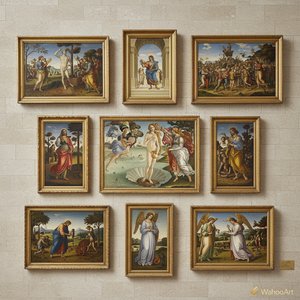
Francesco’s paintings stand apart from many of his contemporaries due to their remarkable psychological depth and imaginative grandeur. The Nativity (c. 1475), housed in the Pinacoteca Siena, exemplifies his masterful use of perspective and embodies a humanist sensibility that anticipates the stylistic innovations of Leonardo da Vinci and Michelangelo. Similarly, the Coronation of the Virgin (1472–4), commissioned for Siena Cathedral, showcases his ability to synthesize classical influences with Sienese tradition—a testament to his artistic versatility and intellectual curiosity. His frescoes are notable for their vibrant colors and expressive dynamism, reflecting a profound understanding of human emotion and spiritual contemplation. He wasn’t simply replicating religious scenes; he was conveying the *feeling* of faith through carefully orchestrated compositions and nuanced figures. His work demonstrates an early awareness of atmospheric perspective and the use of light to create depth and drama – elements that would become increasingly important in later Renaissance painting.
Architectural Innovation: Shaping the Ideal City
Francesco di Giorgio Martini’s architectural achievements cemented his reputation as one of the most influential architects of his time. He revolutionized urban planning principles by advocating for star-shaped polygonal geometries—a concept rooted in military fortifications that would become a cornerstone of Renaissance architectural theory. His magnum opus, Santa Maria del Calcinaio (completed 1484), perched precariously atop Siena’s steep incline, demanded extraordinary engineering skill and demonstrated his unwavering dedication to realizing ambitious designs. Notably, he pioneered staircase planning—dividing at a landing to return symmetrically on each wall—a technique that would become commonplace in subsequent centuries. His architectural writings, particularly *Trattato di architettura civile e militare,* articulated these groundbreaking ideas with clarity and conviction, establishing him as a pivotal voice in shaping the intellectual landscape of the Renaissance. He envisioned cities not just as collections of buildings but as complex systems designed for defense, beauty, and the well-being of their inhabitants.
Sculpture: Bronze Figures and Artistic Influence
Francesco’s sculptural output is equally impressive, primarily consisting of four bronze angels adorning Siena Cathedral's high altar (1489–97)—a commission that showcased his technical prowess and artistic vision. These sculptures bear the unmistakable imprint of Andrea del Verrocchio’s influence—reflecting Francesco’s engagement with Florentine artistic culture and demonstrating his ability to absorb and transform stylistic innovations. Furthermore, he designed fortifications, battle machinery, and weapons, cementing his reputation as a military engineer and furthering his contribution to Renaissance technological advancement. His sculptures are characterized by their dynamic poses and expressive gestures, reflecting a deep understanding of human anatomy and movement. They represent a significant departure from the more static and stylized sculpture of previous eras, foreshadowing the naturalism that would characterize later Renaissance art.
Legacy: A Pioneer of Renaissance Thought
Francesco di Giorgio Martini's enduring legacy resides not only in his artistic creations but also in his pioneering contributions to architectural theory and military engineering—a testament to his multifaceted intellect and unwavering commitment to pushing the boundaries of creative exploration. His work has been recognized by art historians like Nikolaus Pevsner, who hailed him as one of the most interesting later quattrocento architects—a judgment that underscores his significance within the broader context of Renaissance artistic history. He remains a beacon of intellectual curiosity and artistic innovation, inspiring generations of artists and scholars alike. His *Trattato di architettura civile e militare* continues to be studied today for its insights into Renaissance urban planning and military strategy, demonstrating the lasting impact of this remarkable polymath.