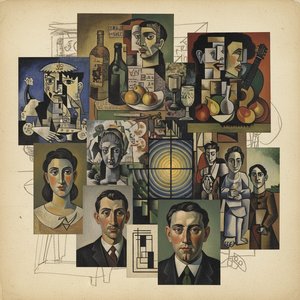
Amadeo de Souza-Cardoso: A Pioneer of Portuguese Modernism
Amadeo de Souza-Cardoso, a name resonating with the vibrant energy of early 20th-century modernism, remains a somewhat enigmatic figure despite his pivotal role in bridging Portuguese art to the international avant-garde. Born on November 14, 1887, in Manhufe, Portugal, his brief but intensely creative life was marked by a restless spirit and an unwavering dedication to artistic innovation. From humble beginnings rooted in the rural landscapes of his homeland, Souza-Cardoso embarked on a journey that would lead him to the heart of Parisian modernism, where he forged connections with some of the most influential artists of his time – Modigliani, Brancusi, Delaunay, and Gris among them. His early education began with architectural studies in Lisbon, but it was the allure of painting, particularly the expressive power of caricature, that truly captured his imagination and set him on a path toward artistic exploration. This initial foray into art wasn’t merely technical training; it was an awakening to the potential of visual language as a means of commentary and self-expression.
- Early Life & Education: Amadeo’s formative years were spent in Manhufe, where he absorbed the traditions of his rural upbringing. His architectural studies in Lisbon provided him with foundational knowledge but it was caricature—a medium that allowed for biting social critique—that ignited his artistic passion.
- Parisian Encounters & Artistic Development: In 1906, Souza-Cardoso relocated to Paris, immersing himself in the burgeoning artistic scene of Montparnasse. He quickly embraced Cubism and Futurism, synthesizing these movements with his own distinctive vision.
His paintings weren’t merely representations of reality but rather explorations of perception, emotion, and the very essence of form itself. Works like *Saut du Lapin* (1911) and *Cabeça* (1913) exemplify this period, showcasing his experimentation with fragmented perspectives and a heightened sense of chromatic intensity. These weren’t chaotic arrangements but carefully balanced structures, revealing a deliberate artistic vision beneath the surface of apparent randomness. He participated in key exhibitions, including the Salon des Indépendants and, crucially, the groundbreaking 1913 Armory Show in New York, bringing his innovative work to an international audience.
- Style & Influences: Souza-Cardoso’s style was characterized by bold forms, vibrant colors, and dynamic compositions—a direct result of absorbing the ideas circulating within Cubism and Futurism. He skillfully blended these influences with his own sensibilities, creating a unique aesthetic that distinguished him from his contemporaries.
- Cultural Synthesis: Souza Cardoso's art reflected his dual heritage – Portuguese tradition intertwined with Parisian avant-garde experimentation. Recurring motifs from rural Portugal—religious processions, landscapes—were juxtaposed against modernist techniques, resulting in a dialogue between cultures.
Tragically, Amadeo de Souza-Cardoso’s promising career was cut short by his untimely death on October 25, 1918, at the age of just thirty. He succumbed to pneumonia during the Spanish Flu pandemic, leaving behind a relatively small but remarkably impactful body of work. For many years, his contributions were overlooked, overshadowed by more prominent figures in the modernist movement. However, in recent decades, there has been a growing recognition of his significance as a pioneer of Portuguese modernism and an important voice within the broader European avant-garde. Two major retrospectives – one in 1958 and another at the Grand Palais in Paris in 2016 – have helped to reintroduce his work to a wider audience, solidifying his place in art history. Today, his paintings can be found in museums around the world, including the Plymouth City Museum and Art Gallery, alongside works by other notable artists. His legacy continues to inspire contemporary artists, serving as a reminder of the power of artistic innovation and the enduring importance of cultural exchange.
Key Characteristics of Souza-Cardoso’s Work
- Innovative Style: A pioneering approach to modern Portuguese art, blending Cubism, Futurism, and his own unique sensibility.
- Vivid Color Palette: Characterized by aggressive and vibrant use of color, creating dynamic and emotionally resonant compositions.
- Dynamic Composition: Often employing fragmented perspectives and seemingly chaotic arrangements that are, in fact, carefully balanced and structured.
- Cultural Synthesis: A unique ability to reconcile Portuguese themes and motifs with modernist techniques, creating a dialogue between cultures.
Amadeo de Souza-Cardoso’s brief but impactful career left an indelible mark on the world of art. His innovative style and contributions to modern Portuguese art continue to fascinate art enthusiasts worldwide, ensuring his legacy endures for generations to come.