Early Life and Artistic Awakening
Christopher Richard Wynne Nevinson, known as C.R.W. Nevinson or simply Richard Nevinson, emerged onto the British art scene at a moment of profound societal shift. Born in 1889 in Hampstead, London, his upbringing was steeped in intellectual and progressive ideals. His father, Henry Nevinson, was a renowned war correspondent and journalist, while his mother, Margaret Nevinson, dedicated herself to the burgeoning suffrage movement as a writer and activist. This environment instilled in young Richard a keen awareness of social issues and a spirit of independent thought that would permeate his artistic vision. Though initially struggling to find direction, he eventually enrolled at the Slade School of Art in 1909, studying under Henry Tonks alongside future luminaries like Stanley Spencer and Mark Gertler. While Tonks encouraged traditional techniques, Nevinson found himself drawn towards more radical currents, seeking a visual language that could capture the dynamism of the modern world. Early influences included the work of Augustus John, but it was his encounter with the Italian Futurists and Wyndham Lewis that truly ignited his artistic trajectory.
Embracing Modernity: Futurism, Vorticism, and the Brink of War
Nevinson’s artistic development took a decisive turn when he befriended Filippo Marinetti, the charismatic leader of the Italian Futurist movement. Captivated by Futurism's celebration of speed, technology, and the energy of urban life, Nevinson began to incorporate its principles into his own work. He briefly aligned himself with Wyndham Lewis’s Rebel Art Centre, a hub for avant-garde experimentation in London. However, this association was short-lived. A fundamental disagreement over artistic direction led to a rift between Nevinson and Lewis, resulting in Nevinson's exclusion from the Vorticist movement—a distinctly British offshoot of Futurism founded by Lewis himself. Despite this falling out, Nevinson continued to explore Futurist ideas, even co-authoring a manifesto for English Futurism alongside Marinetti. His early paintings reflected these influences, depicting scenes of modern London – bustling streets, railway stations, and the nascent Underground system – with fragmented forms and dynamic compositions. These works weren’t merely representations of place; they were attempts to convey the *feeling* of modernity—its exhilarating pace and relentless energy. Alongside his exploration of Futurist aesthetics, Nevinson maintained close ties with artists like Mark Gertler and Dora Carrington, sharing a brief period of artistic kinship rooted in Neo-Primitivism before diverging onto their individual paths.
The Horrors of War and the Rise of a War Artist
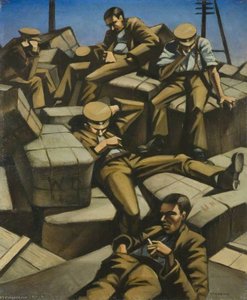
The outbreak of World War I irrevocably altered Nevinson’s artistic focus. Initially joining the Friends' Ambulance Unit, he witnessed firsthand the brutal realities of war while tending to wounded French and British soldiers. Illness forced his return to Britain, but he soon volunteered with the Royal Army Medical Corps. He used these experiences as the subject matter for a series of powerful paintings which combined Futurist and Cubist aesthetics. Bleak, outspoken and often angry, his work from 1915–16 stands as powerful testaments to the devastation of modern warfare. Utilizing fragmented forms and jarring perspectives, Nevinson conveyed not just the physical destruction but also the psychological trauma inflicted by mechanized conflict. His paintings like *La Mitrailleuse* (The Machine Gunner) exemplify this approach—a bold rejection of Impressionistic idealism in favor of confronting the grim truth of the battlefield. Critics lauded his daring vision, recognizing it as “the most authoritative and concentrated utterance on the war in the history of painting.” He was appointed an official war artist in 1917, continuing to develop his distinctive style while grappling with the moral complexities of documenting the conflict.
Post-War Years: Travels, Turmoil, and Legacy
Following the armistice, Nevinson embarked on a journey to New York City, where he captured the towering skyscrapers and vibrant energy of American urban life in canvases that reflected both Futurism’s fascination with technology and Cubism's exploration of geometric abstraction. However, his subsequent career was marked by personal struggles—depression, breakdowns, and difficulties reconciling his artistic ambitions with the demands of daily life. He published *Paint and Prejudice* in 1937, a memoir that offered glimpses into his inner world but also contained inaccuracies and inconsistencies. Despite these challenges, Nevinson remained an influential figure in British art history. His pioneering use of Futurist techniques—particularly the fragmentation of form and the incorporation of dynamic movement—established him as one of the foremost innovators of his generation. He is remembered not only for his wartime paintings but also for his broader engagement with avant-garde ideas and his unwavering commitment to portraying the anxieties and uncertainties of the modern age. His legacy continues to inspire artists today, reminding us that art can serve as a powerful tool for confronting difficult truths and challenging conventional perspectives.