A Prodigy of the Parisian Atelier
The story of Pierre Louis Henri Grévedon begins not merely in Paris, but within the very heart of French artistic tradition. Born in 1776 to a father who served as an officer in the guard of King Louis XVI, Grévedon’s early life was steeped in the grandeur of the Ancien Régime. His talent was nothing short of precocious; it is said he entered the Academy in Paris at the tender age of eight, honing his draughtsmanship by meticulously copying the masterworks that surrounded him in the Louvre. By thirteen, his skill had already earned him an Academy medal, signaling the arrival of a virtuoso. Under the rigorous tutelary guidance of Jean-Baptiste Regnault, a titan of Neoclassicism, Grévedon absorbed the disciplined principles of anatomical precision and monumental composition that would form the bedrock of his technical mastery.
His early career was marked by a series of triumphs at the Paris Salons. Between 1798 and 1806, his works captured the attention of the French public and critics alike. In 1804, he presented a piece of profound political resonance, Achille débarquant sur le rivage de Troie, which served as a subtle, daring allusion to Napoleon I’s projected invasion of England. Such works demonstrated his ability to weave contemporary political tension into the fabric of classical mythology. His ascent was punctuated by prestigious accolades, including a first-class gold medal in 1805 and the first prize for the torso in 1806, establishing him as one of the most promising figures of his generation.
A Wanderer Through Empires
Driven by an insatiable thirst for success and a desire to explore the wider world, Grévedon’s life became a grand European odyssey. In 1806, he turned his gaze eastward toward Russia, a move that would profoundly shape his artistic identity. In St. Petersburg, he found a fertile ground for his talents, eventually becoming an agrégé of the Académie de Saint-Pétersbourg. This period was characterized by a magnificent engagement with the Russian imperial court; his portraits and panoramas captured the sweeping grandeur and atmospheric light of the Russian landscape, earning him the patronage of luminaries such as Empress Catherine II and Emperor Alexander I. His ability to translate the vastness of the Russian spirit onto paper or canvas brought a new dimension to his repertoire.
The artist’s journey continued through the shifting borders of a continent in flux. Following his time in Russia, he moved to Stockholm in 1812 before eventually finding himself in the vibrant, competitive artistic atmosphere of London. In England, Grévedon sought to absorb the nuances of the British Romantic movement, studying the influential portraiture style of Sir Thomas Lawrence. This period of exploration allowed him to refine his skills as a miniaturist, blending the structured discipline of his French training with the more emotive and atmospheric sensibilities prevalent in the English school. His travels were not merely geographical but intellectual, as he continuously integrated the diverse cultural aesthetics of the empires he traversed.
The Mastery of Line and Light
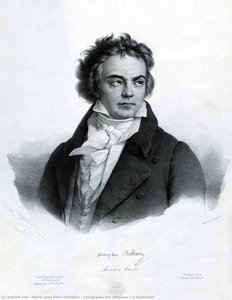
While Grévedon’s early reputation was built upon the oil canvas and the monumental scale of Neoclassical painting, his true enduring legacy lies in the delicate, intimate world of lithography and printmaking. Upon his return to Paris in 1816, he underwent a profound artistic evolution. He began to devote himself almost entirely to lithography, a medium that allowed for a level of expressive freedom and textural nuance that traditional painting could rarely match. It was through this medium that he achieved his most widespread renown, creating masterful illustrations and prints that possessed a remarkable sensitivity to light and shadow.
His graphic works are celebrated for their exquisite detail and an understated elegance that speaks to the transition from Neoclassicism to Romanticism. Whether capturing the delicate features of a high-society sitter or the sweeping vistas of a distant landscape, his hand remained remarkably precise yet imbued with a soft, atmospheric quality. His subjects were a veritable who’s who of the era, ranging from the celebrated actress Mademoiselle Mars to the German singer Henrietta Sontag. Through his lithographs, Grévedon did more than just record faces; he captured the very essence of an age of transition, leaving behind a body of work that remains a vital window into the cultural and social tapestry of early 19th-century Europe.