

The Great Stripping: Defining the Essence of Geometric Abstraction
 Geometric Abstraction's 10 Defining Masterpieces | Art for Your Home - Most-Famous-Paintings
Introduction Imagine a world stripped bare to its essential forms – lines, colors, and shapes resonating with an almost mathematical purity. This is the realm of Geometric Abstraction, a movement that dared to abandon representational art in favor of...
For the student of art history, understanding this "stripping away" is crucial. It represents a shift from the mimetic—the imitation of nature—to the non-objective, where the painting exists as its own reality. At Most-Famous-Paintings.com, we see this enduring power in our collection of canonical masterpieces, where the clean lines and bold colors offer a sanctuary of contemplation from the chaos of the modern world.
Architectural Foundations: Cubism and the Deconstruction of Reality
--- title: Geometric Abstraction - The Metropolitan Museum of Art author: Magdalena Dabrowski url: https://www.metmuseum.org/essays/geometric-abstraction hostname: metmuseum.org description: Geometric abstraction, through the Cubist process of purify...
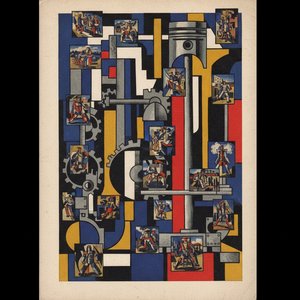
This process of purifying art from the vestiges of visual reality focused on the inherent features of painting itself: flatness, color, and form. By breaking down objects into geometric fragments, Cubism provided the essential toolkit for later abstractionists to move even further away from the object. It taught artists that a composition could be built through the arrangement of planes rather than the depiction of depth. For those looking to study these textures firsthand, our hand-painted oil reproductions capture the very impasto and structural weight that defines this era, offering a much deeper tonal range than any standard print.
The Bauhaus Ethos: Synthesizing Form, Function, and Mass Production
 Bauhaus
The Staatliches Bauhaus (German: [ˈʃtaːtlɪçəs ˈbaʊˌhaʊs] ), commonly known as the Bauhaus (German for 'building house'), was a German art school operational from 1919 to 1933 that combined crafts and the fine arts. The school became famous for its ap...
The Bauhaus approach revolutionized how we perceive the relationship between art and life. It emphasized that the same geometric logic used in a painting could be applied to architecture, typography, and furniture. This era saw the presence of legendary figures such as Wassily Kandinsky and Paul Klee, who brought their profound understanding of form to the school's curriculum. The legacy of the Bauhaus remains visible today in everything from modern graphic design to minimalist architecture. Our studio artists, trained with similar academic excellence, continue this tradition by ensuring that every reproduction we create adheres to the highest standards of precision and craftsmanship, respecting the original's structural integrity.
A Visual Grammar: Decoding Color, Line, and Mathematical Purity
--- title: Bauhaus: The Importance of Shapes - Google Arts & Culture url: https://artsandculture.google.com/story/bauhaus-the-importance-of-shapes/OwURAJwcVUkTow hostname: google.com description: Established since 1914, the correspondence between pri...
This mathematical approach to art allows for a level of precision that feels almost scientific. The use of:
- Lines: Acting as boundaries or directional forces that guide the eye through non-illusionistic space.
- Shapes: Utilizing circles, squares, and triangles to create balance and tension.
- Color: Employing a palette that avoids naturalistic references in favor of pure, emotive impact.
The Quest for the Eternal: Geometry as a Universal Spiritual Language
 The Solomon R. Guggenheim Museum
A Spiraling Sanctuary of Modern Vision To step into The Solomon R. Guggenheim Museum in New York City is to leave the rigid, rectangular geometry of Manhattan behind and enter a realm where form and movement converge. This is not merely a repository ...
This spiritual dimension is perhaps most evident in the history of the Solomon R. Guggenheim Museum, which was founded specifically to nurture non-objective art. Under the guidance of visionaries like Hilla Rebay, the museum became a sanctuary for radical concepts that challenged established boundaries. The works housed there—and the works we celebrate at Most-Famous-Paintings.com—remind us that simplicity can hold immense power. Whether through the vibrant, dynamic energy of an Olga Rozanova composition or the disciplined, rhythmic planes of a Mondrian, geometric abstraction continues to offer a space for contemplation and emotional resonance in an increasingly complex world. It remains a testament to the enduring human quest for meaning, expressed through the timeless elegance of the shape and the form.