The Weight of Memory: The Art of Xiaoze Xie
Born in 1966 in Guangdong, China, Xiaoze Xie emerged into a world on the precipice of profound transformation. His early years were shaped by the seismic shifts of the Cultural Revolution, an era that left indelible marks on his psyche and provided the foundational imagery for his later explorations of loss and erasure. Growing up with memories of his father, a school principal, being compelled to collect books destined for destruction, Xie developed a lifelong preoccupation with the fragility of recorded history. This personal connection to the vulnerability of the written word would eventually evolve into a sophisticated artistic language that bridges the gap between the tangible textures of the past and the ephemeral nature of contemporary existence.
Xie’s academic journey reflects a rigorous pursuit of both architectural precision and fine art mastery. After earning a Bachelor of Architecture from Tsinghua University in Beijing, he moved to the United States in 1993, eventually receiving his Master of Fine Arts from the University of North Texas and later honing his conceptual depth at Yale University. This unique blend of architectural training and fine arts education is evident in his work, where a structural understanding of space meets an intense, almost haunting, focus on surface and detail. Today, as the Paul L. & Phyllis Wattis Professor of Art at Stanford University, he continues to inhabit a space between continents, splitting his time between Beijing and Palo Alto, California.
The Poetics of Decay and Documentation
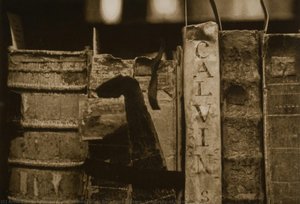
The hallmark of Xie’s oeuvre is a breathtakingly meticulous photorealism that serves a much deeper, conceptual purpose. He is perhaps most renowned for his monumental paintings of library books and aging newspapers—works that capture the battered spines, dusty edges, and yellowing pages of decaying printed matter with such intensity that they almost transcend representation to become objects of meditation. In these canvases, the artist does not merely depict paper; he captures the very process of erosion. Through his brush, the subtle textures of crumbling parchment and the fraying edges of newsprint become symbols for the gradual fading of cultural narratives and the relentless march of time.
Beyond the physical decay of books, Xie’s work delves into the darker currents of political history. His investigative projects have led him to explore the history of banned and forbidden books in China, tracing a lineage of censorship from the Qing Dynasty through the modern era. By rendering these "doomed" titles with such reverence and clarity, he breathes life back into subjects that were once targeted for oblivion. This thematic thread extends into his more recent explorations of digital media, where he captures fleeting scenes from Chinese blogging platforms like Weibo, reminding his audience that even in our current age of instant information, the integrity of truth remains subject to manipulation and neglect.
A Legacy of Cultural Preservation
Xie’s significance in the contemporary art world lies in his ability to slow down the frantic pace of modern information. While much of contemporary art grapples with the speed of the digital revolution, Xie uses the deliberate, time-consuming medium of painting to force a confrontation with the past. His work functions as a form of visual archaeology, where the act of painting becomes an act of recovery. Whether he is working with ancient Chinese manuscripts dating back to the 4th century or contemporary digital fragments, his focus remains on the preservation of memory against the forces of destruction.
His achievements are reflected in his extensive exhibition history at prestigious institutions worldwide, including:
- The Cantor Arts Centre at Stanford University
- The Asia Society Museum in New York
- The Denver Art Museum, Colorado
- The Modern Chinese Art Foundation in Ghent, Belgium
- The Tsinghua University Art Museum in Beijing
Through his mastery of photorealism and conceptual tautness, Xiaoze Xie has created a body of work that is both deeply personal and universally resonant. He reminds us that while history can be suppressed and books can be burned, the traces left behind—the dust, the stains, and the shadows—remain as enduring witnesses to the human experience.