x

Handmålad olja på duk i din valda storlek och ram, tillverkad efter beställning av våra konstnärer. ( Beställ tryck Byt till bild)





























Välj bland våra förinställda storlekar som motsvarar konstverkets ursprungliga proportioner.

Du kan ange egna mått för att passa en specifik ram eller yta. Om den valda storleken inte matchar originalbildens proportioner kommer vi antingen att beskära konstverket eller utöka målningen med ytterligare handmålade element. En digital skiss skickas till dig för godkännande innan produktionen påbörjas.
Observera att förhandsvisningen på skärmen inte återspeglar den faktiska beskärningen eller utökningen. Endast skissen visar den slutgiltiga kompositionen korrekt.
Även om anpassade storlekar är möjliga, rekommenderar vi att du väljer en dimension från den fördefinierade listan för att bevara originalproportionerna.
Leverans över hela världen () på 3–4 veckor istället för standard 5 veckor. (6 augusti). Inga kompromisser med kvaliteten.


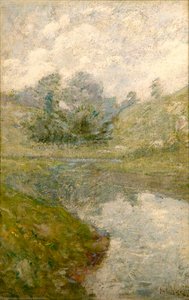
Old Holley House, Cos Cob
Reproduktionsstorlek
John Henry Twachtman's “Old Holley House, Cos Cob” is more than just a depiction of a snowy landscape; it’s a poignant meditation on stillness, memory, and the enduring beauty of the Connecticut countryside. Painted in 1890, during his most intensely productive period, this artwork captures a moment of profound quietude at the Bush–Holley House, a pivotal location within the burgeoning Cos Cob Art Colony. The scene unfolds with a deliberate restraint, reflecting Twachtman’s evolving approach to Impressionism – one that prioritized atmosphere and emotional resonance over purely representational accuracy.
The house itself, rendered with meticulous detail despite its softened edges, anchors the composition. Its rectangular form provides a structural counterpoint to the swirling snowdrifts and the blurred forms of the surrounding landscape. The bare tree in the foreground isn’t merely a compositional element; it speaks to themes of dormancy and the cyclical nature of time – a common motif within Twachtman's work, often interpreted as reflecting his own contemplative state. The muted palette, dominated by whites, blues, and grays, doesn’t simply record a winter scene; it *evokes* one—a feeling of profound peace and introspection.
Twachtman masterfully employs a muted color palette dominated by whites, blues, and grays. This isn't a vibrant celebration of winter; rather, it’s an exploration of the subtle nuances of light and shadow on a snowy day. The diffused lighting, characteristic of an overcast winter afternoon, creates a sense of ethereal calm. Notice how he uses variations in gray – from the deepest shadows cast by the house to the lighter tones reflecting off the snow – to build depth and create a palpable sense of atmosphere. Subtle browns appear in the tree branches, grounding the scene and adding a touch of warmth against the prevailing coolness. This careful manipulation of color is key to Twachtman’s signature style—a rejection of bright, bold hues in favor of atmospheric effects.
Executed in oil paints on canvas, “Old Holley House” exemplifies Twachtman’s signature Impressionistic technique. Loose brushstrokes, layered washes of color, and broken forms contribute to a sense of movement and immediacy. This isn't about precise detail; it’s about capturing the *impression* of light and form. The painting’s texture is deliberately implied – you can almost feel the roughness of the snow and the weathered surface of the building through the artist’s expressive application of paint. It’s crucial to understand that Twachtman was a key figure in the Cos Cob Art Colony, a group of artists who sought to break away from academic constraints and explore new ways of seeing and representing the world. The Bush–Holley House served as a gathering place for these artists – Weir, Robinson, Hassam – fostering an environment of experimentation and collaboration. The colony’s influence is evident in Twachtman's willingness to prioritize subjective experience over objective representation.
Beyond its technical brilliance, “Old Holley House” possesses a quiet emotional depth. The scene evokes a sense of solitude and reflection, inviting the viewer to contemplate the passage of time and the beauty of the natural world. The stillness of the landscape mirrors a contemplative mood, suggesting a moment of respite from the demands of daily life. It’s a painting that rewards patient observation – encouraging us to slow down and appreciate the subtle wonders of a winter afternoon. This artwork offers a window into the artistic spirit of a pivotal era in American art history, and its enduring appeal lies in its ability to transport us to a place of serene beauty and quiet contemplation. It’s more than just a landscape; it's an invitation to find peace within oneself.


1853 - 1902 , USA

Explore the serene landscapes of John Varley I, a key figure in British Romanticism. Discover his unique watercolour style, collaboration with William Blake & lasting artistic legacy. Learn about collecting Varley's work.

Explore the captivating landscapes of Henri Moret, a master of Post-Impressionism. Discover his unique style, key works, and legacy in our expert guide. Learn about collecting Moret's art & its investment potential.

Explore the captivating work of Henry Marvell Carr, a pivotal figure in American Impressionism. Discover his evocative realism, war art, and cultural depictions – a journey through light, form, and legacy.

Explore the captivating portraits of Sir John Watson Gordon, a leading Scottish master. Discover his evolution from neoclassical style to atmospheric Tonalism and influence on 19th-century British art. Learn about his iconic sitters & legacy.

Explore the life & art of Theodore Clement Steele, a leading American Impressionist painter. Discover his luminous Indiana landscapes, contributions to the Hoosier Group, and enduring legacy. A comprehensive guide for art enthusiasts.


Håll dig uppdaterad med de senaste konstnyheterna, exklusiva erbjudanden och inredningsidéer.
Berätta om ditt projekt så kommer våra konstexperter att ge dig 3 personliga konstförslag.
Vi skapar ett urval av 3 alternativ helt anpassat för dig – gratis!


 Visa i rummet
 Skicka
 Dela
Dela
 Detaljer

 Ladda ner
 Liknande objekt
 Röntgen
 Bildspel

 Läs mer







 Glasalternativet är endast tillgängligt i storlekar under 110 cm.