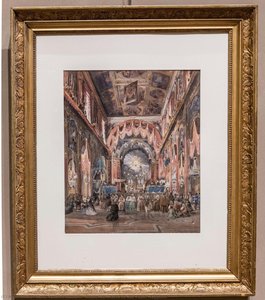
The Luminous Landscapes of Carlo Teodoro Duclère
In the heart of nineteenth-century Naples, a period defined by a profound romantic connection to the natural world, the works of Carlo Teodoro Duclère emerged as a testament to the enduring beauty of the Italian landscape. Born in 1812 to a French father and an Italian mother, Duclère’s very identity was a bridge between cultures, much like his art, which sought to capture the soul of Southern Italy through a lens of refined observation. His journey into the realm of fine art began under the tutelage of the esteemed Dutch-born painter Anton Sminck van Pitloo. This mentorship at the Academy of Fine Arts provided Duclère with more than just technical proficiency; it instilled in him a devotion to the en plein air tradition, a way of seeing that prioritized the authentic light and atmosphere of the Mediterranean.
As his talent blossomed, Duclère became deeply entwined with the School of Posillipo, an influential movement led by masters such as Salvatore Fergola and Giacinto Gigante. This school revolutionized landscape painting by moving away from rigid, idealized compositions toward a more spontaneous and realistic depiction of nature. Duclère’s brushwork reflected this shift, embracing the subtle nuances of light filtering through coastal groves or the soft haze settling over the Bay of Naples. His travels through Sicily, Puglia, and Campania served as his greatest inspiration, allowing him to document the diverse topography of the Italian peninsula with an intimacy that felt both personal and universal.
A Legacy of Light and Tradition
The life of Duclère was one of deep-rooted connections, both familial and professional. His marriage to Sofia van Pitloo, the daughter of his mentor, solidified a lineage of artistic excellence that would influence the Neapolitan art scene for generations. Beyond his personal milestones, his professional ascent was marked by significant recognition within the academic community. In 1849, his expertise was sought for a commission to reform the Academy of Fine Arts, and by 1861, he achieved the prestigious status of a member of the Academy, a distinction supported by influential figures such as Eugenio Emanuele di Savoia-Villafranca.
The enduring significance of Duclère’s oeuvre lies in its ability to evoke the quiet majesty of a bygone era. His paintings are not merely topographical records but emotional landscapes that invite the viewer to experience the warmth and serenity of the Italian sun. Today, his contributions to the history of landscape painting are preserved in esteemed institutions, ensuring that his vision of the Mediterranean remains vibrant and accessible:
- Museo di Capodimonte: Housing some of his most evocative works that capture the essence of Neapolitan scenery.
- Municipal Art Gallery in Giulianova: A testament to the reach of his influence across the Italian landscape.
- The School of Posillipo Legacy: His role in maintaining the movement's commitment to observed reality and atmospheric truth.
Through his meticulous attention to detail and his ability to translate the ephemeral qualities of light into permanent pigment, Carlo Teodoro Duclère remains a vital figure for anyone seeking to understand the romantic spirit of nineteenth-century Italian art.