A Master of Dutch Realism: The Life and Art of Johannes Cornelisz Verspronck
Johannes Cornelisz Verspronck, a name perhaps less immediately recognizable than his celebrated contemporary Frans Hals, nevertheless occupies a significant position within the pantheon of Dutch Golden Age portraiture. Born in Haarlem sometime between 1600 and 1603 – recent archival research suggests closer to 1606-1609 than previously believed – Verspronck dedicated his life to capturing the likenesses, and more importantly, the *essence* of his fellow citizens. His career unfolded during a period of unprecedented prosperity for the Dutch Republic, a time when civic pride and individual wealth fueled a burgeoning demand for portraits that reflected status and respectability. While biographical details remain somewhat sparse, piecing together fragments from guild records and surviving artworks reveals a life devoted to meticulous observation and skillful execution. He was the son of Cornelis Engelsz, also a painter, who initially instructed him in the fundamentals of the craft. Verspronck’s artistic journey led him to join the Haarlem Guild of St. Luke in 1632, marking his formal entry into the professional art world.
Early Influences and Artistic Development
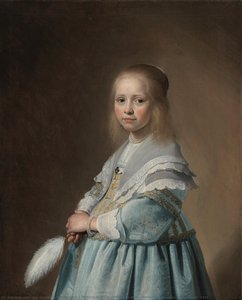
The shadow of Frans Hals looms large over any discussion of Verspronck's development. While definitive proof of a direct apprenticeship remains elusive, the influence is undeniable. Both artists shared a remarkable ability to convey personality through seemingly effortless brushwork and a keen understanding of light and shadow. However, where Hals often prioritized dynamic energy and bravura technique, Verspronck tended towards a more restrained and precise approach. He absorbed Hals’s naturalism but refined it with an almost photographic attention to detail – particularly in rendering textures like lace, jewelry, and fabrics. This meticulousness proved highly appealing to his clientele, especially the women of Haarlem's prosperous merchant class. Early works demonstrate a growing confidence in capturing individual features and expressions, moving beyond mere physical resemblance towards a more psychological portraiture. He wasn’t simply painting *what* people looked like; he was attempting to convey *who* they were.
A Career Defined by Civic Portraiture
Verspronck's success stemmed largely from his ability to secure prestigious commissions within Haarlem society. He became particularly renowned for group portraits, notably those depicting the regentesses – the female administrators – of charitable institutions like the St. Elisabeth Gasthuis and the Heilige Geesthuis. The commission for the latter in 1642 is a pivotal moment in his career. It was awarded at the expense of Frans Hals himself, who had anticipated securing the lucrative project. These group portraits are not merely records of individuals; they are carefully constructed statements about social order, piety, and civic responsibility. Verspronck’s compositions often feature a sense of dignified composure, with each figure rendered with individual attention and subtle variations in expression. He excelled at capturing the nuances of character within a formal setting, creating images that were both visually striking and socially meaningful. Beyond these large-scale commissions, he produced numerous individual portraits, showcasing his versatility and skill across various formats.
Technique and Style: A Legacy of Detail
Verspronck’s technique is characterized by its remarkable precision and attention to detail. He employed a layered approach to oil painting, building up forms with subtle gradations of tone and color. His brushwork, while not as overtly expressive as Hals's, is nonetheless skillful and controlled. He possessed an exceptional ability to render textures – the sheen of silk, the sparkle of jewels, the delicate folds of lace – creating a sense of tactile realism that captivated his patrons.
His portraits are often described as being “exact”, reflecting not only physical likeness but also the material wealth and social standing of the sitters. This emphasis on detail wasn’t merely technical virtuosity; it served to elevate the status of his subjects, presenting them as individuals worthy of careful consideration and respect.
He was a master of capturing the subtle interplay of light and shadow, using chiaroscuro to create depth and volume in his compositions.
Historical Significance and Enduring Appeal
Johannes Cornelisz Verspronck’s legacy lies in his ability to capture the spirit of the Dutch Golden Age through his portraits. He documented a society brimming with confidence, prosperity, and civic pride. While overshadowed by more flamboyant contemporaries like Hals, his work offers a unique perspective on 17th-century life – one characterized by meticulous observation, skillful execution, and a deep understanding of human character. His paintings provide invaluable insights into the social structures, material culture, and artistic sensibilities of the period. The fact that his portrait of Jean le Gouche once hung in Hermann Göring’s collection underscores its historical significance, even if for unsettling reasons. Today, Verspronck's works are prized by museums and collectors alike, offering a glimpse into a bygone era and a testament to the enduring power of Dutch realism.
- His paintings offer invaluable insights into 17th-century life.
- He documented a society brimming with confidence and prosperity.
- Verspronck’s work provides a unique perspective on Dutch Golden Age art.