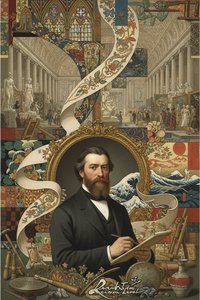
Jean-Louis Ernest Meissonier: The Architect of Miniature Realism
Jean-Louis Ernest Meissonier (1815 – 1891) stands as a singular figure in the annals of French painting, revered not merely for his prolific output but for an unparalleled dedication to meticulous detail and historical narrative. He wasn’t simply depicting scenes; he was reconstructing worlds—frozen moments captured with astonishing precision that continue to fascinate art historians today.
- Early Life & Training: Born in Lyon, Meissonier's artistic inclinations emerged early, nurtured by a father who initially envisioned a business career for his son. However, the irresistible allure of painting swiftly took precedence, securing him permission to pursue his passion and enrolling him in Léon Cogniet’s studio where he honed his skills alongside fellow artists.
- The Influence of Dutch Masters: Meissonier's artistic breakthrough arrived in 1831 with *Les Bourgeois Flamands*, an immediate testament to his distinctive talent—a capacity for recreating bourgeois life or historical vignettes with microscopic accuracy. His formative years were profoundly shaped by the study of Dutch masters like Gabriel Metsu and Gerard Dou, whose masterful use of light and shadow instilled in him a fundamental aesthetic sensibility.
- Genre Scenes & Military Narratives: Meissonier swiftly established himself as a genre painter, capturing everyday life with remarkable sensitivity. Simultaneously, he embraced grand historical narratives—particularly military sieges—demonstrating his ability to command monumental compositions while retaining his signature level of detail. His fascination with the Napoleonic era fueled countless paintings that remain iconic representations of the period.
- Technique & Method: Meissonier’s technique was legendary for its painstaking effort. He undertook exhaustive research, meticulously studying costumes, weaponry, and architectural details to ensure historical accuracy. This dedication extended to the natural world as well—he famously studied horses extensively, analyzing their anatomy and movement to depict them convincingly in his battle scenes.
- Legacy & Recognition: Meissonier’s work commanded exorbitant prices during his lifetime, securing him a magnificent estate in Poissy where he established dedicated studios designed to facilitate his meticulous process. He was lauded for his technical mastery and his ability to bring history to life with unparalleled realism. John Ruskin famously examined Meissonier’s paintings under a magnifying glass, marveling at the artist's “manual dexterity and eye for fascinating minutiae.” His enduring influence can be seen in subsequent generations of painters who strive for similar levels of precision and artistic vision.
To explore more of Meissonier’s art, visit Most-Famous-Paintings.com or the Musée d'Orsay website.