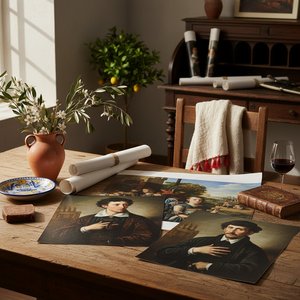
Juan van der Hamen y León (1596-1631): The Master of Light and Detail
Juan van der Hamen y León, born in Madrid in 1596, stands as a cornerstone of Spanish Baroque art – an artist whose meticulous technique and profound understanding of visual perception elevated still life painting to new heights. His legacy continues to resonate today, securing his place among the most celebrated painters of his era.
A Family Rooted in Flemish Heritage
Juan’s lineage was remarkable: his father, Jan van der Hamen, a Flemish courtier who had established himself in Spain decades prior, instilled in him an appreciation for Northern European artistic rigor. Dorotea Witman Gómez de León, Juan's mother, descended from noble Toledan ancestry – a blend of cultural influences that subtly shaped the artist’s distinctive style. The family consciously embraced their Spanish identity by incorporating “Gómez de León” into their names, reflecting their integration into Iberian society. This upbringing fostered a keen awareness of artistic traditions while simultaneously nurturing an inquisitive spirit eager to explore new creative horizons.
Early Artistic Beginnings and Royal Patronage
Juan’s formal artistic training began in 1619 with a commission for a still life destined for the royal palace of El Pardo – marking his initial foray into *bodegones*, the genre that would define his career. However, to reduce him solely to a painter of still lifes would diminish the scope of his talent. He demonstrated proficiency across diverse artistic mediums: religious history paintings imbued with dramatic narratives and symbolic imagery; allegorical scenes exploring philosophical concepts; and landscapes rendered with atmospheric subtlety and meticulous detail. Crucially, he secured patronage from Philip III and Philip IV – positions within the royal household afforded him stability and freedom to pursue his artistic vision. This relationship fostered a collaborative spirit between artist and monarch, resulting in masterpieces that captured the grandeur of the Spanish court.
The Flemish Influence and Innovative Composition
Initially influenced by Flemish painting traditions—particularly the masterful use of light and shadow—Van der Hamen gradually assimilated innovations from artists like Sánchez Cotán, adopting asymmetrical arrangements within his still lifes. These compositional choices created dynamic spatial constructions brimming with complexity and textural richness – a departure from earlier conventions that signaled a decisive shift toward a uniquely Spanish Baroque aesthetic. His meticulous technique involved painstakingly rendering surfaces with astonishing realism, capturing the subtle nuances of color and texture to create images that seemed to breathe with life.
A Singular Vision: Still Life, Portraiture, and Allegory
Juan van der Hamen’s artistic output spanned multiple genres—religious history paintings, portraits, landscapes, and above all, still lifes. He achieved particular renown for his *bodegones*, elevating the genre beyond mere decorative representation to one of profound contemplation. His depictions weren't merely exercises in technical skill; they were meditations on mortality, transience, and the beauty found within everyday objects—a characteristic that distinguishes him from many of his contemporaries. Notable among his achievements are *Offering to Flora* (1627), a monumental allegorical work showcasing his mastery of Flemish compositional techniques; *Portrait of a Dwarf* (circa 1623), demonstrating sensitivity to individual character and anticipating later developments in portraiture; and numerous portraits commissioned by prominent intellectuals and writers, reflecting the intellectual ferment of the era.
A Legacy Illuminated: Influence and Enduring Significance
Juan van der Hamen’s tragically premature death in 1631 at the age of thirty-five curtailed his artistic journey but solidified his place as a pivotal figure in Spanish art history. He profoundly impacted subsequent generations of painters, establishing still life painting as a respected genre and championing innovative compositional approaches. His meticulous technique—characterized by dramatic lighting and painstaking attention to detail—became a hallmark of Baroque artistry throughout Spain. Today, Van der Hamen’s paintings are housed in prestigious museums across Europe and America – testament to the enduring beauty and intellectual depth of his work. He remains an artist whose vision continues to inspire admiration and scholarly inquiry, securing his legacy as one of the most luminous voices of the Spanish Baroque.