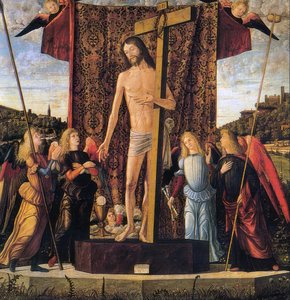
Early Life and Training
Vittore Carpaccio, a prominent Italian painter of the Venetian school, was born in Venice around 1465. He descended from a family of fishermen and boat builders—a heritage that would subtly permeate his artistic vision. His formative years were spent under the tutelage of Gentile Bellini, arguably Venice’s most celebrated artist during his time. This apprenticeship proved pivotal, establishing Carpaccio's future success as a master craftsman and storyteller. Bellini instilled in him a disciplined approach to observation and composition—principles that would define Carpaccio’s distinctive style.
Artistic Style and Influences
Carpaccio’s artistic style stood apart from the burgeoning humanist fervor sweeping across Italy during his lifetime. Unlike many of his contemporaries who embraced intellectual discourse and idealized beauty, Carpaccio remained steadfastly conservative in his technique. His work bore a discernible imprint from Antonello da Messina's innovative use of oil paint—a bold departure from tempera—and crucially, from early Netherlandish art. This unusual confluence resulted in a singular Venetian aesthetic characterized by meticulous detail, subdued color palettes, and an unwavering focus on narrative clarity. He eschewed grand gestures or dramatic expressions, prioritizing instead the careful depiction of human emotion and spiritual contemplation.
Notable Works
Carpaccio’s artistic output spanned from 1490 to 1519, cementing his position as one of Venice's earliest masters of the Renaissance. His most enduring legacy resides in *The Legend of Saint Ursula*, a monumental cycle comprising nine paintings housed within the Gallerie dell’Accademia. This ambitious undertaking exemplifies Carpaccio’s mastery of narrative painting—a genre he elevated to new heights through painstaking observation and masterful execution. The altarpiece *Glory of St. Ursula* similarly showcases his exceptional skill in capturing light and color, mirroring Bellini's luminous style and demonstrating a profound understanding of Venetian artistic tradition. Furthermore, *Miracle of the Relic of the Cross at the Ponte di Rialto*, completed in 1494, exemplifies Carpaccio’s ability to synthesize complex visual information into harmonious compositions—a hallmark of his oeuvre.
Career Highlights and Legacy
Carpaccio's commissions primarily stemmed from Venetian scuole apostoliche—religious confraternities dedicated to honoring saints and fostering piety within the city. These scuole served as vital patrons of the arts, commissioning elaborate paintings and sculptures to adorn their chapels and inspire devotion among their members. Carpaccio’s involvement with these institutions not only provided him with financial support but also exposed him to a vibrant intellectual milieu—one that championed humanist ideals while simultaneously upholding Venetian artistic conventions. Despite being somewhat overshadowed by luminaries like Bellini and Giorgione, Carpaccio's contribution to Venetian art remains significant—a testament to his unwavering commitment to craftmanship and narrative storytelling. His work continues to captivate viewers today with its serene beauty and profound spiritual depth.
References and Further Reading
Discover more about Vittore Carpaccio and the Venetian School on Most-Famous-Paintings.