Early Life and Career
Nikolai Aslánovich Pirosmanashvili, known universally as Niko Pirosmani (1862-1918), emerged from humble beginnings in Mtskheta, Georgia—a village steeped in ancient traditions and nestled amidst the verdant foothills of Kakheti Province. Born to Aslan Pirosmanashvili and Tekle Toklikishvili, farmers who cultivated a modest vineyard, Pirosmani’s early life was marked by hardship and loss. Orphaned at a young age due to illness, he found solace in the care of his elder sisters, shaping his formative years amidst rural simplicity. Despite lacking formal education, Pirosmani possessed an innate artistic talent that would blossom into a singular vision—a rejection of academic conventions and an embrace of raw emotion and untamed observation.
Artistic Style and Themes
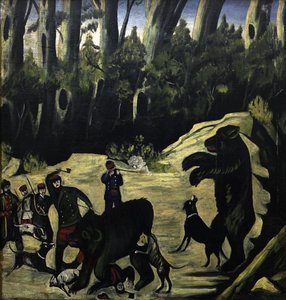
Pirosmani’s distinctive style defies easy categorization, firmly establishing him as a pivotal figure in the primitivist movement. His canvases are characterized by a breathtaking naïveté—a deliberate avoidance of meticulous detail and perspectival accuracy—yet brimming with an astonishing sensitivity to color and composition. Primarily working on oilcloth – a durable fabric treated with linseed oil – Pirosmani achieved remarkable effects through layering pigments, creating textured surfaces that pulsate with life. His frontal placements of figures are striking, conveying immediacy and confronting the viewer directly with the subject matter. Unlike many artists of his time who sought inspiration in urban landscapes or mythological narratives, Pirosmani’s gaze remained firmly fixed on the everyday realities of Georgian peasant life—a fascination that fueled his artistic explorations. He captured scenes of rural rituals, harvests, weddings, and portraits of ordinary people with an unparalleled ability to distill their essence onto canvas.
Notable Works and Exhibitions
Pirosmani's oeuvre comprises approximately 350 paintings, each imbued with a palpable spirit of authenticity. Among his most celebrated works are “Musha with a Wineskin,” a masterful depiction of Georgian folklore—a testament to Pirosmani’s profound connection with his cultural heritage. Similarly, “Georgian Wedding” vividly portrays the vibrant traditions surrounding Georgian nuptials, capturing the joyous energy and communal spirit of the occasion. His portrait of Mikhail Le-Dantyu, commissioned by Kirill Zdanevich and Ilia Zdanevich—members of the Russian nobility—stands as a remarkable achievement in psychological portraiture, reflecting Pirosmani’s astute understanding of human emotion. These paintings garnered considerable acclaim during exhibitions held in Russia (Ryazan Regional Art Museum) and Ukraine (Lugansk Regional Art Museum), securing his place within the broader context of primitivism art movement.
Legacy and Posthumous Recognition
Pirosmani's life was tragically curtailed by illness, but his artistic legacy endured—a testament to the enduring power of untutored creativity. His work gained recognition posthumously, becoming celebrated in exhibitions commemorating Georgian painters’ achievements. Today, Pirosmani’s paintings reside prominently within the Art Museum of Georgia and the Historical-Ethnographic Museum of Sighnaghi, attracting visitors from across the globe—over 350,000 individuals annually marvel at his evocative imagery. Niko Pirosmani remains an icon of Georgian art history, inspiring artists and scholars alike with his uncompromising vision and unwavering devotion to capturing the soul of rural Georgia.