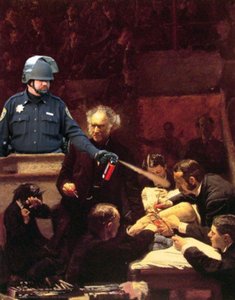
x

 Contemporary Realism
 2010
2010 457.0 x 335.0 cm
لوحة زيتية مرسومة يدوياً على الكانفاس بالمقاس والإطار الذي تفضله، تُنفذ حسب الطلب على أيدي فنانينا. ( اشترِ نسخة مطبوعة اشترِ الصورة)
اختر من بين أحجامنا المُعدّة مسبقًا والتي تتطابق مع النسب الأصلية للعمل الفني.

يمكنك إدخال أبعادك الخاصة لتناسب إطارًا معينًا أو مساحة محددة. وإذا لم يتطابق الحجم الذي اخترته مع نسب الصورة الأصلية، فسنقوم إما بقص العمل الفني أو توسيع اللوحة بإضافة عناصر مرسومة يدويًا. سيتم إرسال نموذج رقمي إليك للموافقة عليه قبل بدء الإنتاج.
يرجى ملاحظة أن المعاينة على الشاشة لا تعكس عملية القص أو التوسيع الفعلية؛ حيث إن النموذج الرقمي وحده هو الذي سيوضح التكوين النهائي بدقة.
وعلى الرغم من توفر أحجام مخصصة، إلا أننا نوصي باختيار أبعاد من القائمة المحددة مسبقًا للحفاظ على النسب الأصلية للعمل الفني.
توصيل عالمي إلى خلال 3 إلى 4 أسابيع بدلاً من المدة المعتادة البالغة 5 أسابيع. (15 أغسطس). جودة لا تهاون فيها.


The Path
مقاس النسخة المطبوعة

To encounter the work of Enrique Martínez Celaya is to step into a space where the boundaries between the empirical and the ethereal dissolve. Born in Havana, Cuba, in 1964, his life has been a series of profound migrations—not merely across geographic borders from Cuba to Spain and Puerto Rico, but across disciplines. Before he was an acclaimed painter and sculptor, Celaya was a man of science, a trained laser physicist who navigated the rigorous, mathematical certainties of Cornell University and the University of California, Berkeley. This scientific foundation remains an invisible architecture within his art; there is a precision in his compositions that suggests the structural integrity of the physical universe, even when he is exploring the most nebulous territories of human emotion.
His creative evolution is a testament to the tension between logic and lyricism. While his early years were marked by the discipline of physics—even patenting several laser devices—the pull of narrative and figurative painting proved irresistible. This transition was not a rejection of science, but rather an expansion of it. In his canvases, the "big gears of nature" meet the "small gears of human experience." He utilizes a technique that often marries meticulous observation with expressive, tactile layers, frequently employing oil, wax, and charcoal to create surfaces that feel as much like geological strata as they do emotional landscapes. His work does not merely depict a scene; it excavates it, pulling themes of memory, exile, and the passage of time from beneath the surface of the pigment.
The imagery in Celaya’s oeuvre often evokes vast, desolate terrains that serve as metaphors for the internal state. His landscapes are rarely just topographical studies; they are psychological maps. Through expansive vistas and symbolic motifs, he explores the exilic imagination—the sense of displacement and the search for authenticity that characterizes much of his work. There is a haunting quality to his compositions, where a single figure or an isolated object might stand against a sweeping sky, embodying the profound solitude of individual consciousness. He approaches themes of loss and attachment not by offering easy resolutions, but by posing existential questions that resonate with a universal vulnerability.
This mastery of symbolism allows him to bridge the gap between the semi-autobiographical and the mythic. In works such as The Puppet or The Fiery Wound, the viewer is invited to contemplate the fragility of existence. His use of color is equally evocative, often employing palettes that feel both ancient and immediate, grounding his philosophical inquiries in a visceral, sensory reality. By blending the precision of his scientific training with the fluidity of contemporary painting, he creates an immersive experience where the viewer is encouraged to linger in the ambiguity of the unknown.
The significance of Enrique Martínez Celaya’s contribution to contemporary art lies in his ability to resist the fragmentation of modern disciplines. He remains a polymath, working seamlessly across painting, sculpture, installation, and even literature as an accomplished author of nine books. His work has achieved immense institutional recognition, finding permanent homes in some of the world's most prestigious collections, including:
As a scholar and educator—serving as the first Provost Professor of Humanities and Arts at the University of Southern California—his influence extends far beyond the studio. He continues to shape the discourse on how art can serve as a vessel for philosophical inquiry, proving that the most profound truths are often found in the delicate intersection of what we can measure and what we can only feel.

1964 - , Cuba


ابقَ على اطلاع بأحدث أخبار الفن، والعروض الحصرية، وأفكار الديكور.
أخبرنا عن مشروعك، وسيقدم لك خبراؤنا الفنيون 3 اقتراحات فنية مخصصة لك.
دعنا نختار لك ٣ خيارات مخصصة تماماً - مجاناً!


 معاينة الحجم الحقيقي
 مشاركة
 مشاركة
 التفاصيل

 تحميل الملف
 قطع مشابهة
 الأشعة السينية
 عرض شرائح
 عرض المزيد




































 خيار الزجاج متاح فقط للمقاسات التي تقل عن 110 سم