


x

 Abstract Expressionism
 1989
1989 220.0 x 364.0 cm
لوحة زيتية مرسومة يدوياً على الكانفاس بالمقاس والإطار الذي تفضله، تُنفذ حسب الطلب على أيدي فنانينا. ( اشترِ نسخة مطبوعة اشترِ الصورة)
اختر من بين أحجامنا المُعدّة مسبقًا والتي تتطابق مع النسب الأصلية للعمل الفني.

يمكنك إدخال أبعادك الخاصة لتناسب إطارًا معينًا أو مساحة محددة. وإذا لم يتطابق الحجم الذي اخترته مع نسب الصورة الأصلية، فسنقوم إما بقص العمل الفني أو توسيع اللوحة بإضافة عناصر مرسومة يدويًا. سيتم إرسال نموذج رقمي إليك للموافقة عليه قبل بدء الإنتاج.
يرجى ملاحظة أن المعاينة على الشاشة لا تعكس عملية القص أو التوسيع الفعلية؛ حيث إن النموذج الرقمي وحده هو الذي سيوضح التكوين النهائي بدقة.
وعلى الرغم من توفر أحجام مخصصة، إلا أننا نوصي باختيار أبعاد من القائمة المحددة مسبقًا للحفاظ على النسب الأصلية للعمل الفني.
توصيل عالمي إلى خلال 3 إلى 4 أسابيع بدلاً من المدة المعتادة البالغة 5 أسابيع. (21 أغسطس). جودة لا تهاون فيها.


Untitled
مقاس النسخة المطبوعة
The story of John Graham is one of profound transformation, a narrative that begins far from the bustling studios of New York, amidst the aristocratic elegance and subsequent political turbulence of Kyiv. Born Ivan Gratianovitch Dombrowsky in 1886, his early years were defined by a classical education and a lineage of privilege that seemed destined for a life of law or diplomacy. Yet, the winds of history had other plans. The seismic shifts of the Russian Revolution and the subsequent Bolshevik seizure of power thrust him into a crucible of conflict, leading to his imprisonment as a counterrevolutionary. This period of upheaval served as a spiritual and artistic catalyst; fleeing the chaos of his homeland, he eventually found refuge in the United States in 1920. It was during this migration that he shed his old identity, adopting the name John Graham—a moniker that would come to represent a bridge between the Old World's traditions and the New World's avant-garde energy.
Graham’s arrival in New York City marked the beginning of an extraordinary artistic awakening. Though he did not begin his formal studies in painting until his thirties, his late start was compensated by a voracious intellectual hunger. He immersed himself in the vibrant, gritty reality of the Ashcan School through the mentorship of John F. Sloan, yet his gaze was perpetually fixed on the horizon of modernism. His journey was not merely one of personal discovery but of cultural synthesis, as he navigated the complexities of Cubism, Surrealism, and Abstract Expressionism, weaving these disparate threads into a cohesive visual language that honored classical structure while embracing modern fragmentation.
Beyond his own canvas, Graham functioned as a vital conduit for the burgeoning New York art scene. He was far more than a solitary painter; he was a collector, a writer, and a philosopher of form. His deep engagement with System Theory and dialectics allowed him to view art not just as an aesthetic pursuit, but as a structured argument—a belief encapsulated in his famous assertion that “an abstract painting is an argument drawn to conclusion.” This intellectual rigor made him a central figure in the development of the New York School. As a mentor and advocate, he provided the scaffolding upon which legends like Jackson Pollock and Willem de Kooning could build their revolutionary styles. He possessed the rare ability to champion the radical unknown while maintaining a profound respect for the masters of the past.
His artistic development was characterized by a fascinating tension between the figurative and the abstract. While he was deeply moved by the expressive potential of modern abstraction, his later works returned to a highly sophisticated figurative style. This period saw him drawing inspiration from classical masters to depict subjects such as Russian soldiers with an intensity that felt both ancient and immediate. His brushwork often carried a palpable emotional weight, utilizing vibrant color palettes and a sense of Baroque drama to navigate the tensions of a modern age. Through his work, the heavy shadows of history met the bright, fractured light of the twentieth century.
The historical significance of John Graham lies in his role as a stabilizer and a provocateur within the whirlwind of mid-century modernism. He did not merely witness the birth of Abstract Expressionism; he helped cultivate the environment that made it possible. His legacy is found in several key areas:
Though he passed away in London in 1961, the echoes of Graham's influence remain embedded in the DNA of modern art. He remains a figure of immense mystery and brilliance—a man who survived revolution only to help orchestrate an artistic revolution of his own.

1886 - 1961 , Russia
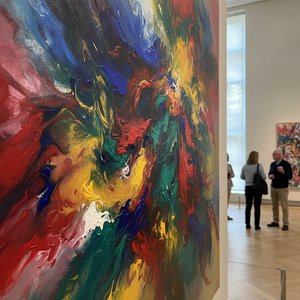
Explore the profound emotional depth of Lyrical Abstraction. Discover how masters like Raymond Parker used color and form to bridge Impressionism and Abstract Expressionism. Learn about this pivotal movement through our expert-led art history guide.

Explore the profound emotional depth of Color Field painting. Discover the history of mid-century abstraction, from Rothko to Newman, and learn how pure color transforms the viewer's experience through our expert art history guide.

Explore the profound history and emotional depth of Abstract Expressionism. From Jackson Pollock to Mark Rothko, master the nuances of the New York School through our expert art history guide. Discover museum-quality hand-painted reproductions for your collection.


ابقَ على اطلاع بأحدث أخبار الفن، والعروض الحصرية، وأفكار الديكور.
أخبرنا عن مشروعك، وسيقدم لك خبراؤنا الفنيون 3 اقتراحات فنية مخصصة لك.
دعنا نختار لك ٣ خيارات مخصصة تماماً - مجاناً!


 معاينة الحجم الحقيقي
 مشاركة
 مشاركة
 التفاصيل

 تحميل الملف
 قطع مشابهة
 الأشعة السينية
 عرض شرائح
 عرض المزيد




































 خيار الزجاج متاح فقط للمقاسات التي تقل عن 110 سم


