x


 Купи картина Купи изображение
 Изпрати
 Детайли
 Добавяне към любими
 Изтегляне
 Подобни
 Рентгенова снимка
 Слайдшоу
 EnamelDecorAbstract Expressionism
 1950Modern
 25.0 x 96.0 cm
Giclée печат или принт върху платно с музейно качество, бързо производство и гъвкави опции за завършен вид.
Изберете от предварително зададените размери, които съответстват на оригиналните пропорции на произведението.

Можете да въведете собствени размери, за да паснат на конкретна рамка или пространство. Ако избраният от Вас размер не съвпада с пропорциите на оригиналното изображение, ние ще изрежем произведението или ще разширим изображението с огледален или едноцветен ръб. Дигитален макет ще бъде изпратен за Ваше одобрение преди започването на производството.
Моля, имайте предвид, че предпрегледът на екрана не отразява реалното изрязване или разширяване. Само макетът ще покаже точно финалната композиция.
Въпреки че са налични персонализирани размери, препоръчваме да изберете размер от предварително дефинирания списък, за да запазите оригиналните пропорции.
Доставка по целия свят () в рамките на 2 седмици вместо стандартните 4/5 седмици. (23 Юли)


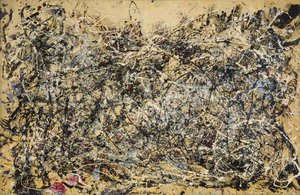
Number 25
Размер на репродукцията
To stand before Number 25 is to confront pure, unmediated action. This canvas does not merely depict an image; it records an event—a moment of intense physical and emotional outpouring from the artist himself. Created in 1950, this work by Paul Jackson Pollock stands as a monumental pillar of Abstract Expressionism, forever altering the trajectory of modern art. It is a testament to the revolutionary spirit of post-war New York, where the very act of painting became as significant as the final product. The viewer is invited not just to look, but to feel the kinetic energy that saturated Pollock’s studio during those formative years.
What immediately arrests the eye is the material choice: an exclusive use of black enamel paint. This was a deliberate departure from his more recognizable drip techniques, lending Number 25 a profound, almost tar-like consistency that dries with a captivating depth. The monochromatic nature of the piece strips away the distraction of color, forcing the focus entirely onto line, texture, and the sheer force of application. It is a study in contrast—the deep void of black against the implied light catching the varied viscosity of the paint. This singular focus elevates the work from mere splattering to a highly controlled, dramatic composition.
Pollock’s signature method, often termed "action painting," involved him moving around and over the canvas, dripping, pouring, and flinging paint with his entire body. In Number 25, this process is visible in every stratum of black enamel. One can trace the paths of flung droplets alongside broader sweeps of material, creating a complex web that suggests both chaos and rigorous structure. The composition possesses an "all-over" quality; there is no discernible focal point, only an immersive field where force meets gravity. This technique transforms the canvas into an arena for performance art.
Beyond its technical brilliance, Number 25 resonates with a deep sense of modern anxiety and liberation. The black enamel can be read as both oppressive weight and ultimate freedom—a visual representation of wrestling with profound existential questions. For the collector or designer, this piece offers an unparalleled emotional anchor for any space. It does not whisper; it declares. Its raw power injects intellectual vigor and dramatic depth into a room, serving as a conversation starter that speaks to the history of artistic rebellion.
Owning a reproduction of Number 25 is acquiring a piece of art history’s most electrifying chapter. The scale, measuring approximately 25 x 96 cm, allows this dense field of action to command attention without overwhelming a space. When considering a hand-painted reproduction, one appreciates the painstaking effort required to capture the varied texture and depth that Pollock achieved so effortlessly in life. It is an investment not just in decoration, but in the enduring narrative of artistic innovation.

1912 - 1956 , Съединени американски щати
Разгледайте топ 25 шедьоври на Василий Кандински – пионер на абстрактното изкуство и експресионизма. Открийте историите зад цветните композиции, техниките и вдъхновението му. Купете висококачествени репродукции на картини Кандински за вашия дом на Most-Famous-Paintings.com!

Разгледайте топ 10 шедьовъра на абстрактния експресионизъм – Полък, Ротко, де Кунинг и други. Открийте историите зад тези емблематични картини и преобразете дома си с изкуство от Most-Famous-Paintings.com! Разгледайте пълната колекция онлайн.
Разгледайте топ 25 шедьовъра на Марк Ротко – емоционални абстрактни живописи, определящи експресионизма. Историята зад всяка картина, техники и цветове. Купете репродукции с музейно качество за вашия дом на Most-Famous-Paintings.com!
Открийте 25 шедьовъра на Джеймс Абът Макнил Уистлър! Разгледайте историите зад неговите емблематични ноктюрни, портрети и импресионистични картини. Вдъхновете се за вашия интериор с висококачествени репродукции на Most-Famous-Paintings.com
Разгледайте топ 25 шедьовъра на Егон Шиле – австрийски експресионизъм, емоционални портрети и завладяващи картини. Вдъхновете се за интериорния дизайн с Most-Famous-Paintings! Разгледайте колекцията онлайн.


Бъдете информирани за последните новини в света на изкуството, ексклузивни оферти и идеи за декорация.
Разкажете ни за вашия проект и нашите експерти по изкуство ще ви предложат 3 персонализирани предложения за произведения на изкуството.
Нека подберем 3 варианта само за вас – безплатно!


 Сподели

 Прочетете повече




































 Стъклото е налично само в размери под 110 см