Продавайте вашата изкуство
Списък с желания Пазарска количка Cart
x
Представи си гоПредстави си го AR прегледAR преглед Купете ръчно рисувана картина Купете ръчно рисувана картинаКупете изображение Купете изображение ИзпратиИзпрати
ДетайлиДетайли Добавяне към любими Добавяне към любими ИзтеглянеИзтегляне ПодобниПодобни Рентгенова снимкаРентгенова снимка СлайдшоуСлайдшоу

The Three Elder Princesses

Admire Thomas Gainsborough's masterpiece 'The Three Elder Princesses,' a stunning portrait capturing the elegance of 18th-century nobility at Hampton Court Palace. Explore its rich texture and masterful depiction of royal femininity.

Томас Гейнсбъроу (1727-1788): Изследвайте елегантните портрети и пейзажите на този британски майстор, основател на Кралската академия и влияние върху Констабле.

Жикле / Художествен принт

Giclée печат или принт върху платно с музейно качество, бързо производство и гъвкави опции за завършен вид. (Купете ръчно рисувана картина Купете ръчно рисувана картинаКупете изображение Купете изображение)

P118B $10
P118H $10
P118W $10
P438Z $10
P508JH $12
P508YH $12
P805H $10
P805Z $10
P919BZ $10
P919G $10
P919XJ $10
P959ZH $10
P968JZ $12
W106C $8
W218G $10
W218JH $8
W218Y $10
W307PJ $10
W316G $10
W316PJ $8
W316Y $10
W398PJ $8
W4111J $10
W500HY $15
W500JH $15
W692G $12
W849H $8
W940BG $15
W953PJ $8

Standard
custom
CM
INCH

Изберете от предварително зададените размери, които съответстват на оригиналните пропорции на произведението.

ширина
височина

Можете да въведете собствени размери, за да паснат на конкретна рамка или пространство. Ако избраният от Вас размер не съвпада с пропорциите на оригиналното изображение, ние ще изрежем произведението или ще разширим изображението с огледален или едноцветен ръб. Дигитален макет ще бъде изпратен за Ваше одобрение преди започването на производството.
Моля, имайте предвид, че предпрегледът на екрана не отразява реалното изрязване или разширяване. Само макетът ще покаже точно финалната композиция.
Въпреки че са налични персонализирани размери, препоръчваме да изберете размер от предварително дефинирания списък, за да запазите оригиналните пропорции.

Доставка по целия свят () в рамките на 2 седмици вместо стандартните 4/5 седмици. (18 Август)

why_choose_icon
Безплатна експресна доставка по целия свят
why_choose_icon
Висококачествено ленено платно
why_choose_icon
Пълно застраховане при доставка
why_choose_icon
Гаранция за възстановяване на митнически такси
why_choose_icon
Гаранция за цветова точност
why_choose_icon
60-Дневен период за връщане (Само при дефекти)
why_choose_icon
100% Гаранция за връщане на парите
why_choose_icon
Предложение за отстъпка при поръчка на едро

Обща цена

$ 68

reproduction

The Three Elder Princesses

Жикле / Художествен принт

Размер на репродукцията

-

Обща цена

$ 68

Бързи факти

  • Medium: Oil on canvas
  • Movement: Neoclassical
  • Artist: Thomas Gainsborough
  • Influences: Rousseau
  • Notable elements or techniques: Detailed portraiture; Luminosity
  • Title: The Three Elder Princesses
  • Artistic style: Elegant realism

Тест за изкуство

Има само един верен отговор за всеки въпрос.

Въпрос 1:
What is the artist responsible for creating?
Въпрос 2:
Where can you find this painting?
Въпрос 3:
What is a prominent feature of the painting's style?
Въпрос 4:
Describe the clothing and hairstyles of the women depicted in 'The Three Elder Princesses'.
Въпрос 5:
Thomas Gainsborough is known for his contribution to which artistic movement?

Описание на колекционерския предмет

A Vision of Royal Grace

In the grand tapestry of eighteenth-century British portraiture, few works capture the delicate intersection of familial affection and royal dignity as exquisitely as Thomas Gainsborough’s The Three Eldest Princesses. Completed in 1784, this masterpiece serves as a luminous window into the heart of the House of Hanover, presenting a meticulously crafted tableau of Princess Charlotte, Princess Augusta, and Princess Elizabeth. As the eldest daughters of King George III and Queen Charlotte, these young women are not merely subjects of a formal commission; they are presented through Gainsborough’s Romantic lens as icons of an idealized, serene nobility. The painting transcends the rigid requirements of a royal group portrait, inviting the viewer into a moment of quiet elegance where the weight of their titles is softened by the gentle light and the tender, almost ethereal, atmosphere that defines the artist's mature style.

The composition is a masterclass in balanced arrangement, guiding the eye through a rhythmic dance of figures and textures. One princess sits with a poised, graceful stillness, while her sisters stand behind her, creating a tiered effect that lends depth and architectural stability to the group. This arrangement allows Gainsborough to showcase his unparalleled ability to render the tactile splendor of 18$th-century aristocratic life. The viewer is immediately captivated by the shimmering luster of pearls draped around their necks and the intricate, voluminous folds of their silk and satin gowns. Each brushstroke contributes to a sense of movement within the stillness, as if the very air around the princesses is infused with the soft, diffused glow characteristic of the sfumato technique.

The Mastery of Light and Texture

To behold this work is to witness Gainsborough at the height of his technical prowess. Eschewing the starker, more clinical lines of the Neoclassical movement, Gainsborough embraced a more fluid and emotive approach. His technique relies on a sophisticated layering process that achieves a breathtaking luminosity. The light does not simply strike the subjects; it seems to emanate from within the canvas itself, catching the delicate edges of lace and the subtle sheen of fine fabric. This mastery of light serves a dual purpose: it highlights the material wealth of the royal subjects while simultaneously imbuing the scene with a dreamlike, Romantic quality that softens the boundaries between reality and idealization.

For the discerning collector or interior designer, the emotional resonance of this piece lies in its ability to command a room through subtlety rather than sheer scale. The palette, though rich, is harmoniously balanced, making it an exquisite centerpiece for spaces that demand sophistication and a touch of historical grandeur. Whether placed in a sunlit gallery or a more intimate study, the painting brings with it an aura of timelessness. It is a work that rewards prolonged contemplation, revealing new nuances in the expressions of the princesses—moments of youthful innocence intertwined with the burgeoning gravity of their royal station. Owning a high-quality reproduction of such a masterpiece allows one to curate an environment steeped in the elegance of the English Golden Age, offering a permanent connection to the sublime beauty of Gainsborough’s vision.


Биография на художника

A Suffolk Beginning: The Early Life and Artistic Awakening

The story of Thomas Gainsborough, one of Britain’s most celebrated artists, unfolds not within the confines of a grand academy or bustling metropolis, but in the tranquil market town of Sudbury, Suffolk. Born in 1727, the youngest son of John Gainsborough, a weaver and wool merchant, young Thomas displayed an innate artistic sensibility from a remarkably early age. While his siblings pursued more conventional paths, Thomas’s world rapidly became consumed by drawing and painting – miniature self-portraits and delicate landscapes blossoming from his hand even before he reached ten years old. This precocious talent wasn't merely a childhood pastime; it was the burgeoning of a vision that would reshape British art. His father, recognizing this unique gift, encouraged its development, setting young Thomas on a path diverging sharply from the family trade. The Suffolk countryside itself became his first studio, imbuing his later works with a deep and abiding love for the natural world – a characteristic that would distinguish him throughout his career. This early immersion in landscape wasn’t simply about replicating what he saw; it was about *feeling* the essence of the English countryside, an emotional resonance that would permeate his canvases for decades to come.

London and the Shaping of a Style: Influences and Early Commissions

In 1740, at the age of thirteen, Gainsborough journeyed to London, embarking on formal artistic training under Hubert Gravelot, a French engraver renowned for his elegant rococo style. This exposure proved pivotal, introducing him to refined techniques and fashionable aesthetics. However, it was his association with William Hogarth and the St Martin’s Lane Academy that truly began to mold his artistic identity. Initially influenced by Hogarth's narrative approach – his detailed depictions of London life and social commentary – Gainsborough soon charted his own course, developing a distinctive style characterized by its lightness of touch, fluid brushwork, and subtle color palettes. He absorbed lessons from various masters, yet resisted strict adherence to any single school, forging a path that blended observation with imagination. He studied the works of Old Masters like Rembrandt and Rubens, but ultimately developed his own unique approach, prioritizing atmosphere and feeling over meticulous detail. Returning to Sudbury after marrying Margaret Burr in 1746, Gainsborough established himself as a portraitist for the local gentry. This period honed his skills in capturing likenesses and character, but it was during his subsequent move to Ipswich, and later Bath, that he began attracting a more sophisticated clientele – individuals who appreciated not just accurate representation, but also artistic flair and emotional depth.

Bath and Beyond: Portraiture, Landscape, and Royal Patronage

The years spent in Bath (1759-1774) marked a significant turning point in Gainsborough’s career. The city was a hub of fashionable society, providing him with ample opportunities to paint portraits of the wealthy and influential. He quickly gained renown for his ability to capture not only physical resemblance but also the personality and social standing of his sitters. His portraits weren't merely depictions; they were statements about identity and status. He skillfully employed light and shadow to create a sense of depth and drama, capturing the nuances of human expression with remarkable sensitivity. However, even amidst the demands of portraiture, Gainsborough never abandoned his passion for landscape painting. In fact, he often seamlessly integrated landscapes into his portraits, creating compositions that celebrated both human subjects and the beauty of the natural world. This innovative approach – a hallmark of his style – set him apart from many of his contemporaries. He experimented with loose brushstrokes and atmospheric effects, capturing the fleeting qualities of light and weather. The culmination of his success came with his move to London in 1774, where he established a studio on Pall Mall and became a founding member of the Royal Academy. He also secured royal patronage, becoming a favorite painter of King George III and Queen Charlotte, further solidifying his position as one of Britain’s leading artists. *Mrs. Thomas Gainsborough*, painted in 1785, exemplifies this period – an elegant portrait showcasing rococo style and muted tones.

A Legacy of Innovation: Enduring Appeal and Influence

Thomas Gainsborough died in 1788, leaving behind a body of work that continues to captivate audiences today. His influence on subsequent generations of British artists is undeniable. He liberated portraiture from rigid formality, infusing it with spontaneity and emotional resonance. His loose brushwork and atmospheric effects paved the way for the Impressionists, while his lyrical landscapes inspired artists like John Constable, who deeply admired Gainsborough’s ability to capture the spirit of the English countryside. Gainsborough's legacy extends beyond technique; it lies in his profound understanding of human character and his unwavering commitment to artistic expression. He wasn’t simply a painter of portraits or landscapes; he was a storyteller, a poet of light and color, and a visionary who transformed British art. His paintings are a testament to the power of observation, imagination, and the enduring allure of the English landscape.

Exploring Gainsborough's World Today

Fortunately, the opportunity to experience Gainsborough’s genius firsthand remains readily available. Gainsborough’s House, in his birthplace of Sudbury, stands as a testament to his life and work, offering visitors an intimate glimpse into his early influences and artistic development. Christchurch Mansion in Ipswich houses a significant collection of Gainsborough paintings alongside works by Constable and other masters. Numerous museums across the United Kingdom and internationally display his masterpieces, including the National Gallery in London and the Metropolitan Museum of Art in New York. His work continues to be studied, analyzed, and celebrated, ensuring that his artistic vision will endure for generations to come. The enduring appeal of Gainsborough’s art lies not only in its technical brilliance but also in its timeless beauty and emotional depth – qualities that resonate with viewers across centuries.
Томас Гейнсбъроу

Томас Гейнсбъроу

1727 - 1788 , Великобритания

Бързи факти

  • Artistic Movement Or Style: Рококо, Портрети
  • Artists Or Movements Influenced By This Artist: ['Йон Констебл']
  • Artists Who Influenced This Artist:
    • Хуберт Гравелот
    • Уилям Хогар
  • Date Of Birth: 1727
  • Date Of Death: 1788
  • Full Name: Thomas Gainsborough
  • Nationality: Британски
  • Notable Artworks:
    • Г-жа Гейнсбъроу
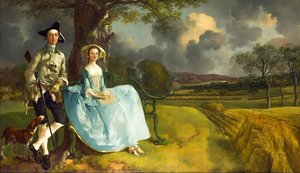
    • Мистър и г-жа Андрюс
  • Place Of Birth (City And Country): Судебри, Великобритания
Разгледайте произведения на изкуството, организирани по теми, стилове и характеристики.