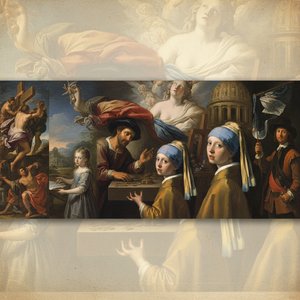
Jean-Baptiste-Simeon Chardin: A Master of Quiet Observation
Jean-Baptiste-Simeon Chardin, a name synonymous with understated elegance and profound realism, remains one of the most beloved figures in French art. Born in the heart of Paris’s Saint-Germain-des-Prés district in 1699, his life was a testament to the power of dedication and a quiet rebellion against familial expectations. Initially destined for his father's cabinetmaking workshop – a profession steeped in tradition – Chardin’s true passion lay within the realm of art, a pursuit he fiercely championed despite considerable resistance. This early conflict shaped his artistic vision, imbuing his work with a unique sensitivity to the ordinary and a profound appreciation for the subtle beauty found in everyday life.
Chardin's training was somewhat unconventional, lacking the formal structure typically associated with aspiring artists of the era. He initially apprenticed under Pierre-Jacques Cazes, a history painter, followed by Noël-Nicolas Coypel, another influential figure in Parisian art circles. However, it was through his connection to Nicolas de Largillière, a master known for his portraits and whose discerning eye recognized Chardin’s exceptional talent, that he truly began to establish himself within the artistic community. Largillière's patronage proved pivotal, granting Chardin entry into the Royal Academy of Painting in 1724 – a significant achievement that marked the beginning of his professional career.
The Language of Still Life and Genre
Chardin’s artistic legacy rests primarily on two distinct yet interconnected genres: still life and genre painting. He is celebrated for his intimate and remarkably realistic depictions of inanimate objects—buffets laden with food, skateboards resting on tables, musical instruments, and everyday utensils. These seemingly simple subjects are rendered with an extraordinary level of detail, capturing not just their physical appearance but also the play of light and shadow, the texture of surfaces, and the inherent dignity of each object. His still lifes transcend mere representation; they evoke a sense of quiet contemplation and invite viewers to appreciate the beauty in the mundane.
Simultaneously, Chardin excelled at genre scenes—paintings that captured moments from ordinary domestic life. These works often feature small groups of figures engaged in simple activities: a woman sealing a letter, children playing, or a family gathered around a table. Unlike the grand narratives and dramatic compositions favored by many of his contemporaries, Chardin’s genre paintings are characterized by their restraint, intimacy, and lack of sentimentality. He eschewed theatricality, focusing instead on capturing the quiet dignity and inherent humanity of his subjects. His ability to convey emotion through subtle gestures and expressions is a hallmark of his genius.
Influences and Artistic Style
Chardin’s artistic style was profoundly influenced by several sources. The Dutch masters—particularly their meticulous attention to detail, masterful use of light, and focus on everyday subjects—served as a crucial model. He also drew inspiration from the Flemish painters, known for their luminous color palettes and ability to create a sense of depth and atmosphere. However, Chardin’s work is distinctively French, characterized by its refined elegance, understated emotion, and remarkable sensitivity to texture and form.
A key element of Chardin's technique was his deliberate slowness and meticulousness in the painting process. He often worked on multiple versions of a single composition, refining each iteration with painstaking care. This dedication to detail is evident in every brushstroke, contributing to the remarkable realism and depth of his paintings. Furthermore, Chardin’s masterful manipulation of light—a technique he learned from observing Dutch masters—is central to his aesthetic. He used subtle gradations of tone to create a sense of volume and atmosphere, transforming ordinary scenes into moments of quiet beauty.
A Legacy of Quiet Dignity
Jean-Baptiste-Simeon Chardin’s career spanned nearly five decades, during which he established himself as one of the most respected and admired artists in France. He held various positions within the Royal Academy, including treasurer for almost twenty years, a testament to his integrity and influence. Despite personal tragedies—the loss of his wife and children—he continued to create works that reflected his unwavering commitment to his art.
Chardin’s impact on subsequent generations of artists is undeniable. His emphasis on realism, his sensitivity to light and texture, and his ability to capture the essence of ordinary life paved the way for Impressionism and other modern artistic movements. Today, Chardin's paintings are celebrated for their quiet dignity, profound beauty, and enduring appeal. They offer a timeless reminder that art can be found not only in grand gestures but also in the simple moments of everyday existence—a lesson that continues to resonate with viewers centuries after his death in 1779.