


x

 Akryl på lærredVægkunstBaroque Illusionisme
 1630
1630 34.0 x 27.0 cm
 Szépművészeti Múzeum
Håndmalet olie på lærred i din valgte størrelse og ramme, udført efter bestilling af vores kunstnere. ( Skift til print Skift til billede)





























Vælg mellem vores forudindstillede størrelser, der matcher kunstværkets originale proportioner.

Du kan indtaste dine egne mål for at passe til en bestemt ramme eller plads. Hvis den valgte størrelse ikke stemmer overens med det originale billedes proportioner, vil vi enten beskære kunstværket eller udvide maleriet med yderligere håndmalede elementer. En digital skitse sendes til din godkendelse, før produktionen påbegyndes.
Bemærk venligst, at forhåndsvisningen på skærmen ikke afspejler den faktiske beskæring eller udvidelse. Kun skitsen vil nøjagtigt vise den endelige komposition.
Selvom specialmål er mulige, anbefaler vi at vælge en dimension fra den foruddefinerede liste for at bevare de originale proportioner.
Levering i hele verden () på 3/4 uger i stedet for de standard 5 uger. (7 august). Ingen kompromiser med kvaliteten.


Jagt ved lyset
Størrelse på reproduktion

Gerrit Dou (1613-1675), a name perhaps less familiar than Rembrandt’s or Vermeer’s, nevertheless stands as one of the most remarkable and profoundly influential artists of the Dutch Golden Age. Born in Leiden, a city renowned for its artistic vibrancy, Dou’s career unfolded within a period of immense creative ferment, shaped by the legacy of Rembrandt but ultimately forging his own distinctive path – a path characterized by an extraordinary command of illusionism, meticulous detail, and a subtle mastery of light and shadow that continues to captivate viewers today. His life, though relatively short, was marked by both artistic apprenticeship and independent innovation, solidifying his place as a true master of his time.
Gerrit Dou’s early life was deeply intertwined with the burgeoning art scene of Leiden. Born into a family involved in glassmaking – his father, Douwe Jansz de Vries van Arentsvelt, was a glazier – he displayed an early aptitude for visual arts, a passion nurtured by his father's encouragement and later formally recognized through apprenticeships. Initially, he studied under Bartholomeus Dolendo, an engraver, followed by Pieter Couwenhorn, a glass painter, both seeking to hone the skills necessary for creating intricate surfaces. Crucially, in 1628, at just fifteen years old, Dou entered the workshop of Rembrandt van Rijn, then a young and ambitious artist establishing his reputation in Leiden. This formative period proved pivotal; while he absorbed many of Rembrandt’s techniques – particularly his use of chiaroscuro and dramatic lighting – Dou quickly distinguished himself through an exceptional ability to render textures and create convincing illusions.
What truly set Gerrit Dou apart was his extraordinary skill in creating *trompe-l'oeil* – literally “fool the eye” – images. Unlike many artists who relied on straightforward representation, Dou employed a complex layering of techniques to generate an illusion of depth and three-dimensionality on a flat surface. He achieved this through meticulous attention to detail, using subtle variations in color, texture, and light to mimic the appearance of real objects. This wasn’t merely about creating realistic depictions; it was about constructing entirely new visual realities.
Dou’s subject matter reflected the tastes of his time, encompassing portraits, genre scenes depicting everyday life, and meticulously rendered still lifes. However, he approached these subjects with a distinctive sensibility, imbuing them with an air of quiet contemplation and psychological depth. His portraits are not merely likenesses; they capture subtle nuances of character and emotion. Similarly, his still lifes—often featuring humble objects like fruit or household items—are imbued with a sense of atmosphere and narrative, suggesting stories beyond the immediate visual representation.
Despite his considerable talent and the admiration of his contemporaries, Gerrit Dou’s reputation suffered a decline after his death in 1675. His meticulous technique and preference for subtlety were not always appreciated by audiences accustomed to more dramatic or overtly theatrical styles. However, in the late 19th century, a renewed interest in Dutch art led to a reassessment of Dou’s work, revealing its profound artistic merit and innovative techniques. Today, Gerrit Dou is recognized as one of the most important artists of the Dutch Golden Age, a master of illusionism whose subtle yet powerful works continue to fascinate and inspire.
His influence can be seen in later generations of painters, particularly those who explored the possibilities of creating realistic illusions on canvas. Gerrit Dou’s legacy lies not only in his individual masterpieces but also in his pioneering spirit—his willingness to challenge conventional artistic practices and forge a unique path that continues to resonate with viewers centuries after his death.

1613 - 1642 , Netherlands
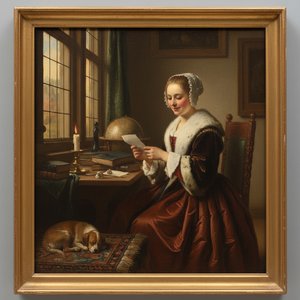
Explore the exquisite world of Gerrit Dou, a master of Dutch Golden Age painting. Discover his intimate genre scenes, signature use of light, and lasting legacy. Learn about collecting Dou's works & their value.
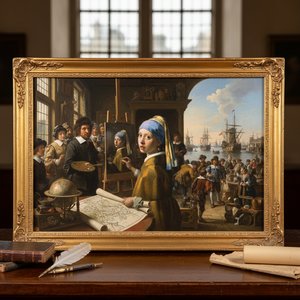
Explore the Dutch Golden Age of painting! Discover key artists like Vermeer & ter Borch, their innovative techniques, and the rich cultural context behind these Baroque masterpieces. Learn about collecting & appreciating this iconic art period.

Oplev de 10 mest ikoniske værker fra den hollandske guldalder! Rembrandt, Vermeer og andre mestre afsløres. Find inspiration til dit hjem & køb museumskvalitets kunsttryk på Most-Famous-Paintings.com.

Explore the Dutch Golden Age of painting (1600-1700) with Most-Famous-Paintings. Discover Rembrandt, Vermeer & other masters. Learn about techniques, history & find museum-quality reproductions.

Explore the Dutch Golden Age of painting with Most-Famous-Paintings. Discover Rembrandt, Vermeer & other Masters. Learn about key characteristics, iconic artworks, and lasting influence. Expert insights for collectors & enthusiasts.


Hold dig opdateret med de seneste kunstnyheder, eksklusive tilbud og indretningsideer.
Fortæl os om dit projekt, og vores kunsteksperter vil give dig 3 personlige kunstforslag.
Vi kuraterer 3 valgmuligheder kun til dig – Gratis!


 Se i fuld skala
 Del
Del Del
Del
 Detaljer

 Download
 Lignende værker
 Røntgenundersøgelse
 Diasshow
 Se mere







 Glasmulighed er kun tilgængelig i størrelser under 110 cm


