x

Håndmalet olie på lærred i din valgte størrelse og ramme, udført efter bestilling af vores kunstnere. ( Køb print Køb billede)





























Vælg mellem vores forudindstillede størrelser, der matcher kunstværkets originale proportioner.

Du kan indtaste dine egne mål for at passe til en bestemt ramme eller plads. Hvis den valgte størrelse ikke stemmer overens med det originale billedes proportioner, vil vi enten beskære kunstværket eller udvide maleriet med yderligere håndmalede elementer. En digital skitse sendes til din godkendelse, før produktionen påbegyndes.
Bemærk venligst, at forhåndsvisningen på skærmen ikke afspejler den faktiske beskæring eller udvidelse. Kun skitsen vil nøjagtigt vise den endelige komposition.
Selvom specialmål er mulige, anbefaler vi at vælge en dimension fra den foruddefinerede liste for at bevare de originale proportioner.
Levering i hele verden () på 3/4 uger i stedet for de standard 5 uger. (14 august). Ingen kompromiser med kvaliteten.


Lighthouse HIll
Størrelse på reproduktion
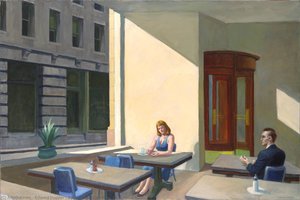
Edward Hopper's "Lighthouse Hill," painted in 1927, isn’t merely a depiction of a coastal scene; it’s a distilled essence of American loneliness and the quiet contemplation inherent within the vastness of the landscape. This work, rendered with Hopper’s signature meticulous realism and an almost unnerving stillness, invites us to consider the solitary figures—both human and architectural—that populate his canvases. The painting immediately establishes a mood of profound introspection; the clear blue sky, devoid of clouds, feels expansive yet somehow isolating, mirroring the emotional distance within the scene.
Hopper’s technique is remarkably precise, reflecting his rigorous training under William Merritt Chase. He masterfully employs light and shadow to sculpt form, creating a sense of depth that draws the viewer into the composition. Note the subtle gradations in color – the muted greens and browns of the hillside contrasting with the vibrant blue of the sky – all contributing to an atmosphere of understated drama. The brushstrokes are controlled and deliberate, avoiding any hint of looseness or spontaneity; this reflects a deep understanding of how light interacts with surfaces and how to translate that onto canvas.
At the heart of “Lighthouse Hill” lies its architectural elements: the lighthouse itself, a sentinel standing proudly against the horizon, and the two modest houses nestled within the landscape. The lighthouse, a symbol of guidance and safety, ironically becomes a representation of isolation. It stands alone, offering no immediate connection to the viewer or the surrounding world. The placement of these structures—one closer to the left, the other more centrally positioned—suggests a deliberate arrangement, perhaps hinting at a narrative of separation or a longing for connection. The houses, small and unassuming, speak to a quiet domesticity, yet their distance from each other reinforces the theme of solitude.
The choice of a lighthouse as a subject is particularly resonant within Hopper’s oeuvre. He frequently used lighthouses to explore themes of isolation, longing, and the human condition against the backdrop of nature's indifference. It’s a motif that speaks powerfully to the American experience – the frontier spirit tempered by the realization of vastness and the potential for loneliness.
1927 was a pivotal year in Hopper’s artistic development, marking a shift towards greater independence and a more personal style. Following his initial training with Chase and Henri, he began to develop his own unique vision—one characterized by an acute awareness of urban life and the psychological states of its inhabitants. “Lighthouse Hill” exemplifies this emerging sensibility; it's less about documenting a specific location and more about capturing a feeling, a mood – that pervasive sense of quiet melancholy that would become a hallmark of Hopper’s work.
The painting also reflects the broader cultural anxieties of the post-World War I era. The rapid industrialization and urbanization of America had led to a growing sense of alienation and displacement. Hopper's art, including “Lighthouse Hill,” resonated with this sentiment, offering a poignant reflection on the challenges of navigating modern life.
Most-Famous-Paintings offers meticulously crafted hand-painted reproductions of Edward Hopper’s "Lighthouse Hill," ensuring that the artist's nuanced vision is faithfully preserved. These reproductions capture not only the visual details but also the emotional depth and atmospheric quality of the original painting. Whether adorning a contemporary living space or serving as a thoughtful addition to an art collection, this image evokes a powerful sense of contemplation and invites viewers to consider their own relationship with solitude and the beauty of the natural world. The scale and detail of our reproductions allow you to experience the subtle nuances of Hopper’s technique – the careful layering of paint, the masterful use of light – as if standing before the original masterpiece itself.


1931 - 1967 , USA

Explore the ethereal beauty of Luminism. Discover how 19th-century American masters captured light and atmosphere through profound landscape painting. Learn about this iconic movement and find museum-quality, hand-painted oil reproductions to bring historical brilliance to your home.


Hold dig opdateret med de seneste kunstnyheder, eksklusive tilbud og indretningsideer.
Fortæl os om dit projekt, og vores kunsteksperter vil give dig 3 personlige kunstforslag.
Vi kuraterer 3 valgmuligheder kun til dig – Gratis!


 Se i fuld skala
 Del
Del Del
Del
 Detaljer

 Download
 Lignende værker
 Røntgenundersøgelse
 Diasshow


 Se mere







 Glasmulighed er kun tilgængelig i størrelser under 110 cm