


x

Giclée- eller lærredstryk i museumskvalitet med hurtig produktion og fleksible muligheder for finish. ( Køb håndlavet maleri Køb billede)





























Vælg mellem vores forudindstillede størrelser, der matcher kunstværkets originale proportioner.

Du kan indtaste dine egne mål for at passe til en specifik ramme eller et bestemt område. Hvis den valgte størrelse ikke stemmer overens med det originale billedes proportioner, vil vi enten beskære kunstværket eller udvide billedet med en spejlet eller ensfarvet kant. En digital mockup vil blive sendt til din godkendelse, før produktionen påbegyndes.
Bemærk venligst, at forhåndsvisningen på skærmen ikke afspejler den faktiske beskæring eller udvidelse. Kun mockuppen vil nøjagtigt vise den endelige komposition.
Selvom specialmål er tilgængelige, anbefaler vi at vælge et mål fra den foruddefinerede liste for at bevare de originale proportioner.
Verdensomspændende levering () på 2 uger i stedet for de sædvanlige 4/5 uger. (22 august)


Stepsin Paris
Størrelse på reproduktion
Edward Hopper’s "Steps in Paris," painted in 1906, is far more than a mere depiction of an architectural element; it is a masterful distillation of the anxieties and aspirations inherent in the early 20th-century consciousness. Executed in oil on wood—a medium favored by the artist for its unique ability to capture subtle tonal variations—the painting embodies a signature style where stark realism is infused with an almost palpable sense of solitude. Upon first encounter, the viewer is drawn into a meticulously crafted scene, dominated by muted, earthy hues and punctuated by the assertive red railing that bisects the composition diagonally, acting as both a visual guide and a sharp emotional accent.
The staircase itself serves as a profound visual anchor, guiding the eye upward through the frame while simultaneously emphasizing the heavy emptiness surrounding it. Hopper utilizes light—emanating from an unseen source—to sculpt the forms within the painting, highlighting the contours of the stone steps and casting long, melancholic shadows that deepen the sense of stillness. The presence of two figures adds a layer of narrative tension: a man positioned near the top gazing out of a window, representing an individual adrift in the bustling city, and another figure descending the stairs, offering a fleeting glimpse of companionship that is ultimately overshadowed by the pervasive atmosphere of isolation.
Hopper’s technical prowess is evident in his precise brushstrokes and careful blending, which create textures that feel both tactile and luminous. While the painting leans into the traditions of New Realism, it transcends simple documentation through its atmospheric suggestion. The palette, dominated by browns, grays, and the striking red of the railing, contributes to an overall mood of quiet contemplation. This careful manipulation of color and light allows the artwork to function as a window into a psychological landscape, where the physical structure of the Parisian stairs becomes a metaphor for the transitions and thresholds of human life.
For the discerning collector or interior designer, this piece offers a sophisticated focal point that brings a sense of timelessness and intellectual depth to any space. The composition’s balance between movement—suggested by the diagonal railing and the descending figure—and profound stillness makes it an ideal selection for environments seeking to evoke introspection. Whether placed in a modern gallery setting or a classic study, "Steps in Paris" commands attention through its ability to tell a story without words, inviting viewers to linger within its shadows and find beauty in the quiet moments of urban existence.


1931 - 1967 , USA
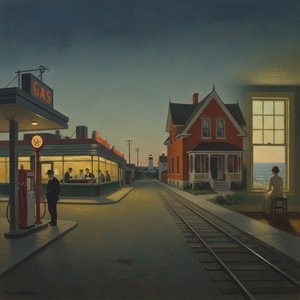
Oplev Edward Hoppers 25 mest ikoniske malerier! Dyk ned i amerikansk realisme, ensomme motiver og stemningsfulde bylandskaber. Find inspiration & køb museumskvalitets kunsttryk på Most-Famous-Paintings.com.
Oplev de 10 mest ikoniske værker inden for amerikansk realisme! Fra Edward Hopper til Andrew Wyeth – lær historierne bag mesterværkerne og find inspiration til dit hjem. Køb museumskvalitets reproduktioner på Most-Famous-Paintings.com.

Explore the profound beauty of American Realism. From the Ashcan School's urban grit to intimate portraits, discover how artists captured the authentic soul of a nation through unvarnished truth and masterful observation.

Explore the powerful social commentary & artistic representation of American Realism. Discover key artists like Bellows & Sloan, and understand the movement's lasting impact on 20th-century art history.

Explore the life & legacy of Robert Henri, a pivotal figure in American Realism. Discover his captivating portraits, influence on the Ashcan School, and enduring impact on art history. Learn more at Most-Famous-Paintings.


Hold dig opdateret med de seneste kunstnyheder, eksklusive tilbud og indretningsideer.
Fortæl os om dit projekt, og vores kunsteksperter vil give dig 3 personlige kunstforslag.
Vi kuraterer 3 valgmuligheder kun til dig – Gratis!


 Se i fuld skala
 Del
Del Del
Del
 Detaljer

 Download
 Lignende værker
 Røntgenundersøgelse
 Diasshow

 Se mere







 Glasmulighed er kun tilgængelig i størrelser under 110 cm


