


x


 Preview
 Bestil tryk Køb højopløseligt billede
 Del
Del
 Detaljer
 Tilføj til favoritter
 Download
 Lignende værker
 Røntgenundersøgelse
 Diasshow
Håndmalet olie på lærred i din valgte størrelse og ramme, udført efter bestilling af vores kunstnere.





























Vælg mellem vores forudindstillede størrelser, der matcher kunstværkets originale proportioner.

Du kan indtaste dine egne mål for at passe til en bestemt ramme eller plads. Hvis den valgte størrelse ikke stemmer overens med det originale billedes proportioner, vil vi enten beskære kunstværket eller udvide maleriet med yderligere håndmalede elementer. En digital skitse sendes til din godkendelse, før produktionen påbegyndes.
Bemærk venligst, at forhåndsvisningen på skærmen ikke afspejler den faktiske beskæring eller udvidelse. Kun skitsen vil nøjagtigt vise den endelige komposition.
Selvom specialmål er mulige, anbefaler vi at vælge en dimension fra den foruddefinerede liste for at bevare de originale proportioner.
Levering i hele verden () på 3/4 uger i stedet for de standard 5 uger. (25 juli). Ingen kompromiser med kvaliteten.


The green tree
Størrelse på reproduktion
Fernand Léger’s “The Green Tree,” painted in 1932, stands as a cornerstone of Tubism—a radical departure from Cubism that solidified Léger's position as one of the foremost champions of machine age aesthetics. More than just a depiction of foliage, this artwork embodies Léger’s profound conviction that art could capture not merely what is seen but also what *feels* like – the pulsating energy and geometric precision inherent in industrial processes.
Léger initially honed his skills in architecture before gravitating towards painting around 1900, immersing himself in Parisian artistic circles. Unlike many of his contemporaries who sought refuge in abstraction as a reaction to representational art, Léger actively embraced it as a tool for conveying the dynamism and structural logic of the burgeoning industrial landscape. This fascination stemmed from his formative years spent laboring on farms in Normandy—a stark contrast that fueled his desire to translate the physicality of rural life into visual terms.
Tubism, developed alongside Picasso, represents Léger’s most distinctive contribution to Cubist innovation. Rejecting the fragmentation characteristic of traditional Cubism, Tubism prioritized simplified geometric forms – circles, squares, and triangles – arranged in overlapping planes that suggested movement and vibration. Léger famously declared that he wished to “paint like a machine,” aiming to distill the essence of industrial production into an aesthetically compelling visual language.
“The Green Tree” exemplifies this Tubist ethos with remarkable clarity. The dominant green hue isn’t merely descriptive; it pulsates with implied energy, mirroring the rhythmic repetition of leaf shapes and branches. The central yellow circle acts as a focal point, disrupting the geometric grid and injecting warmth into the composition—a subtle nod to the incandescent glow of factory lamps.
Beyond its formal brilliance, “The Green Tree” carries symbolic weight. Léger’s deliberate simplification of natural forms speaks to his belief that art could transcend mere imitation, capturing underlying principles of order and rhythm. The tree itself symbolizes resilience and growth—themes resonant with the optimistic spirit of the era, as humanity navigated the transformative challenges posed by industrial expansion.
The painting resides in the Kunstmuseum Den Haag’s collection (Object Number: 0335238), a testament to Léger's enduring influence on artistic thought. Its vibrant colors and striking geometric forms continue to inspire interior designers and collectors alike, securing its place as an iconic masterpiece of modern art.
Further research can be found at AKG Images and Gandalf’s Gallery.
Kunstmuseum Den Haag – Long Term Loan Private Collection offers detailed information about the artwork's provenance and artistic significance.

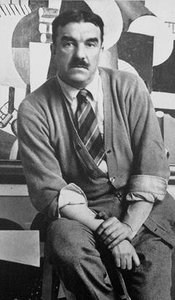
1881 - 1955 , Frankrig

Explore Orphism, the vibrant abstract art movement pioneered by Robert & Sonia Delaunay. Discover its unique color theory, lasting influence on modern art, and how to bring this 'symphony of color' into your home with Most-Famous-Paintings.
Oplev cubismens 10 mest ikoniske værker! Fra Picassos banebrydende stil til Braques innovative teknik. Lær historien bag mesterværkerne og find inspiration til din boligindretning med Most-Famous-Paintings.dk – køb kunst online i museumskvalitet.

Udforsk integrationen af kubistisk kunst i moderne villaarkitektur. Få ekspertråd om design, farver, materialer og juridiske aspekter. Skab unikke rum med stil & værdi.

Explore the evolution of geometric abstraction from Cubism to contemporary art. Discover key artists like Malevich & Mondrian, investment insights, and expert collecting advice at Most-Famous-Paintings.
Oplev de 10 mest ikoniske værker inden for geometrisk abstraktion! Fra Kandinsky til Mondrian – lær historierne bag disse banebrydende kunstnere og deres farverige malerier. Find museumskvalitets reproduktioner & inspiration til din indretning på Most-Famous-Paintings.dk.


Hold dig opdateret med de seneste kunstnyheder, eksklusive tilbud og indretningsideer.
Fortæl os om dit projekt, og vores kunsteksperter vil give dig 3 personlige kunstforslag.
Vi kuraterer 3 valgmuligheder kun til dig – Gratis!


 Del
Del


 Se mere







 Glasmulighed er kun tilgængelig i størrelser under 110 cm


