x


 Preview
 Bestil maleri Køb højopløseligt billede
 Del
Del
 Detaljer
 Tilføj til favoritter
 Download
 Lignende værker
 Røntgenundersøgelse
 Diasshow
 Oil On CanvasWallArtSymbolist Movement
 1850
1850 41.0 x 32.0 cm
Giclée- eller lærredstryk i museumskvalitet med hurtig produktion og fleksible muligheder for finish.





























Vælg mellem vores forudindstillede størrelser, der matcher kunstværkets originale proportioner.

Du kan indtaste dine egne mål for at passe til en specifik ramme eller et bestemt område. Hvis den valgte størrelse ikke stemmer overens med det originale billedes proportioner, vil vi enten beskære kunstværket eller udvide billedet med en spejlet eller ensfarvet kant. En digital mockup vil blive sendt til din godkendelse, før produktionen påbegyndes.
Bemærk venligst, at forhåndsvisningen på skærmen ikke afspejler den faktiske beskæring eller udvidelse. Kun mockuppen vil nøjagtigt vise den endelige komposition.
Selvom specialmål er tilgængelige, anbefaler vi at vælge et mål fra den foruddefinerede liste for at bevare de originale proportioner.
Verdensomspændende levering () på 2 uger i stedet for de sædvanlige 4/5 uger. (27 juli)


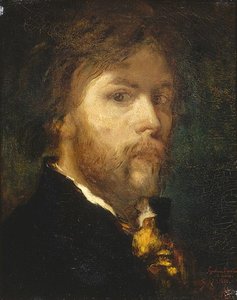
Self-Portrait
Størrelse på reproduktion
Gustave Moreau's "Self-Portrait," painted in 1850, isn’t merely a depiction of an artist; it’s a profound meditation on the human condition, rendered with the meticulous detail and evocative symbolism that would come to define his enduring legacy. This oil on canvas, measuring a modest 41 x 32 cm, currently resides within the Musée National Gustave-Moreau in Paris—a fitting home for a work so deeply rooted in introspection and artistic exploration. Moreau, a pivotal figure bridging the Romanticism of his predecessors with the nascent Symbolist movement, invites us into a world where reality is filtered through layers of dream, myth, and personal feeling.
The painting immediately establishes an atmosphere of quiet intensity. Moreau himself appears framed within a richly textured interior, reminiscent of a dimly lit study or perhaps a scholar’s chamber. His long hair, cascading down his shoulders, and the carefully groomed beard suggest a deliberate cultivation of intellectualism and a connection to the past. The black suit, a formal garment signifying status and discipline, is unexpectedly offset by a vibrant yellow tie—a bold splash of color that hints at hidden passions and perhaps even a touch of rebellion against conventional norms. His direct gaze, unwavering and almost challenging, compels the viewer to confront not just an image, but a presence.
Moreau’s artistic approach was fundamentally rooted in symbolism—a deliberate rejection of the objective representation favored by earlier movements. He wasn't interested in simply *showing* something; he sought to *evoke* it through carefully chosen details and layered meanings. The setting itself is laden with symbolic weight. The architectural elements, though vaguely reminiscent of classical structures, possess an unsettling quality—they seem both familiar and subtly distorted, reflecting the artist’s own internal landscape. Moreau frequently drew inspiration from mythology, religion, and folklore, weaving these narratives into his work to explore universal themes of love, loss, beauty, and mortality.
The yellow tie, a recurring motif in Moreau's oeuvre, is particularly significant. It represents not just color but also illumination, knowledge, and even the divine—a subtle nod to the artist’s own pursuit of spiritual understanding through his art. The overall composition feels deliberately unbalanced, creating a sense of unease and inviting the viewer to actively engage with the painting’s enigmatic narrative.
Moreau's technique is characterized by its meticulous detail and rich color palette. He employed a glazing method—applying thin layers of paint that build up depth and luminosity over time—to create an almost velvety surface. This painstaking process reflects his commitment to capturing not just the appearance but also the *essence* of his subjects. Painted in 1850, this work represents a crucial moment in Moreau’s artistic development, as he was beginning to establish his unique style and explore the possibilities of Symbolist imagery.
The painting emerged during a period of significant social and intellectual upheaval—the mid-19th century. The rise of industrialization, coupled with growing anxieties about modernity, fueled a desire for escape into realms of imagination and spirituality. Moreau’s work perfectly captured this mood, offering a refuge from the harsh realities of the world through the beauty and mystery of his symbolic visions. He was a key figure in fostering an environment where art could be more than just representation; it could become a vehicle for exploring the deepest recesses of the human psyche.
Most-Famous-Paintings offers exquisite, hand-painted reproductions of Gustave Moreau's "Self-Portrait," allowing you to experience the depth and complexity of this iconic work in your own space. These meticulously crafted reproductions capture not only the visual details but also the emotional resonance of the original painting. Whether you’re an art collector, a design enthusiast, or simply someone seeking a piece that speaks to the soul, a Most-Famous-Paintings reproduction of Moreau's "Self-Portrait" is a timeless addition to any collection. Discover more and order your high-quality reproduction at Most-Famous-Paintings.com

1826 - 1898 , Frankrig
Oplev Gustav Klimts 25 mest ikoniske værker! Fordyb dig i symbolisme, jugendstil og den gyldne periodes skønhed. Find inspiration til din indretning & køb luksus kunst reproduktioner på Most-Famous-Paintings.com.

Oplev de 25 mest ikoniske kunstværker fra Metropolitan Museum of Art i New York! Fra Monet til Van Gogh – lær historierne bag mesterværkerne og find inspiration til dit hjem. Køb museumskvalitets reproduktioner på Most-Famous-Paintings.com.

Oplev portrætmaleriets storhed! Udforsk top 10 ikoniske værker fra Leonardo da Vinci til Frida Kahlo. Lær om kunstnernes teknik og inspiration, og find museumskvalitets reproduktioner til dit hjem på Most-Famous-Paintings.com.

Oplev Detroit Institute of Arts' 25 mest ikoniske kunstværker – fra Van Gogh til Monet. Lær historierne bag mesterværkerne og find inspiration til din boligindretning med Most-Famous-Paintings.coms eksklusive reproduktioner. Udforsk samlingen online!
Oplev James Abbott McNeill Whistlers 25 mest ikoniske kunstværker. Fordyb dig i æstetismens verden, tonale malerier & harmoniske kompositioner. Find reproduktioner af højeste kvalitet og inspiration til din indretning på Most-Famous-Paintings.com.


Hold dig opdateret med de seneste kunstnyheder, eksklusive tilbud og indretningsideer.
Fortæl os om dit projekt, og vores kunsteksperter vil give dig 3 personlige kunstforslag.
Vi kuraterer 3 valgmuligheder kun til dig – Gratis!


 Del
Del

 Se mere







 Glasmulighed er kun tilgængelig i størrelser under 110 cm