x

Håndmalet olie på lærred i din valgte størrelse og ramme, udført efter bestilling af vores kunstnere. ( Køb print Køb billede)





























Vælg mellem vores forudindstillede størrelser, der matcher kunstværkets originale proportioner.

Du kan indtaste dine egne mål for at passe til en bestemt ramme eller plads. Hvis den valgte størrelse ikke stemmer overens med det originale billedes proportioner, vil vi enten beskære kunstværket eller udvide maleriet med yderligere håndmalede elementer. En digital skitse sendes til din godkendelse, før produktionen påbegyndes.
Bemærk venligst, at forhåndsvisningen på skærmen ikke afspejler den faktiske beskæring eller udvidelse. Kun skitsen vil nøjagtigt vise den endelige komposition.
Selvom specialmål er mulige, anbefaler vi at vælge en dimension fra den foruddefinerede liste for at bevare de originale proportioner.
Levering i hele verden () på 3/4 uger i stedet for de standard 5 uger. (16 august). Ingen kompromiser med kvaliteten.


The Prisoner
Størrelse på reproduktion
Jacques-Louis David's "The Prisoner," a deceptively simple pencil drawing, is far more than a depiction of a reclining figure; it’s a profound meditation on human suffering, the weight of constraint, and the enduring power of vulnerability. Completed in Brussels during his self-imposed exile from revolutionary France (1816-1825), this work represents a pivotal moment in David's artistic evolution, shifting away from the grand historical narratives that defined his earlier career towards a more intimate and psychologically charged style. The drawing’s stark monochrome palette—a masterful exercise in tonal control—immediately establishes an atmosphere of somber contemplation, mirroring the subject’s evident distress.
The central figure, rendered with meticulous anatomical detail yet imbued with a palpable sense of weariness, is positioned within a carefully constructed space. A shelf above holds a bowl and a small plant – symbols often associated with sustenance and life, subtly juxtaposed against the figure's apparent lack of agency. The chain draped across his left wrist isn’t merely an accessory; it’s a potent emblem of oppression, a visual representation of the forces holding him captive—both physically and metaphorically. The composition itself is deliberately restrained, drawing the viewer’s eye to the figure’s slumped posture and the downward gaze that speaks volumes about resignation and quiet despair.
David's artistic journey is inextricably linked to the tumultuous events of the late 18th and early 19th centuries. Following the French Revolution, he found himself increasingly distanced from the opulent Rococo style that had defined his earlier work. He embraced Neoclassicism, a movement inspired by the art and ideals of ancient Greece and Rome, seeking to restore moral clarity and civic virtue after the revolutionary fervor. “The Prisoner,” therefore, can be viewed as a direct response to this shift—a conscious rejection of frivolous excess in favor of austere beauty and profound emotional depth.
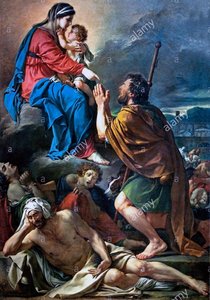
Interestingly, research reveals that this drawing belongs to a series of enigmatic sheets created during David’s exile. These works, often featuring close-up portraits of heads, were gifted to his friends, suggesting a personal and introspective dimension to the artist's creative process. The reference to David’s painting “The Intercession of Saint Roch” (1780) further illuminates this connection—a shared motif of suffering and sacrifice that resonates throughout the series. This earlier work, with its dramatic use of light and shadow, foreshadows the emotional intensity found in "The Prisoner," demonstrating a consistent exploration of human vulnerability.
Beyond its immediate visual impact, “The Prisoner” is rich in symbolic meaning. The chain itself has been interpreted as representing not just physical imprisonment but also the constraints imposed by societal expectations, political ideologies, or perhaps even personal demons. The bowl and plant, while offering a hint of hope, are overshadowed by the figure’s profound sadness—suggesting that even sustenance cannot fully alleviate the burden of suffering. The overall effect is one of quiet desperation, inviting viewers to contemplate the nature of freedom, confinement, and the enduring human capacity for resilience.
David’s technical skill is evident in every meticulously rendered line and subtle gradation of tone. The drawing showcases his mastery of dry pencil technique—a deliberate choice that lends a tactile quality to the image, emphasizing the texture of skin, fabric, and stone. The use of cross-hatching and stippling creates a remarkable sense of depth and volume, bringing the figure to life with an almost haunting realism. “The Prisoner” stands as a testament to David’s artistic genius—a poignant reminder of the power of art to capture not only outward appearances but also the deepest recesses of the human soul. Reproductions of this iconic work offer a unique opportunity to experience its profound emotional impact and appreciate the enduring legacy of one of history's greatest artists.


1748 - 1800 , Frankrig

Explore the profound mastery of graphite pencil art. From the historical alchemy of carbon to advanced chiaroscuro techniques, learn to navigate grades and shadows like a master. Discover the precision and depth that define the world's most iconic drawings.

Explore the profound history of drawing techniques, from Dürer's precision to the alchemy of graphite. Discover how masters use line, weight, and contour to capture the human spirit in this expert guide to art history and technical mastery.

Explore the profound elegance of Neoclassicism. Discover how Enlightenment ideals, the discovery of Pompeii, and masters like Jacques-Louis David revived the glory of Greek and Roman antiquity through art defined by order, reason, and timeless beauty.


Hold dig opdateret med de seneste kunstnyheder, eksklusive tilbud og indretningsideer.
Fortæl os om dit projekt, og vores kunsteksperter vil give dig 3 personlige kunstforslag.
Vi kuraterer 3 valgmuligheder kun til dig – Gratis!


 Se i fuld skala
 Del
Del Del
Del
 Detaljer

 Download
 Lignende værker
 Røntgenundersøgelse
 Diasshow
 Se mere







 Glasmulighed er kun tilgængelig i størrelser under 110 cm