x

Håndmalet olie på lærred i din valgte størrelse og ramme, udført efter bestilling af vores kunstnere. ( Køb print Køb billede)





























Vælg mellem vores forudindstillede størrelser, der matcher kunstværkets originale proportioner.

Du kan indtaste dine egne mål for at passe til en bestemt ramme eller plads. Hvis den valgte størrelse ikke stemmer overens med det originale billedes proportioner, vil vi enten beskære kunstværket eller udvide maleriet med yderligere håndmalede elementer. En digital skitse sendes til din godkendelse, før produktionen påbegyndes.
Bemærk venligst, at forhåndsvisningen på skærmen ikke afspejler den faktiske beskæring eller udvidelse. Kun skitsen vil nøjagtigt vise den endelige komposition.
Selvom specialmål er mulige, anbefaler vi at vælge en dimension fra den foruddefinerede liste for at bevare de originale proportioner.
Levering i hele verden () på 3/4 uger i stedet for de standard 5 uger. (17 august). Ingen kompromiser med kvaliteten.


untitled (3915)
Størrelse på reproduktion
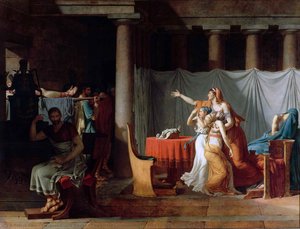
Jacques-Louis David (1748-1825) stands as a monumental figure in the annals of French art history, embodying not merely artistic skill but also the tumultuous spirit of his era – the dawn of the Enlightenment and the explosive upheaval of the French Revolution. His journey from humble beginnings to international acclaim is itself a chronicle of dramatic transformation, mirroring the broader societal shifts that reshaped Europe.
Born in Paris amidst considerable hardship—his father’s untimely death leaving him orphaned at a young age and a facial deformity presenting significant challenges to his speech—David possessed an innate dedication to mastering his craft. Initially apprenticed to François Boucher, David quickly recognized the profound moral resonance of Joseph-Marie Vien's approach to history painting, prioritizing classical ideals and heroic narratives.
Early successes in competitions secured him a place at the Académie Royale de peinture et de sculpture, where he honed his technique under Vien’s tutelage. However, David’s artistic vision swiftly diverged from established conventions, gravitating towards a style characterized by austere clarity and monumental grandeur – Neoclassicism. This stylistic preference wouldn't simply be aesthetic; it would become inextricably linked to the revolutionary fervor gripping France.
David’s artistic philosophy was deeply rooted in the revival of classical antiquity, fueled by humanist scholarship and a fervent belief in reason. Rejecting the ornate excesses of Rococo art, he championed forms reminiscent of Greek and Roman sculpture – idealized figures conveying moral virtue and embodying heroic action. This stylistic choice wasn't accidental; it served as a deliberate rebuke to the perceived decadence of the Bourbon monarchy and an affirmation of republican values.
"Oath of the Horatii," arguably David’s most celebrated masterpiece, exemplifies this Neoclassical ethos. Painted in 1784, it depicts a poignant scene from Roman legend—three brothers pledging allegiance to their father and upholding honor above personal ambition. The composition is meticulously balanced, utilizing geometric precision and dramatic chiaroscuro to heighten emotional impact. More than just an aesthetically pleasing image, the painting functioned as a powerful symbol of civic duty and moral fortitude – sentiments that resonated deeply with the burgeoning republican movement.
"The Death of Marat," completed in 1793 during the height of the Reign of Terror, cemented David’s reputation as a propagandist for the revolution. This unflinching depiction of Jean-Paul Marat—a radical journalist assassinated by Charlotte Corday—captured the visceral horror and moral urgency of the period with remarkable realism. The painting's stark simplicity – bathed in muted light – underscores Marat’s martyrdom, conveying profound sorrow and commemorating his unwavering commitment to republican ideals.
David’s artistic legacy extends far beyond his iconic paintings. He profoundly influenced subsequent generations of artists, shaping the visual language of Romanticism and establishing Neoclassicism as a dominant aesthetic force throughout Europe. His meticulous attention to detail, masterful use of technique—particularly etching—and unwavering commitment to classical ideals continue to inspire admiration and scholarly study today. A testament to artistic brilliance and historical significance, Jacques-Louis David’s oeuvre remains an enduring emblem of the Enlightenment's transformative power.


1748 - 1800 , Frankrig

Explore the profound elegance of Neoclassicism. Discover how Enlightenment ideals, the discovery of Pompeii, and masters like Jacques-Louis David revived the glory of Greek and Roman antiquity through art defined by order, reason, and timeless beauty.

Explore the profound shift of Neoclassicism, from the rejection of Rococo excess to the embrace of Enlightenment reason. Discover how archaeological finds and classical ideals reshaped art, architecture, and sculpture in a timeless return to order and grandeur.

Explore the profound elegance of Neoclassicism. Discover how the Enlightenment era embraced Greek and Roman ideals of order, reason, and symmetry to redefine art history through masters like Mengs and Hamilton. A definitive guide for history lovers and art collectors.


Hold dig opdateret med de seneste kunstnyheder, eksklusive tilbud og indretningsideer.
Fortæl os om dit projekt, og vores kunsteksperter vil give dig 3 personlige kunstforslag.
Vi kuraterer 3 valgmuligheder kun til dig – Gratis!


 Se i fuld skala
 Del
Del Del
Del
 Detaljer

 Download
 Lignende værker
 Røntgenundersøgelse
 Diasshow
 Se mere







 Glasmulighed er kun tilgængelig i størrelser under 110 cm