x


Giclée- eller lærredstryk i museumskvalitet med hurtig produktion og fleksible muligheder for finish. ( Skift til håndmalet maleri Skift til billede)





























Vælg mellem vores forudindstillede størrelser, der matcher kunstværkets originale proportioner.

Du kan indtaste dine egne mål for at passe til en specifik ramme eller et bestemt område. Hvis den valgte størrelse ikke stemmer overens med det originale billedes proportioner, vil vi enten beskære kunstværket eller udvide billedet med en spejlet eller ensfarvet kant. En digital mockup vil blive sendt til din godkendelse, før produktionen påbegyndes.
Bemærk venligst, at forhåndsvisningen på skærmen ikke afspejler den faktiske beskæring eller udvidelse. Kun mockuppen vil nøjagtigt vise den endelige komposition.
Selvom specialmål er tilgængelige, anbefaler vi at vælge et mål fra den foruddefinerede liste for at bevare de originale proportioner.
Verdensomspændende levering () på 2 uger i stedet for de sædvanlige 4/5 uger. (31 juli)


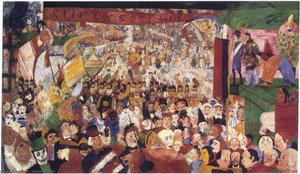
Carnaval sur la plage 1
Størrelse på reproduktion
James Ensor’s “Carnaval sur la Plage” (Carnival on the Beach), painted around 1887, isn't merely a depiction of a seaside gathering; it’s an immersive plunge into the artist’s uniquely unsettling and profoundly evocative world. Born in Ostend, Belgium, a town renowned for its exuberant Carnival celebrations, Ensor was inextricably linked to this spectacle from his childhood. His parents operated a souvenir shop overflowing with masks, curiosities, and the paraphernalia of a festive gathering – a veritable treasure trove that fueled his imagination and became the cornerstone of his artistic vocabulary. This early exposure to the theatricality of disguise and the unsettling beauty of the bizarre profoundly shaped his approach to painting, leading him away from conventional academic styles and toward a deeply personal and often disconcerting vision.
Ensor’s work is characterized by a deliberate rejection of naturalism in favor of psychological intensity. He wasn't interested in faithfully rendering reality; instead, he sought to capture the *feeling* of an event – the sense of unease, mystery, and perhaps even madness that can permeate such gatherings. This approach aligns him with the burgeoning Symbolist movement, though his style is distinctly singular, marked by a bold palette, distorted figures, and a pervasive atmosphere of theatricality.
Central to “Carnaval sur la Plage” are the masks themselves. Ensor’s subjects aren't simply individuals enjoying a day at the beach; they are enveloped in layers of disguise, their identities obscured and transformed. These aren’t charming or celebratory masks—they possess an unsettling quality, hinting at hidden desires, anxieties, and perhaps even sinister intentions. The repetition of mask motifs throughout his oeuvre suggests a preoccupation with the duality of self – the visible persona versus the concealed inner world. The figures are rendered in a flattened perspective, almost like stage characters, further emphasizing the theatrical nature of the scene.
Beyond the masks, the composition itself is laden with symbolic weight. The blurred background, dominated by the sea and distant boats, creates a sense of disorientation and isolation. The foreground figures, though numerous, seem strangely detached from one another, lost in their own private dramas. The use of vibrant, almost jarring colors – reds, yellows, blues – contributes to the painting’s overall unsettling effect, amplifying the feeling that something is fundamentally *wrong* with this seemingly idyllic scene.
Ensor's technique in “Carnaval sur la Plage” is both meticulous and deliberately rough. He employs a layered approach, building up the image through multiple glazes of paint, creating a rich surface texture that seems to shimmer with an inner light. The brushstrokes are visible, adding to the sense of immediacy and spontaneity. Notably, Ensor’s treatment of space departs from traditional perspective; he utilizes atmospheric effects—particularly in the depiction of the sea—to create a dreamlike quality, blurring the boundaries between reality and illusion.
The painting's emotional impact is profound. It evokes a sense of both fascination and unease, inviting the viewer to contemplate the hidden depths beneath the surface of social interaction. “Carnaval sur la Plage” isn’t simply a record of a seaside event; it’s a powerful meditation on identity, performance, and the unsettling beauty of the human condition – a testament to James Ensor's unique vision and enduring legacy as one of art history's most original and challenging figures.


1860 - 1949 , Belgien

Oplev Sir Alfred James Munnings' 25 mest ikoniske værker – fra betagende hestemalerier til engelske landskaber. Lær om kunstnerens historie, teknik og stil. Find luksus reproduktioner & inspiration til dit hjem på Most-Famous-Paintings.com
Oplev James Abbott McNeill Whistlers 25 mest ikoniske kunstværker. Fordyb dig i æstetismens verden, tonale malerier & harmoniske kompositioner. Find reproduktioner af højeste kvalitet og inspiration til din indretning på Most-Famous-Paintings.com.

Explore the rich history & enduring techniques of oil painting with Most-Famous-Paintings. Discover masterpieces, learn about art collecting, and find authentic handmade reproductions crafted by skilled artists.

Explore the rich history & techniques of oil painting – from Renaissance masters to Impressionism. Discover pigments, layering methods, and why this timeless medium endures. Expert insights for artists & art enthusiasts.
Oplev 10 ikoniske mesterværker malet på træ – fra Van Gogh til Monet! Lær historien bag disse klassiske kunstværker og find inspiration til din indretning. Museumskvalitet reproduktioner hos Most-Famous-Paintings.com. Udforsk samlingen online!


Hold dig opdateret med de seneste kunstnyheder, eksklusive tilbud og indretningsideer.
Fortæl os om dit projekt, og vores kunsteksperter vil give dig 3 personlige kunstforslag.
Vi kuraterer 3 valgmuligheder kun til dig – Gratis!


 Se i fuld skala
 Del
Del Del
Del
 Detaljer

 Download
 Lignende værker
 Røntgenundersøgelse
 Diasshow

 Se mere







 Glasmulighed er kun tilgængelig i størrelser under 110 cm