x


Giclée- eller lærredstryk i museumskvalitet med hurtig produktion og fleksible muligheder for finish. ( Skift til håndmalet maleri Skift til billede)





























Vælg mellem vores forudindstillede størrelser, der matcher kunstværkets originale proportioner.

Du kan indtaste dine egne mål for at passe til en specifik ramme eller et bestemt område. Hvis den valgte størrelse ikke stemmer overens med det originale billedes proportioner, vil vi enten beskære kunstværket eller udvide billedet med en spejlet eller ensfarvet kant. En digital mockup vil blive sendt til din godkendelse, før produktionen påbegyndes.
Bemærk venligst, at forhåndsvisningen på skærmen ikke afspejler den faktiske beskæring eller udvidelse. Kun mockuppen vil nøjagtigt vise den endelige komposition.
Selvom specialmål er tilgængelige, anbefaler vi at vælge et mål fra den foruddefinerede liste for at bevare de originale proportioner.
Verdensomspændende levering () på 2 uger i stedet for de sædvanlige 4/5 uger. (31 juli)


Skeletons in the Studio
Størrelse på reproduktion
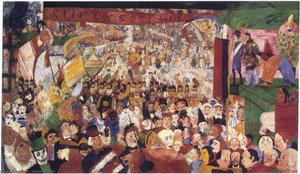
James Ensor's 1900 painting, *Skeletons in the Studio*, isn’t merely a depiction of decaying remains; it’s a profoundly unsettling exploration of mortality, memory, and the anxieties simmering beneath the surface of Victorian society. Housed within the National Gallery of Canada, this oil on canvas transcends simple morbidity, offering instead a glimpse into the artist's uniquely skewed perspective – one that simultaneously delights and disturbs. Ensor, a Belgian painter who deliberately pushed against academic conventions, created a world populated by masked figures, unsettling rituals, and a pervasive sense of unease, all hallmarks of his distinctive style.
The painting immediately draws the viewer into a dimly lit chamber, dominated by a starkly monochromatic palette. The absence of vibrant color amplifies the somber mood, creating an atmosphere thick with anticipation and dread. Notice how Ensor masterfully utilizes light – or rather, its deliberate lack – to sculpt the forms of the skeletons, furniture, and objects within the room. This isn’t a romanticized vision of death; it's a claustrophobic space where decay feels intensely present. The composition itself is carefully constructed: the skeletal figures are arranged in a seemingly chaotic manner, yet there’s an underlying order that suggests a staged performance, perhaps a macabre tableau vivant.
The presence of skeletons, naturally, dominates the scene. However, they aren't simply lifeless remains; Ensor imbues them with a strange vitality. They’re engaged in an activity – a silent struggle, perhaps – that hints at a forgotten past or an unresolved conflict. The scattered objects—a dining table, chairs, a clock, and various decorative items—suggest a domestic setting abruptly interrupted by death. The clock, frozen at a specific time, adds another layer of temporal distortion, reinforcing the sense that time itself has ceased to operate within this space.
Crucially, Ensor’s use of masks is integral to understanding the painting's deeper meaning. The skeletons are not presented as unadorned bones but rather as figures wearing elaborate, theatrical masks – a direct reference to the carnival culture that so profoundly influenced his childhood in Ostend. These masks symbolize deception, hidden identities, and the performance of social roles. They suggest that beneath the veneer of respectability lies a darker, more primal reality.
Ensor's technique is characterized by bold brushstrokes and an expressive use of color – though here, it’s largely restrained to shades of gray and black. He employs a flattened perspective, creating a sense of claustrophobia and intensifying the emotional impact of the scene. His style anticipates elements of Expressionism and Surrealism, foreshadowing movements that would emerge decades later. It's important to remember Ensor was working at a time when traditional artistic conventions were being challenged, and he embraced a highly personal and often unsettling vision.
Consider also the historical context: 1900 was a period of significant social and political upheaval in Europe. The rise of industrialization, urbanization, and anxieties about mortality were all contributing to a growing sense of unease. Ensor’s *Skeletons in the Studio* can be interpreted as a reflection of these broader societal concerns – a visual meditation on death, decay, and the fragility of human existence. The painting invites us to confront our own fears about mortality and to question the masks we wear in everyday life.
Most-Famous-Paintings offers meticulously crafted, hand-painted reproductions of James Ensor’s *Skeletons in the Studio*, allowing you to experience this iconic artwork firsthand. Each reproduction is created by skilled artists using traditional oil painting techniques, ensuring a faithful and vibrant representation of Ensor's original vision. Whether displayed in your home or office, this stunning piece will undoubtedly spark conversation and evoke a powerful emotional response. Explore our collection today at Most-Famous-Paintings.com – and discover the enduring power of James Ensor’s unsettling masterpiece.


1860 - 1949 , Belgien
Oplev James Abbott McNeill Whistlers 25 mest ikoniske kunstværker. Fordyb dig i æstetismens verden, tonale malerier & harmoniske kompositioner. Find reproduktioner af højeste kvalitet og inspiration til din indretning på Most-Famous-Paintings.com.

Oplev Sir Alfred James Munnings' 25 mest ikoniske værker – fra betagende hestemalerier til engelske landskaber. Lær om kunstnerens historie, teknik og stil. Find luksus reproduktioner & inspiration til dit hjem på Most-Famous-Paintings.com

Explore the unsettling yet captivating world of James Ensor, a pioneer of Expressionism. Discover his satirical masterpieces, symbolic imagery & lasting influence on modern art. High-quality reproductions available at Most-Famous-Paintings.

Explore the life & art of James Sant (1820-1916), renowned Victorian portraitist to Queen Victoria. Discover his captivating depictions of childhood, landscapes, and aristocratic society. Learn about his legacy & find fine art reproductions.

Explore the captivating landscapes of James Stark (1794-1859), a leading Norwich School painter. Discover his Dutch Master influences, critical acclaim, and enduring legacy in contemporary realism. Art collecting insights & investment potential.


Hold dig opdateret med de seneste kunstnyheder, eksklusive tilbud og indretningsideer.
Fortæl os om dit projekt, og vores kunsteksperter vil give dig 3 personlige kunstforslag.
Vi kuraterer 3 valgmuligheder kun til dig – Gratis!


 Se i fuld skala
 Del
Del Del
Del
 Detaljer

 Download
 Lignende værker
 Røntgenundersøgelse
 Diasshow

 Se mere







 Glasmulighed er kun tilgængelig i størrelser under 110 cm