


x

 Oil On CanvasWallArtConstructivism
 1928Modern
 61.0 x 61.0 cm
Håndmalet olie på lærred i din valgte størrelse og ramme, udført efter bestilling af vores kunstnere. ( Skift til print Skift til billede)





























Vælg mellem vores forudindstillede størrelser, der matcher kunstværkets originale proportioner.

Du kan indtaste dine egne mål for at passe til en bestemt ramme eller plads. Hvis den valgte størrelse ikke stemmer overens med det originale billedes proportioner, vil vi enten beskære kunstværket eller udvide maleriet med yderligere håndmalede elementer. En digital skitse sendes til din godkendelse, før produktionen påbegyndes.
Bemærk venligst, at forhåndsvisningen på skærmen ikke afspejler den faktiske beskæring eller udvidelse. Kun skitsen vil nøjagtigt vise den endelige komposition.
Selvom specialmål er mulige, anbefaler vi at vælge en dimension fra den foruddefinerede liste for at bevare de originale proportioner.
Levering i hele verden () på 3/4 uger i stedet for de standard 5 uger. (31 juli). Ingen kompromiser med kvaliteten.


Pillars
Størrelse på reproduktion
Josef Albers’ "Pillars," created in 1928, is a striking example of early geometric abstraction that foreshadows the artist's later explorations of color theory. This artwork, measuring 61 x 61 cm, offers a compelling glimpse into Albers' artistic development during his time at the Bauhaus, a period marked by experimentation and a shift towards non-objective art.
Albers’ journey as an artist was significantly shaped by his enrollment in the Bauhaus school in 1920. This progressive institution championed innovative educational ideas and fostered a climate of creative exploration. Initially studying painting at a traditional art school, Albers quickly gravitated towards the glass workshop within the Bauhaus, disregarding the prescribed wall painting class. It was here that he began creating "wall glass paintings"—assemblages of opaque glass—which served as precursors to his later color studies. “Pillars” reflects this early experimentation with form and material, demonstrating a move away from representational art towards pure abstraction.
The artwork presents a meticulously structured composition characterized by vertical and horizontal lines arranged in a grid-like pattern. The color palette is restrained yet impactful, primarily featuring red, white, black, and grey tones with subtle variations. This deliberate choice of colors contributes to the overall sense of order and precision. The symmetrical arrangement emphasizes balance, while crisp, defined lines form rectangles and blocks that intersect, creating a complex visual texture. Notably, "Pillars" lacks traditional perspective or depth; it exists entirely on a flat, two-dimensional plane. The absence of recognizable objects or scenes reinforces the artwork’s purely abstract nature.
“Pillars” aligns with both Minimalist and Constructivist aesthetics. Its emphasis on geometric forms, clean lines, and a limited color palette are hallmarks of Minimalism. Simultaneously, the structured grid and focus on construction evoke influences from Constructivism, an art movement that prioritized industrial materials and rational design principles. The technique employed appears to be precise painting, likely achieved through careful brushwork or potentially masking techniques to ensure sharp lines. The artwork is executed on canvas, as evidenced by the texture of the wooden backing.
While devoid of overt symbolism or emotional narrative, "Pillars" evokes a sense of order, precision, and intellectual rigor. Some viewers may perceive a slightly sterile or clinical aesthetic due to its geometric nature. However, the interplay of colors and forms creates a subtle visual rhythm that engages the viewer's perception. Ultimately, “Pillars” invites contemplation on the fundamental elements of art—line, shape, color—and their capacity to create compelling abstract compositions.


1888 - 1976 , Tyskland
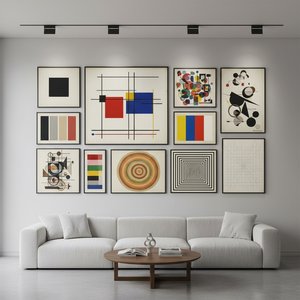
Oplev de 10 mest ikoniske værker inden for geometrisk abstraktion! Fra Kandinsky til Mondrian – lær historierne bag disse banebrydende kunstnere og deres farverige malerier. Find museumskvalitets reproduktioner & inspiration til din indretning på Most-Famous-Paintings.dk.

Skab et elegant og harmonisk rum med sort, hvid og grå. Ekspertvejledning til abstrakt kunst, lysdesign & minimalistisk indretning. Inspiration & tips fra professionelle.

Oplev skønheden i hvide malerier! Fra Monet til Van Gogh – udforsk 10 ikoniske kunstværker og deres historie. Find inspiration til dit hjem & køb museumskvalitets reproduktioner på Most-Famous-Paintings.com.

Explore Josef Albers's groundbreaking color theory & the 'Homage to the Square' series. Discover how his work revolutionized visual perception and influenced modern art movements like Minimalism & Op Art. Learn about his Bauhaus roots & lasting legacy.

Oplev stilhedens resonans med minimalistisk abstrakt kunst. Ekspertvejledning til at skabe et harmonisk og roligt hjem. Kvalitetsmalerier & personlig rådgivning hos Most-Famous-Paintings.


Hold dig opdateret med de seneste kunstnyheder, eksklusive tilbud og indretningsideer.
Fortæl os om dit projekt, og vores kunsteksperter vil give dig 3 personlige kunstforslag.
Vi kuraterer 3 valgmuligheder kun til dig – Gratis!


 Se i fuld skala
 Del
Del Del
Del
 Detaljer

 Download
 Lignende værker
 Røntgenundersøgelse
 Diasshow
 Se mere







 Glasmulighed er kun tilgængelig i størrelser under 110 cm


