


x


Håndmalet olie på lærred i din valgte størrelse og ramme, udført efter bestilling af vores kunstnere. ( Skift til print Skift til billede)





























Vælg mellem vores forudindstillede størrelser, der matcher kunstværkets originale proportioner.

Du kan indtaste dine egne mål for at passe til en bestemt ramme eller plads. Hvis den valgte størrelse ikke stemmer overens med det originale billedes proportioner, vil vi enten beskære kunstværket eller udvide maleriet med yderligere håndmalede elementer. En digital skitse sendes til din godkendelse, før produktionen påbegyndes.
Bemærk venligst, at forhåndsvisningen på skærmen ikke afspejler den faktiske beskæring eller udvidelse. Kun skitsen vil nøjagtigt vise den endelige komposition.
Selvom specialmål er mulige, anbefaler vi at vælge en dimension fra den foruddefinerede liste for at bevare de originale proportioner.
Levering i hele verden () på 3/4 uger i stedet for de standard 5 uger. (2 august). Ingen kompromiser med kvaliteten.


Landscape
Størrelse på reproduktion

Marco Ricci stands as a pivotal figure in the grand tapestry of Venetian Baroque painting, a master whose brush breathed life into the atmospheric expanses of the 18th century. Born in Belluno, Italy, in 1676, Ricci’s artistic journey was deeply rooted in a lineage of excellence. His early training began under the watchful eye of his uncle, the celebrated Sebastiano Ricci, likely within the vibrant artistic hubs of Milan during the mid-1690s. This foundational period established a profound connection to the Venetian tradition, as he moved toward Venice in 1696 to join forces with his uncle. Together, they embarked on a collaborative career that would redefine the boundaries of landscape painting, blending classical grandeur with a new, more expressive sensibility.
The evolution of Ricci’s style was shaped by a rich confluence of influences that bridged the gap between the structured ideals of the past and the burgeoning freedom of the Rococo. He absorbed the luminous, atmospheric perspective of Claude Lorrain and Gaspard Dughet, masters who had perfected the art of the idealized nature scene. Yet, there was a more rugged, emotive current in his work, drawn from the expressive brushwork of Salvatore Rosa and the loose, energetic application seen in the works of Alessandro Magnasco. This unique synthesis allowed Ricci to move beyond mere topographical recording, instead creating landscapes that felt alive with movement, light, and a sense of dramatic narrative.
One of the most remarkable aspects of Ricci’s career was his profound willingness to engage in the collaborative spirit of his era. His work often blurred the lines between individual authorship and collective genius, particularly in large-scale decorative projects. A notable example of this grandeur can be found in his contributions to the decoration of Palazzo Fenzi's Sala d'Ercole alongside Sebastiano Ricci, where he demonstrated an ability to command vast architectural spaces with sweeping vistas and intricate detail. This talent for large-scale design extended into the theatrical realm, where his skill in opera scene design allowed him to manipulate light and space to create immersive, imaginary worlds.
Ricci’s influence was not confined to the borders of the Serenissima Republic. Driven by the encouragement of Charles Montagu, the 4th Earl of Manchester—Venice’s ambassador to England—Ricci undertook a transformative journey to London in late 1708. This English connection expanded his horizons and introduced his Venetian sensibilities to a new international audience, further cementing his reputation as a pan-European master. His ability to adapt his style to different cultural contexts while maintaining his core identity as a landscape innovator remains a testament to his versatility.
The enduring allure of Marco Ricci’s oeuvre lies in his ability to capture the ephemeral qualities of the natural world. His paintings often serve as windows into an idealized past, where classical architecture and untamed nature exist in a delicate, harmonious balance. Whether depicting a serene Villa in a Park Setting or a more dynamic Landscape with River and Figures, Ricci utilized light to guide the viewer's eye through complex compositions, creating depth and a sense of profound tranquility.
His technical mastery is evident in several key areas of his work:
Ultimately, Marco Ricci was more than just a painter of scenery; he was an architect of emotion. Through his innovative approach to the landscape genre, he paved the way for the later triumphs of Canaletto and Guardi, ensuring that the Venetian tradition of landscape painting would remain a cornerstone of European art history.

1676 - 1730 , Italy

Explore the rich history of pastoral landscape art, from classical Arcadia to Impressionism & beyond. Discover key artists, movements, and how to collect serene rural scenes for your home. Expert insights at Most-Famous-Paintings.
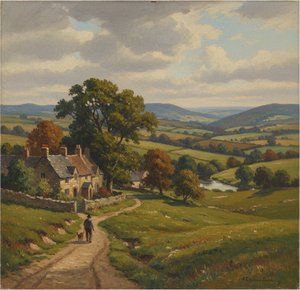
Explore the captivating landscapes & portraits of Brian Hatton (1887-1916), a promising British artist lost too soon. Discover his unique style, Herefordshire roots, and lasting legacy in early 20th-century art.

Oplev top 10 berømte malerier i smukke sandfarver! Fra Monet til Rembrandt – udforsk kunsthistorien, teknikker og inspiration. Find museumskvalitets reproduktioner & dekorer dit hjem med tidløs elegance på Most-Famous-Paintings.com.

Explore the rich history of rural life in art! Discover masterpieces from Dutch Masters to Van Gogh & Courbet. Uncover artistic movements, social significance & expert collecting insights at Most-Famous-Paintings.

Explore the captivating world of earth tones in art! Discover historical context, emotional resonance & artistic techniques behind these timeless colors. Find inspiration for your home decor and museum-quality reproductions.


Hold dig opdateret med de seneste kunstnyheder, eksklusive tilbud og indretningsideer.
Fortæl os om dit projekt, og vores kunsteksperter vil give dig 3 personlige kunstforslag.
Vi kuraterer 3 valgmuligheder kun til dig – Gratis!


 Se i fuld skala
 Del
Del Del
Del
 Detaljer

 Download
 Lignende værker
 Røntgenundersøgelse
 Diasshow

 Se mere







 Glasmulighed er kun tilgængelig i størrelser under 110 cm


