x
Håndmalet olie på lærred i din valgte størrelse og ramme, udført efter bestilling af vores kunstnere. ( Skift til print Skift til billede)





























Vælg mellem vores forudindstillede størrelser, der matcher kunstværkets originale proportioner.

Du kan indtaste dine egne mål for at passe til en bestemt ramme eller plads. Hvis den valgte størrelse ikke stemmer overens med det originale billedes proportioner, vil vi enten beskære kunstværket eller udvide maleriet med yderligere håndmalede elementer. En digital skitse sendes til din godkendelse, før produktionen påbegyndes.
Bemærk venligst, at forhåndsvisningen på skærmen ikke afspejler den faktiske beskæring eller udvidelse. Kun skitsen vil nøjagtigt vise den endelige komposition.
Selvom specialmål er mulige, anbefaler vi at vælge en dimension fra den foruddefinerede liste for at bevare de originale proportioner.
Levering i hele verden () på 3/4 uger i stedet for de standard 5 uger. (10 august). Ingen kompromiser med kvaliteten.


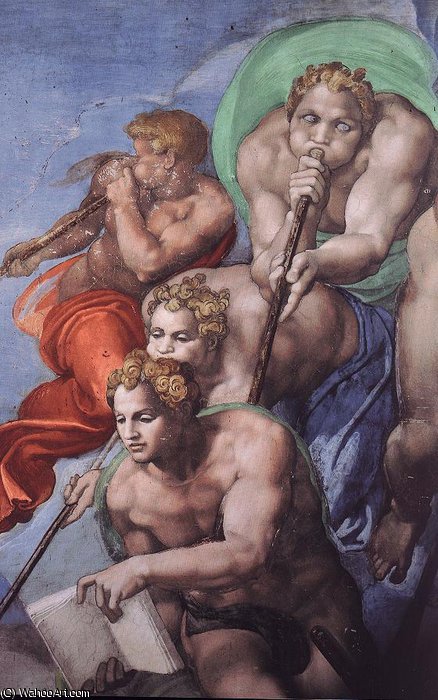
Last Judgment d7
Størrelse på reproduktion
The image before us—often referred to as "Last Judgment d7"—is not merely a painting; it's an experience, a visceral plunge into the heart of humanity’s confrontation with mortality and divine justice. Created by the titan of the High Renaissance, Michelangelo Buonarroti, this monumental work, though shrouded in some mystery regarding its precise commission and location (likely intended for the altar wall of the Old St. Peter’s Basilica), pulsates with a raw energy that transcends time. Michelangelo, born in 1475 in Caprese Michelangelo, Italy, was already a master sculptor by his early twenties, but it was his ambition to tackle painting on this scale – a fresco covering an immense wall – that truly cemented his legacy as a polymath of unparalleled genius.
The scene unfolds with breathtaking dynamism. At its core is the figure holding the trumpet, a potent symbol of both the herald of doom and the call to judgment. His posture, rigid yet conveying a sense of urgent command, immediately draws the eye, anchoring the viewer within this chaotic tableau. Around him swirl figures in varying states of torment and ecstasy – souls being dragged downwards into hell by grotesque demons, while others ascend towards God’s radiant light. The sheer scale of the composition—a testament to Michelangelo's ambition—forces a confrontation with the overwhelming nature of divine judgment.
Michelangelo’s mastery is immediately evident in the anatomical precision of each figure, a hallmark inherited from his sculpting training. He doesn’t shy away from depicting the grotesque – the writhing limbs, contorted faces, and expressions of agony are brutally honest. Yet, within this depiction of suffering, there's an undeniable beauty; Michelangelo imbues even the damned with a tragic grandeur. The *terribilità*, a term often applied to his work, speaks to this potent combination of horror and sublime power.
Technically, “Last Judgment” is executed in fresco—a method requiring rapid application of wet paint onto freshly plastered walls. This necessitated a meticulous planning process, evident in the preparatory drawings that Michelangelo created, revealing the complex network of figures and their interconnected narratives. The vibrant colors, though faded over centuries, retain a remarkable intensity, particularly in the reds and golds used to depict the heavenly realm and the fiery depths of hell. Notice how he uses *chiaroscuro* – the dramatic contrast between light and dark – to heighten the emotional impact, guiding the viewer’s eye through the scene.
The “Last Judgment” is deeply rooted in Christian theology, drawing heavily from biblical accounts of Judgement Day. The trumpet signifies the arrival of Christ, signaling the end of time and the final reckoning. The figures themselves represent a diverse range of humanity – saints, sinners, and ordinary people—all subject to the same inescapable fate. The placement of the two birds, one near the top left corner and another towards the bottom right, is particularly intriguing; they are often interpreted as symbols of hope (the bird ascending) and despair (the bird descending), reflecting the dual nature of salvation and damnation.
Beyond its immediate religious context, the painting speaks to universal themes of mortality, guilt, redemption, and the human condition. Michelangelo’s depiction is not a comforting one; it's a stark reminder of our vulnerability in the face of an unknowable God. The raw emotion conveyed—the anguish, the fear, the desperate plea for mercy—resonates powerfully even today, making “Last Judgment” a timeless masterpiece.
Most-Famous-Paintings offers meticulously crafted hand-painted reproductions of this extraordinary work. We utilize traditional fresco techniques and archival quality pigments to faithfully recreate the intensity and drama of Michelangelo's original. Each reproduction is a testament to our commitment to preserving artistic heritage, allowing you to experience the profound emotional impact of “Last Judgment” in your own space.
Explore our collection today and bring the drama and spirituality of Michelangelo's “Last Judgment” into your home or office.


1475 - 1564 , Italien

Oplev Michelangelos 25 mest ikoniske værker – fra David til Pietà og Sixtinske Kapel. Lær om renæssancens mester, hans teknikker & tidløse kunst. Find museumskvalitets reproduktioner på Most-Famous-Paintings.com.

Explore the life, works & enduring legacy of Michelangelo Buonarroti, a Renaissance titan. Discover his iconic sculptures, frescoes, and architectural achievements. Expert art consultation & high-quality reproductions at Most-Famous-Paintings.

Explore the rich history & enduring artistry of fresco painting – from Giotto to Michelangelo! Discover techniques, conservation efforts, & modern applications. Learn how Most-Famous-Paintings brings this timeless art form to your home.

Explore the revolutionary art of Piero della Francesca – master of perspective, divine proportion & Renaissance humanism. Discover his iconic paintings & lasting influence on art history.

Oplev de 10 mest legendariske freskomalerier, der har formet kunsthistorien! Fra Michelangelos Sixtinske Kapel til Raffaellos vægmalerier. Find inspiration og køb museumskvalitets reproduktioner på Most-Famous-Paintings.com.


Hold dig opdateret med de seneste kunstnyheder, eksklusive tilbud og indretningsideer.
Fortæl os om dit projekt, og vores kunsteksperter vil give dig 3 personlige kunstforslag.
Vi kuraterer 3 valgmuligheder kun til dig – Gratis!


 Se i fuld skala
 Del
Del Del
Del
 Detaljer

 Download
 Lignende værker
 Røntgenundersøgelse
 Diasshow
 Se mere







 Glasmulighed er kun tilgængelig i størrelser under 110 cm