x


 Preview
 Bestil maleri Køb højopløseligt billede
 Del
Del
 Detaljer
 Tilføj til favoritter
 Download
 Lignende værker
 Røntgenundersøgelse
 Diasshow
Giclée- eller lærredstryk i museumskvalitet med hurtig produktion og fleksible muligheder for finish.





























Vælg mellem vores forudindstillede størrelser, der matcher kunstværkets originale proportioner.

Du kan indtaste dine egne mål for at passe til en specifik ramme eller et bestemt område. Hvis den valgte størrelse ikke stemmer overens med det originale billedes proportioner, vil vi enten beskære kunstværket eller udvide billedet med en spejlet eller ensfarvet kant. En digital mockup vil blive sendt til din godkendelse, før produktionen påbegyndes.
Bemærk venligst, at forhåndsvisningen på skærmen ikke afspejler den faktiske beskæring eller udvidelse. Kun mockuppen vil nøjagtigt vise den endelige komposition.
Selvom specialmål er tilgængelige, anbefaler vi at vælge et mål fra den foruddefinerede liste for at bevare de originale proportioner.
Verdensomspændende levering () på 2 uger i stedet for de sædvanlige 4/5 uger. (27 juli)


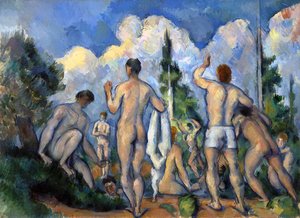
Bathers (Hermitage)
Størrelse på reproduktion
"Bathers (Hermitage)," painted by Paul Cézanne around 1891-1892, depicts a group of nude male figures relaxing in a natural setting. The composition is characterized by its deliberate arrangement of forms rather than a realistic portrayal of the scene. Five bathers are present: one standing prominently on the left, another on the right, and three seated or reclining between them. Cézanne's focus isn’t on narrative; instead, he explores the interplay of shapes, volumes, and planes within the landscape. The figures are integrated into the environment—trees rise behind them, birds fly overhead, and a sense of tranquility pervades the scene.
This artwork exemplifies Cézanne’s distinctive style within the Post-Impressionist movement. Departing from Impressionism’s emphasis on fleeting moments and optical effects, Cézanne sought to represent underlying structures and forms. He employed a technique of building up the image through short, visible brushstrokes, creating a textured surface that emphasizes the materiality of paint. The colors are not blended smoothly but rather applied in distinct planes, contributing to the painting’s geometric quality. Cézanne's approach can be seen as a precursor to Cubism, influencing artists like Picasso and Braque who would further deconstruct forms into abstract shapes.
“Bathers (Hermitage)” was created during a pivotal period in art history. The late 19th century witnessed the decline of traditional academic painting and the rise of new artistic movements challenging established conventions. Cézanne, along with artists like Van Gogh and Gauguin, pushed beyond Impressionism’s focus on capturing light and color to explore more subjective and expressive forms of representation. This work reflects a shift towards abstraction and a greater emphasis on the artist's individual vision—a key characteristic of modern art. The series of "Bathers" paintings was Cézanne's attempt to create a monumental, timeless depiction of human figures in nature, inspired by classical sculpture but reinterpreted through his unique lens.
While seemingly straightforward in its subject matter, “Bathers (Hermitage)” carries layers of symbolic meaning. The nude male figures evoke themes of vitality, physicality, and the connection between humanity and nature. Cézanne’s deliberate distortion of perspective and his emphasis on geometric forms create a sense of timelessness and universality. The painting's emotional impact is subtle yet profound—it invites viewers to contemplate the relationship between form and feeling, representation and reality. It evokes a sense of calm contemplation and appreciation for the beauty of the natural world.


1839 - 1906 , Frankrig

Explore the transformative era of Post-Impressionism. Discover how masters like Van Gogh moved beyond light to embrace emotion, structure, and vibrant color, redefining modern art history through expressive brushwork and symbolic depth.


Hold dig opdateret med de seneste kunstnyheder, eksklusive tilbud og indretningsideer.
Fortæl os om dit projekt, og vores kunsteksperter vil give dig 3 personlige kunstforslag.
Vi kuraterer 3 valgmuligheder kun til dig – Gratis!


 Del
Del


 Se mere







 Glasmulighed er kun tilgængelig i størrelser under 110 cm