x

Køb et højopløst, forbedret digitalt billede, der er langt bedre end online-forhåndsvisningen.
Hver fil er omhyggeligt forberedt af vores interne specialister ved hjælp af avancerede værktøjer og ekspertmæssig manuel retuschering. Vi sikrer, at hvert billede har enestående klarhed, præcis farvegengivelse og fine detaljer.
Den endelige fil leveres via e-mail inden for 72 timer og er optimeret til øjeblikkelig brug i professionelle, redaktionelle og trykte miljøer. Det er den samme kvalitet, som førende designstudier, forlag og gallerier har tillid til.
Download en højopløselig fil til personlig fremvisning, print og kreative projekter. ( Køb print Køb håndlavet maleri)
Når du vælger Most-Famous-Paintings.com, får du ikke blot et billede – du modtager et professionelt optimeret digitalt kunstværk, skabt med præcision og sikret med en tilfredshedsgaranti. Her er alt, hvad din ordre automatisk indeholder:

Din højkvalitets digitale billedfil vil blive sendt til din e-mail inden for 72 timer efter bestilling – klar til øjeblikkelig brug.

Dit kunstværk optimeres professionelt ved hjælp af avancerede AI-værktøjer og manuel redigering, hvilket sikrer maksimal detaljegrad, klarhed og farvenøjagtighed.

Har du ved en fejl slettet eller mistet din fil? Ingen bekymring – vi sender den igen til enhver tid, helt gratis.

Nyd dit kunstværk med det samme uden told, afgifter eller leveringsgebyrer – digitale downloads er altid skattefrie.

Vi sikrer, at dit digitale billede gengiver de originale farver så præcist som muligt ved hjælp af professionelle værktøjer og farvestyring.

Hvis du ikke er tilfreds med dit digitale billede, vil vi revidere det eller refundere 100% inden for 60 dage – uden spørgsmål.

Ik tilfreds? Få fuld refusion inden for 60 dage efter modtagelse af din digitale fil – uden spørgsmål.

Køb 3 billeder, spar 10% - Køb 5, spar 15% - Køb 10+, spar 20%. Ideelt til kreative projekter, gallerier og bureauer.
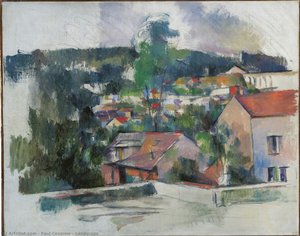
Paul Cézanne's "Untitled (2078)" isn’t merely a landscape; it’s an invitation to contemplate the very essence of perception. Painted in the twilight years of his career, around 1906, this work stands as a pivotal bridge between the fleeting impressions of Impressionism and the nascent explorations of Cubism – a testament to Cézanne's profound understanding of how we truly *see* the world. The canvas unfolds like a carefully constructed architectural study, dominated by a dense grove of trees that seem to both exist within and independently shape the surrounding space. It’s a scene rooted in the Provençal countryside near his beloved Aix-en-Provence, yet transcends simple representation, becoming instead an embodiment of Cézanne's relentless pursuit of formal structure and underlying geometry.
The style is undeniably Post-Impressionist, but one that deliberately rejects the ephemeral qualities favored by its predecessors. Cézanne wasn’t interested in capturing a momentary sunset or the shimmering effect of light; he sought to distill nature down to its fundamental components – cylinders, spheres, and cones – as he famously articulated. This is evident in the way the trees are rendered: not as soft, hazy forms, but as sharply defined planes stacked upon one another, creating an illusion of depth and solidity. The composition itself is vertically oriented, emphasizing the towering presence of the arboreal subjects and drawing the eye upwards into the atmospheric haze above.
Cézanne’s technique is immediately arresting – a deliberate departure from the smooth, blended brushstrokes of Impressionism. Instead, he employs a thick, broken application of paint known as *impasto*, building up layers of color with visible, tactile strokes. These aren't delicate whispers; they are assertive declarations, each mark contributing to the overall structure and form of the painting. Notice how the greens – ranging from deep forest hues to lighter, almost yellowish tones – are applied in distinct patches, creating a sense of texture and volume. The subtle use of ochre and yellow in the foreground grounds the scene, providing a warm counterpoint to the cool blues and greens of the sky and distant hills. The canvas itself feels alive with the artist’s hand; you can almost trace the individual movements as he built up the surface.
He utilized oil paints on canvas, meticulously layering them to achieve his desired effects. The deliberate roughness of the paint application adds a remarkable sense of immediacy and presence to the work – it feels as though Cézanne was working directly onto the canvas, capturing the essence of the scene in real-time. The scale of the *impasto* is particularly noteworthy; it’s not merely decorative but integral to the painting's structural integrity, reinforcing the idea that nature itself is a complex system of interlocking forms.
Beyond its formal qualities, “Untitled (2078)” resonates with a quiet sense of solitude and contemplation. The dense forest creates an enclosure, suggesting a retreat from the outside world – a space for introspection and connection with nature. The distant hills, rendered in muted tones, offer a subtle suggestion of human presence, perhaps a small dwelling or structure nestled within the landscape. This secondary element serves not as a focal point but rather as a reminder of our place within the larger natural order.
Cézanne’s work is deeply rooted in his personal experience and philosophical outlook. He sought to capture not just what he *saw*, but how he *felt* about what he saw – a profound appreciation for the beauty and enduring power of nature. The painting evokes a sense of timelessness, inviting viewers to lose themselves in its tranquil atmosphere and contemplate the mysteries of perception and existence. It’s a reminder that art can be both intellectually stimulating and emotionally resonant, offering a pathway to deeper understanding and connection.
Cézanne's influence on subsequent generations of artists is undeniable. His exploration of form, color, and perspective paved the way for the revolutionary developments of Cubism and other avant-garde movements. Artists like Picasso and Braque were profoundly inspired by his ability to deconstruct reality and represent it in a new and innovative way. “Untitled (2078)” stands as a prime example of this legacy – a work that continues to challenge our perceptions and inspire artists today. Reproductions, while capturing the essence of the original, can never fully replicate the tactile richness and emotional depth of Cézanne’s masterful brushwork.


1839 - 1906 , Frankrig


Hold dig opdateret med de seneste kunstnyheder, eksklusive tilbud og indretningsideer.
Fortæl os om dit projekt, og vores kunsteksperter vil give dig 3 personlige kunstforslag.
Vi kuraterer 3 valgmuligheder kun til dig – Gratis!


 Se i fuld skala
 Del
Del Del
Del
 Detaljer

 Download
 Lignende værker
 Røntgenundersøgelse
 Diasshow

 Se mere