


x

 Oil On CanvasWallArtAbstract Expressionism
 1940Early Medieval
 137.0 x 112.0 cm
Giclée- eller lærredstryk i museumskvalitet med hurtig produktion og fleksible muligheder for finish. ( Køb håndlavet maleri Køb billede)





























Vælg mellem vores forudindstillede størrelser, der matcher kunstværkets originale proportioner.

Du kan indtaste dine egne mål for at passe til en specifik ramme eller et bestemt område. Hvis den valgte størrelse ikke stemmer overens med det originale billedes proportioner, vil vi enten beskære kunstværket eller udvide billedet med en spejlet eller ensfarvet kant. En digital mockup vil blive sendt til din godkendelse, før produktionen påbegyndes.
Bemærk venligst, at forhåndsvisningen på skærmen ikke afspejler den faktiske beskæring eller udvidelse. Kun mockuppen vil nøjagtigt vise den endelige komposition.
Selvom specialmål er tilgængelige, anbefaler vi at vælge et mål fra den foruddefinerede liste for at bevare de originale proportioner.
Verdensomspændende levering () på 2 uger i stedet for de sædvanlige 4/5 uger. (22 august)


The Glazier
Størrelse på reproduktion
Willem de Kooning’s “The Glazier,” painted in 1940, isn't a straightforward portrait; it’s an arresting glimpse into the artist’s evolving psyche and a potent reflection of the anxieties simmering beneath the surface of mid-20th century America. This work, part of a series exploring male figures, immediately captivates with its unsettling blend of figuration and abstraction – a hallmark of De Kooning's distinctive style that foreshadowed his later, more radical explorations within Abstract Expressionism. The painting presents a woman seated before what appears to be a workbench or studio space, yet the scene feels fundamentally off-kilter, imbued with an atmosphere of quiet contemplation tinged with unease. It’s a deliberate departure from traditional portraiture, opting instead for a fractured representation that prioritizes emotional resonance over realistic depiction.
The color palette of “The Glazier” is dominated by a rich tapestry of earthy tones – ochres, browns, muted greens, and the occasional flash of teal-blue. These somber hues are strikingly reminiscent of the frescoes found in Boscoreale, Italy, which De Kooning had frequently visited and deeply admired. This connection to Italian Renaissance art subtly informs the painting’s mood, suggesting a yearning for classical beauty juxtaposed with the complexities of modern life. The visible brushstrokes, thick and deliberate, contribute significantly to the texture of the work, creating a tactile surface that draws the viewer in. Notice how the red garment worn by the figure provides a vital point of visual contrast against the predominantly muted background – a small but significant element that anchors the composition.
Technically, “The Glazier” is a masterful demonstration of De Kooning’s evolving approach. The artist employs loose, gestural lines and simplified shapes to deconstruct traditional forms. The woman's figure isn’t rendered with precise anatomical detail but rather through abstracted planes and suggestive curves, creating a sense of ambiguity about her identity and emotional state. Behind her, geometric shapes – squares and rectangles – interlock with organic forms, generating a fragmented spatial arrangement that defies easy interpretation. There is no clear horizon line or depth perspective; instead, the painting operates within a flattened plane, contributing to its overall feeling of disorientation and psychological intensity. This deliberate distortion challenges the viewer’s expectations of representation, forcing them to engage with the work on an emotional rather than purely visual level.
The symbolism within “The Glazier” remains open to interpretation, reflecting the artist’s own complex inner world. The woman herself could be seen as a representation of the modern individual grappling with uncertainty and alienation. The abstract background elements – hinting at tools, architectural fragments, or perhaps even internal landscapes – suggest a preoccupation with the complexities of contemporary life and the challenges of self-expression. The pensive expression on her face invites speculation about her thoughts and feelings, adding another layer of intrigue to this enigmatic portrait. Ultimately, “The Glazier” serves as a powerful meditation on the nature of identity, perception, and the emotional landscape of a rapidly changing world.


1904 - 1997 , Holland
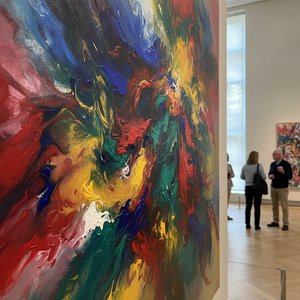
Explore the profound emotional depth of Lyrical Abstraction. Discover how masters like Raymond Parker used color and form to bridge Impressionism and Abstract Expressionism. Learn about this pivotal movement through our expert-led art history guide.

Explore the profound emotional depth of Color Field painting. Discover the history of mid-century abstraction, from Rothko to Newman, and learn how pure color transforms the viewer's experience through our expert art history guide.

Explore the profound history and emotional depth of Abstract Expressionism. From Jackson Pollock to Mark Rothko, master the nuances of the New York School through our expert art history guide. Discover museum-quality hand-painted reproductions for your collection.


Hold dig opdateret med de seneste kunstnyheder, eksklusive tilbud og indretningsideer.
Fortæl os om dit projekt, og vores kunsteksperter vil give dig 3 personlige kunstforslag.
Vi kuraterer 3 valgmuligheder kun til dig – Gratis!


 Se i fuld skala
 Del
Del Del
Del
 Detaljer

 Download
 Lignende værker
 Røntgenundersøgelse
 Diasshow
 Se mere







 Glasmulighed er kun tilgængelig i størrelser under 110 cm


