x


 Preview
 Druck bestellen Bild kaufen
 Versenden
 Details anzeigen
 Zu Favoriten hinzufügen
 Herunterladen
 Ähnliche Objekte
 Röntgenaufnahme
 Diashow anzeigen
 Öl auf LeinwandWandkunstFauvism
 1905
1905 82.0 x 101.0 cm
 Pushkin-Museum
Handgemaltes Ölgemälde auf Leinwand in Ihrer Wunschgröße und mit Rahmen, auf Bestellung von unseren Künstlern angefertigt.





























Wählen Sie aus unseren vordefinierten Größen, die den ursprünglichen Proportionen des Kunstwerks entsprechen.

Sie können Ihre eigenen Maße eingeben, um einen bestimmten Rahmen oder Platz auszufüllen. Wenn die gewählte Größe nicht den Proportionen des Originalbildes entspricht, werden wir das Kunstwerk entweder beschneiden oder das Gemälde durch zusätzliche, handgemalte Elemente erweitern. Ein digitales Mockup wird Ihnen zur Genehmigung zugesandt, bevor die Produktion beginnt.
Bitte beachten Sie, dass die Bildschirmvorschau nicht die tatsächliche Beschneidung oder Erweiterung widerspiegelt. Nur das Mockup zeigt die endgültige Komposition exakt an.
Obwohl Sondermaße verfügbar sind, empfehlen wir, eine Größe aus der vordefinierten Liste zu wählen, um die ursprünglichen Proportionen beizubehalten.
Weltweiter Versand () in nur 3 bis 4 Wochen statt der üblichen 5 Wochen. (25 Juli). Keine Kompromisse bei der Qualität.


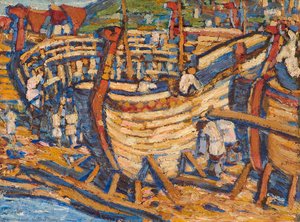
Drying the Sails
Größe der Reproduktion
André Derain’s “Drying the Sails,” painted in 1905, isn't merely a depiction of a harbor scene; it’s an explosion of color and emotion—a quintessential embodiment of the Fauvist movement. Born from a confluence of artistic influences and a desire to break free from traditional representation, this painting captures a fleeting moment on the French coast, imbued with a raw energy that continues to resonate with viewers today. Derain, alongside Henri Matisse, spearheaded this revolutionary approach to art, prioritizing the subjective experience of color and light over strict adherence to realism. The work’s genesis lies in the summer of 1905, spent in Collioure, a vibrant port town on the Mediterranean coast – a location that profoundly shaped Derain's artistic vision.
The painting itself presents a bustling waterfront scene dominated by a collection of sailboats. These vessels aren’t rendered with meticulous detail; instead, they are simplified forms, their edges blurred and dissolving into washes of intense blues, greens, yellows, and reds. The sky is a swirling vortex of color, mirroring the energy of the water below. The figures present – fishermen, sailors, and onlookers – are equally abstracted, contributing to the overall sense of movement and dynamism. It’s important to note that Derain deliberately avoided precise observation, opting instead to translate his *feeling* of the scene onto the canvas.
To truly appreciate “Drying the Sails,” it's crucial to understand the context of Fauvism. Emerging at the turn of the 20th century, this movement rejected the muted tones and academic conventions of the past. Artists like Derain, Matisse, and Maurice de Vlaminck embraced bold, non-naturalistic colors – often using them purely for their expressive qualities. They believed that color could evoke emotions and sensations independently of its representation. This radical departure from tradition was initially met with criticism, earning the Fauves (meaning “wild beasts”) their provocative nickname. Derain’s use of vibrant hues in "Drying the Sails" is a prime example of this approach – colors are applied with abandon, creating a dazzling and almost hallucinatory effect.
Technically, Derain employed loose, expressive brushstrokes—a hallmark of Fauvist painting. The paint is applied thickly, often directly from the tube, resulting in a textured surface that adds to the sense of movement and immediacy. He utilized a technique known as “divisionism,” breaking down colors into smaller dots or patches, allowing the viewer’s eye to blend them together optically. This method further intensified the vibrancy of the palette and created an almost shimmering quality within the painting.
Beyond its technical innovations, “Drying the Sails” is rich in symbolic meaning. The act of drying sails represents a transition – from movement to stillness, from activity to rest. It’s a moment of pause amidst the bustle of harbor life, inviting contemplation. The intense colors can be interpreted as representing the energy and vitality of nature, while the simplified forms suggest a focus on essential shapes and rhythms. The painting isn't simply about depicting a scene; it’s about conveying an *experience* – a feeling of warmth, light, and perhaps even a hint of melancholy.
The painting’s emotional impact is undeniable. It evokes a sense of joy and exuberance, yet also hints at the transient nature of beauty and the inevitability of change. “Drying the Sails” remains a powerful testament to Derain's artistic vision and his pivotal role in shaping the course of modern art. Its legacy continues to inspire artists today, demonstrating the transformative power of color and emotion.


1880 - 1954 , Frankreich
Entdecken Sie die 10 Meisterwerke des Fauvismus! Von Matisse bis Derain – erleben Sie die Revolution der Farben und Emotionen in der modernen Kunst. Hochwertige Reproduktionen & Inspiration für Ihr Zuhause auf

Entdecken Sie die 25 Meisterwerke von Claude Monet! Tauchen Sie ein in die Welt des Impressionismus, erleben Sie Seerosen, Sonnenaufgänge & Kathedralen. Hochwertige Reproduktionen für Ihr Zuhause – exklusiv auf Most-Famous-Paintings.com.
Entdecken Sie die 10 berühmtesten Gemälde, dominiert von grauen Tönen! Von Monet bis Hopper – erfahren Sie die Geschichten hinter den Meisterwerken und lassen Sie sich für Ihre Wohnideen inspirieren. Hochwertige Reproduktionen auf

Entdecken Sie die 10 Meisterwerke des Fauvismus! Von Matisse bis Derain – erleben Sie die Revolution der Farbe und Emotion. Hochwertige Kunstdrucke & Reproduktionen auf Most-Famous-Paintings.com. Jetzt Kunst für Ihr Zuhause finden!

Entdecken Sie die revolutionäre Kunst des Fauvismus und das Wirken von André Derain! Erfahren Sie mehr über Farbgebung, Einflüsse & das Erbe dieser bedeutenden Bewegung. Expertenwissen auf Most-Famous-Paintings.


Bleiben Sie über die neuesten Kunstnachrichten, exklusive Angebote und Dekorationsideen auf dem Laufenden.
Erzählen Sie uns von Ihrem Projekt und unsere Kunstexperten erstellen für Sie 3 personalisierte Kunstvorschläge.
Wir kuratieren 3 Optionen exklusiv für Sie – kostenlos!


 Teilen

 Weiterlesen







 Die Glasoption ist nur in Größen unter 110 cm verfügbar.