x


 Preview
 Gemälde kaufen Bild kaufen
 Versenden
 Details anzeigen
 Zu Favoriten hinzufügen
 Herunterladen
 Ähnliche Objekte
 Röntgenaufnahme
 Diashow anzeigen
Giclée- oder Leinwanddruck in Museumsqualität mit schneller Produktion und flexiblen Veredelungsoptionen.
Wählen Sie aus unseren vordefinierten Größen, die den ursprünglichen Proportionen des Kunstwerks entsprechen.

Sie können Ihre eigenen Maße eingeben, um ein bestimmtes Format oder einen speziellen Platz einzupassen. Wenn das von Ihnen gewählte Format nicht den Proportionen des Originalbildes entspricht, werden wir das Kunstwerk entweder beschneiden oder das Bild mit einem gespiegelten oder einfarbigen Rand erweitern. Ein digitaler Entwurf wird Ihnen zur Genehmigung zugesandt, bevor die Produktion beginnt.
Bitte beachten Sie, dass die Vorschau auf dem Bildschirm nicht den tatsächlichen Zuschnitt oder die Erweiterung widerspiegelt. Nur der Entwurf zeigt die endgültige Komposition präzise an.
Obwohl Sondermaße verfügbar sind, empfehlen wir die Auswahl eines Maßes aus der vordefinierten Liste, um die ursprünglichen Proportionen zu bewahren.
Weltweiter Versand () innerhalb von 2 Wochen statt der üblichen 4/5 Wochen. (25 Juli)


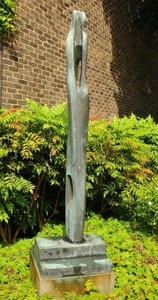
Single Form (Chûn Quoit)
Größe der Reproduktion
Barbara Hepworth’s “Single Form (Chûn Quoit)” is not merely a sculpture; it's an invitation into a dialogue with the ancient, a resonant echo of prehistoric ritual and the enduring power of form. Created in 1961, this arresting piece—a study in dark stone, meticulously carved and subtly textured—captures Hepworth’s signature style: a masterful blend of abstraction and deeply rooted connection to the natural world. The work immediately commands attention with its verticality, a stark yet graceful presence that speaks of both strength and vulnerability. It's a form that seems simultaneously grounded in the earth and reaching for something beyond – a visual embodiment of contemplation.
The sculpture’s genesis lies within the evocative landscape of Cornwall, specifically referencing the “quoit” chamber tombs found on the Penwith peninsula. These Neolithic structures, characterized by their distinctive circular openings, served as sacred spaces, imbued with layers of ritual and belief. Hepworth deliberately chose to evoke this ancient geometry, translating its essence into a contemporary form. The rough-hewn surface of the stone, achieved through careful carving and polishing, suggests the raw materiality of the original tombs while simultaneously hinting at the artist’s deliberate shaping – a delicate balance between preservation and reimagining.
Hepworth's choice of material—a dark, possibly bronze or similar stone—is crucial to the sculpture’s impact. The deep hue absorbs light, creating an immediate sense of weight and solidity. Yet, it is not a monolithic mass; subtle variations in texture – areas of roughness juxtaposed with polished surfaces – invite close inspection. This tactile quality encourages viewers to engage physically with the work, sensing its form through touch as much as sight.
The technique employed is one of painstaking refinement. Hepworth’s process involved a deliberate layering and shaping of the stone, guided by an intuitive understanding of its inherent qualities. The circular opening, piercing the upper portion of the sculpture, isn't simply a decorative element; it acts as a focal point, drawing the eye inward and suggesting a portal to another realm. The subtle gradations in tone, achieved through careful polishing and carving, create a sense of depth and volume, transforming what could have been a flat plane into a dynamic three-dimensional form.
“Single Form (Chûn Quoit)” transcends its purely formal qualities to evoke profound symbolism. The reference to the Neolithic quoit tombs speaks to humanity’s enduring fascination with death, ritual, and the mysteries of the past. The sculpture can be interpreted as a meditation on time, memory, and the cyclical nature of existence – a reminder that we are all connected to those who came before us.
Furthermore, the work possesses an undeniable emotional resonance. Its austere beauty and contemplative form invite viewers to slow down, to breathe deeply, and to engage in a quiet dialogue with their own inner selves. The sculpture’s simplicity is deceptive; it holds within it a vastness of meaning, prompting reflection on themes of spirituality, mortality, and the enduring power of human creativity.
Barbara Hepworth was a pivotal figure in 20th-century art, pioneering new approaches to sculpture that moved beyond traditional representational forms. “Single Form (Chûn Quoit)” stands as a testament to her innovative spirit and her profound connection to the natural world. Her work continues to inspire artists and collectors alike, offering a timeless exploration of form, space, and the human condition. Reproductions of this iconic piece provide a remarkable opportunity to bring Hepworth’s vision into any setting, adding a touch of contemplative elegance and historical significance.

Hepworths künstlerische Entwicklung war von verschiedenen Einflüssen geprägt. Ihre frühen Werke zeigten noch vereinfachte, naturalistische Formen, doch sie konzentrierte sich zunehmend auf formale Aspekte. Die Begegnung mit Künstlern wie Brancusi und Arp in Paris trug maßgeblich zu ihrer Hinwendung zur Abstraktion bei. Sie experimentierte mit Collage, Fotogrammen und Drucken und entwickelte eine einzigartige Sensibilität für ihre Materialien. Ihre Arbeit wurde von der direkten Bearbeitung des Materials geprägt, wobei sie oft Fäden, Drähte und farbiges Pigment in ihre Skulpturen integrierte.

1903 - 1975 , Vereinigtes Königreich

Entdecken Sie die 10 legendärsten Bronzestatuen der Kunstgeschichte! Von Rodin bis Michelangelo – erfahren Sie die Geschichten hinter ikonischen Skulpturen und finden Sie hochwertige Reproduktionen für Ihr Zuhause. Jetzt bei Most-Famous-Paintings entdecken!

Explore the rich history & enduring appeal of bronze sculpture with expert insights for collectors at Most-Famous-Paintings. Learn about casting techniques, iconic artists, collecting tips & contemporary interpretations.

Entdecken Sie die 10 legendärsten Bronze Skulpturen der Kunstgeschichte! Von Michelangelo bis Rodin – erfahren Sie die Geschichten hinter den Meisterwerken und lassen Sie sich von Wanddeko-Ideen inspirieren. Hochwertige Kunstdrucke auf Most-Famous-Paintings.com.

Explore the rich history & enduring appeal of bronze sculpture with expert insights for collectors at Most-Famous-Paintings. Learn about casting techniques, iconic artists, and collecting tips to build a discerning art collection.

Explore the rich history & enduring appeal of bronze sculpture with expert insights for collectors at Most-Famous-Paintings. Learn about casting techniques, iconic artists, and collecting tips.


Bleiben Sie über die neuesten Kunstnachrichten, exklusive Angebote und Dekorationsideen auf dem Laufenden.
Erzählen Sie uns von Ihrem Projekt und unsere Kunstexperten erstellen für Sie 3 personalisierte Kunstvorschläge.
Wir kuratieren 3 Optionen exklusiv für Sie – kostenlos!


 Teilen


 Weiterlesen




































 Die Glasoption ist nur in Größen unter 110 cm verfügbar.